

Integration des Krankenhausverwaltungssystems Powerpoint-Präsentationsfolien





Try Before you Buy Download Free Sample Product
 Impress Your
Audience
 100%
Editable
 Save Hours
of Time


Das Krankenhausverwaltungssystem ist ein Computersystem, das die effiziente Verwaltung von Gesundheitsinformationen und die Arbeitserfüllung des Gesundheitspersonals unterstützt. Sehen Sie sich unsere effizient gestaltete Vorlage für ein integratives Krankenhausmanagementsystem an, die die aktuellen Herausforderungen für die Verwaltung im Gesundheitswesen abdeckt und die steigenden Kosten des Unternehmens aufzeigt. Es umfasst auch die vom Unternehmen benötigten Komponenten im Krankenhausverwaltungssystem, wie Patientenverwaltung, Buchhaltung, Berichterstellung, Bestandsverwaltung usw. Darüber hinaus erfasst diese Präsentation Gesundheitsverwaltungstypen, Benutzer und Patienteninformationssysteme. Außerdem zeigen die Folien einen Prozessablauf für das Patientenabrechnungsmanagement, Statistiken zur Medikamenteneinhaltung und eine Zusammenfassung der Krankenhausentlassung. Darüber hinaus stellt diese Präsentation die Strategien dar, die den klinischen Arbeitsablauf zur Optimierung der Ressourcen, den Prozessablauf zur Verbesserung der Qualität der Gesundheitsversorgung usw. umfassen. Sie zeigt auch Folien zur Optimierung der Krankenhausverwaltungsfunktionen wie Medikamentenbestellung und Lieferschein, Zahlungseinzugsbericht und Rechnungsverfolgung. Außerdem zeigt es die Kosten im Zusammenhang mit der Implementierung von HMS, die Auswirkungen des Krankenhausmanagementsystems auf die Betriebskosten und Metriken zur Messung der Auswirkungen usw. Schließlich enthält es Dashboards zur Messung der Betriebsleistung und Metriken im Zusammenhang mit Entlassungen, Aufnahmen usw. Holen Sie sich jetzt zugreifen.
People who downloaded this PowerPoint presentation also viewed the following :
Inhalt dieser Powerpoint-Präsentation
Folie 1 : Diese Folie stellt die Integration von Krankenhausverwaltungssystemen vor. Geben Sie Ihren Firmennamen an und beginnen Sie.
Folie 2 : Diese Folie gibt die Agenda der Präsentation an.
Folie 3 : Diese Folie zeigt das Inhaltsverzeichnis für die Präsentation.
Folie 4 : Diese Folie zeigt Titel für Themen, die als nächstes in der Vorlage behandelt werden sollen.
Folie 5 : Diese Folie zeigt die Herausforderungen, denen sich Administratoren im Gesundheitswesen gegenübersehen.
Folie 6 : Diese Folie zeigt die steigenden Kosten von Gesundheitsunternehmen aufgrund fehlender optimaler Ressourcennutzung.
Folie 7 : Diese Folie zeigt den Vergleich von Krankenhauskennzahlen mit Wettbewerbern wie durchschnittliche Verweildauer der Patienten, Zeit bis zum Dienst usw.
Folie 8 : Diese Folie zeigt Titel für Themen, die als nächstes in der Vorlage behandelt werden sollen.
Folie 9 : Diese Folie veranschaulicht die Notwendigkeit eines Krankenhausmanagementsystems wie Kosteneffizienz, Fehlerreduzierung usw.
Folie 10 : Diese Folie zeigt vom Unternehmen benötigte Krankenhausverwaltungskomponenten.
Folie 11 : Diese Folie zeigt mehrere Vorteile des Krankenhausmanagementsystems.
Folie 12 : Diese Folie zeigt Titel für Themen, die als nächstes in der Vorlage behandelt werden sollen.
Folie 13 : Diese Folie stellt Arten von Krankenhausmanagementsystem-Software dar.
Folie 14 : Diese Folie konzentriert sich auf die Kategorisierung der Zielgruppe von Krankenhausmanagementsystemen.
Folie 15 : Diese Folie zeigt das Patienteninformationssystem für das Gesundheitsmanagement.
Folie 16 : Diese Folie zeigt Titel für Themen, die als nächstes in der Vorlage behandelt werden sollen.
Folie 17 : Diese Folie zeigt die Auswahl geeigneter Software zur Terminplanung für Patienten.
Folie 18 : Diese Folie zeigt den Prozessablauf für die Patientenabrechnungsverwaltung, die Patientendemografien, Versicherungsdetails usw. umfasst.
Folie 19 : Diese Folie stellt Statistiken dar, die sich auf die Bedeutung der Einhaltung von Medikamenten beziehen.
Folie 20 : Diese Folie zeigt eine Krankenhausentlassungszusammenfassung des Patienten, die den Patientennamen, die Krankenaktennummer usw. enthält.
Folie 21 : Diese Folie zeigt die Struktur des Apothekenmanagementsystems, das Verkaufsmanagement, Kundendienstmanagement usw. umfasst.
Folie 22 : Diese Folie zeigt die Bedeutung des klinischen Laborautomatisierungssystems.
Folie 23 : Diese Folie zeigt Titel für Themen, die als nächstes in der Vorlage behandelt werden sollen.
Folie 24 : Diese Folie zeigt den klinischen Arbeitsablauf zur Optimierung der Ressourcen, einschließlich Patientenregistrierung, Versicherungsplan, Arztbesuch usw.
Folie 25 : Diese Folie repräsentiert die Prozessabbildung zur Verbesserung der implementierten Maßnahmen.
Folie 26 : Diese Folie zeigt den Prozessablauf zur Verbesserung der Qualität im Gesundheitswesen.
Folie 27 : Diese Folie zeigt Titel für Themen, die als nächstes in der Vorlage behandelt werden sollen.
Folie 28 : Diese Folie konzentriert sich auf das Arzneimittelbestellungs- und Lieferformular, das die Gesundheitsstruktur, den Leiter der Struktur, die Unterschrift usw. umfasst.
Folie 29 : Diese Folie zeigt den Zahlungseinzugsbericht von medizinischen Patienten.
Folie 30 : Diese Folie zeigt, wie man Rechnungen und Zahlungen im Auge behält.
Folie 31 : Diese Folie repräsentiert die vergleichende Analyse von Software für elektronische Patientenakten.
Folie 32 : Diese Folie zeigt verschiedene Lösungen zur Steigerung der Patientenzufriedenheit.
Folie 33 : Diese Folie zeigt Titel für Themen, die als nächstes in der Vorlage behandelt werden sollen.
Folie 34 : Diese Folie präsentiert das Risikomanagement-Framework des Krankenhausmanagementsystems.
Folie 35 : Diese Folie zeigt Titel für Themen, die als nächstes in der Vorlage behandelt werden sollen.
Folie 36 : Diese Folie zeigt die Kosten für die Verbesserung des Krankenhausmanagementsystems.
Folie 37 : Diese Folie zeigt Titel für Themen, die als nächstes in der Vorlage behandelt werden sollen.
Folie 38 : Diese Folie stellt die positiven Auswirkungen auf die Krankenhausbetriebskosten dar.
Folie 39 : Diese Folie zeigt Metriken zur Messung der Auswirkungen der Verbesserung des Krankenhausmanagementsystems.
Folie 40 : Diese Folie zeigt Titel für Themen, die als nächstes in der Vorlage behandelt werden sollen.
Folie 41 : Diese Folie zeigt das Krankenhausleistungs-Dashboard zur Verbesserung des Betriebs.
Folie 42 : Diese Folie zeigt das Dashboard zum Verwalten von Patientenkapazität und Betten.
Folie 43 : Diese Folie zeigt Symbole für die Integration von Krankenhausverwaltungssystemen.
Folie 44 : Diese Folie trägt den Titel „Zusätzliche Folien“, um voranzukommen.
Folie 45 : Diese Folie zeigt ein Sequenzdiagramm des Krankenhausmanagementsystems.
Folie 46 : Diese Folie präsentiert die Schlüsselkomponenten der Entlassungszusammenfassung aus dem Krankenhaus.
Folie 47 : Dies ist unsere Zielfolie. Geben Sie hier Ihre Ziele an.
Folie 48 : Dies ist eine Folie zur Ideengenerierung, um eine neue Idee darzulegen oder Informationen, Spezifikationen usw. hervorzuheben.
Folie 49 : Diese Folie präsentiert die Roadmap mit zusätzlichen Textfeldern.
Folie 50 : Diese Folie zeigt eine Lupe, um Informationen, Spezifikationen usw. hervorzuheben.
Folie 51 : Diese Folie zeigt Haftnotizen. Posten Sie hier Ihre wichtigen Notizen.
Folie 52 : Dies ist eine Timeline-Folie. Zeigen Sie hier Daten zu Zeitintervallen an.
Folie 53 : Dies ist eine Dankeschön-Folie mit Adresse, Kontaktnummern und E-Mail-Adresse.
Integration von Krankenhausmanagementsystem Powerpoint-Präsentationsfolien mit allen 58 Folien:
Verwenden Sie unsere Powerpoint-Präsentationsfolien zur Integration des Krankenhausmanagementsystems, um effektiv dabei zu helfen, wertvolle Zeit zu sparen. Sie sind gebrauchsfertig und passen in jede Präsentationsstruktur.
-

Integrating Hospital Management System
-
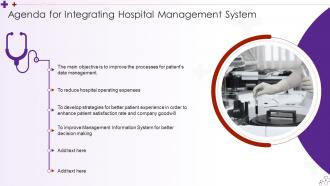
Agenda for Integrating Hospital Management System
-
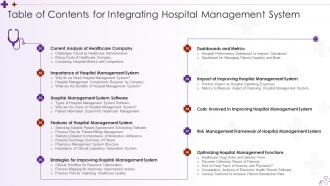
Table of Contents for Integrating Hospital Management System
-
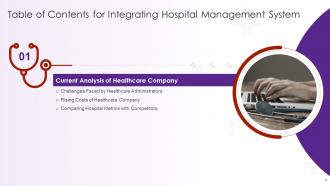
Table of Contents for Integrating Hospital Management System
-

Challenges Faced by Healthcare Administrators
-

Rising Costs of Healthcare Company
-

Comparing Hospital Metrics with Competitors
-
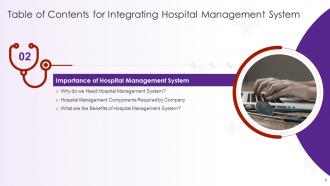
Table of Contents for Integrating Hospital Management System
-

Why do we Need Hospital Management System
-

Hospital Management Components Required by Company
-

What are the Benefits of Hospital Management System
-

Table of Contents for Integrating Hospital Management System
-

Types of Hospital Management System Software
-

Who are the Users of Hospital Management System
-

Patient Information System for Healthcare Management
-

Table of Contents for Integrating Hospital Management System
-

Selecting Suitable Patient Appointment Scheduling Software
-

Process Flow for Patient Billing Management
-

Statistics Related to Importance of Medication Adherence
-

Hospital Discharge Summary of Patient
-

Pharmacy Management System Structure
-

Importance of Clinical Laboratory Automation System
-

Table of Contents for Integrating Hospital Management System
-

Clinical Workflow for Resource Optimization
-

Process Mapping for Improving Implemented Actions
-

Process Flow for Improving Healthcare Quality
-

Table of Contents for Integrating Hospital Management System
-

Healthcare Drug Order and Delivery Form
-

Payment Collection Report of Patients
-

How to Keep Track of Invoices and Payments
-

Comparative Analysis of Electronic Health Record Software
-

Various Solutions to Increase Patient Satisfaction Rate
-

Table of Contents for Integrating Hospital Management System
-

Risk Management Framework of Hospital Management System
-

Costs Involved in Improving Hospital Management System
-

Costs Involved in Improving Hospital Management System
-

Table of Contents for Integrating Hospital Management System
-

Positive Impact on Hospital Operating Expenses
-

Metrics to Measure Impact of Improving Hospital Management System
-

Table of Contents for Integrating Hospital Management System
-

Hospital Performance Dashboard to Improve Operations
-

Dashboard for Managing Patient Capacity and Beds
-

Icons Slide for Integrating Hospital Management System
-

Additional Slides
-

Sequential diagram of Hospital Management System
-

Key Components of Hospital Discharge Summary
-

Our Target
-

Idea Generation
-

Roadmap
-

Magnifying Glass
-

Post it Notes
-

Timeline
-

Thank You
-

-

-

-

-

FAQs for Integrating Hospital Management System
So you'll definitely need the basics covered - patient registration, scheduling, EHRs, billing/insurance stuff. Inventory and staff scheduling too. Don't forget pharmacy management and lab integration. The reporting dashboards are actually crucial, trust me on that one. You'll be living in those reports way more than you think. Bed management and discharge summaries are must-haves, plus role-based access so nurses can't mess with admin stuff (learned that the hard way). Here's the thing though - find something where all the modules actually talk to each other instead of feeling like random software duct-taped together. Demo at least 2-3 options with your real workflows before pulling the trigger.
Dude, HMS basically automates all your scheduling headaches and tracks patient flow automatically. Wait times drop big time because it optimizes everything and pings staff when patients are ready. No more hunting for paper charts - doctors just pull up records instantly. Your patients get faster check-ins and way better coordination between departments. Everyone's working with the same current info, so treatment gets more accurate too. Honestly, the scheduling module alone will blow your mind. Start there first and you'll see results immediately. Trust me on this one.
Honestly, data security should be your top priority with any HMS. Patient records, medical histories, financial stuff - it's all super sensitive and heavily regulated under HIPAA. One breach and you're screwed with massive fines, lawsuits, and patients will never trust you again. Plus medical data getting compromised could literally put lives at risk. You'll need solid encryption and access controls built in from the start. Regular security audits too. Oh, and make sure whoever you pick for a vendor actually takes this seriously - don't just assume they do.
So basically it becomes this central spot where all your patient info lives - no more chasing people down hallways lol. You can shoot secure messages back and forth, share test results right away, and actually see what everyone's documented instead of digging through random paper charts. The alerts are pretty clutch too - they'll ping you when something critical changes or there's new orders. Honestly, just getting your team to actually use the messaging consistently will solve like 80% of the communication chaos. Way better than the whole phone tag nightmare. Everyone's literally looking at the same updated record instead of working off different versions.
So an HMS basically handles all that billing nightmare you're dealing with. It auto-generates invoices from treatments, tracks payments as they come in, and does electronic insurance claims - no more paper shuffling. The really nice part? It catches coding mistakes before you submit, so you don't get those stupid rejections later. Works with most major insurance networks too. I mean, honestly the time you'll save is crazy. Oh, and definitely map out how you're doing billing now first - makes it way easier to figure out where this thing fits in.
So HMS tracks everything automatically - stock levels, low supply alerts, the whole deal. It'll even create purchase orders for you which is honestly a game changer. You can see exactly what's being used where instead of doing that manual tracking nightmare we used to deal with. The cool part is it learns your usage patterns and figures out supplier performance, so you won't accidentally order way too much expensive stuff or run out of the basics. Just set your reorder points right and you're golden.
Honestly, patient data analytics is a game changer - it spots patterns you'd never see otherwise. Your hospital can predict when patient volumes will spike, schedule staff way better, and catch bottlenecks before everything goes to hell. The insights just sitting in your existing data are crazy good. High-risk patients get flagged to prevent readmissions, wait times drop through smarter resource allocation. Equipment failures? You'll know before they happen. My advice - pick one area first, maybe ED flow or bed management. Even basic analytics there will show immediate wins that'll get everyone on board for rolling it out everywhere else.
Look for an HMS that plugs right into your current telehealth setup - you don't want to be switching between five different systems during a virtual visit. The good ones will automatically sync with remote monitoring devices too, pulling in blood pressure readings and all that stuff from patients at home. Saves you from typing everything manually, which is honestly a godsend. You can still set alerts for weird readings and track patterns like normal. Oh, and definitely ask about their API situation before you sign anything - some systems are weirdly picky about what they'll connect to.
Oh man, data migration is going to be your worst nightmare - trust me on this one. Getting old systems to actually work with new HMS software? Total pain. Half your equipment probably runs on ancient protocols that hate modern platforms. Don't even get me started on staff pushback. Doctors can be surprisingly stubborn about tech changes! You'll deal with workflow chaos during the switch too, maybe some downtime. Your network might need beefing up for all that extra data flow. Pro tip: map everything out first. Figure out what integrations you absolutely need vs what's just fancy extras.
Honestly, HMS is a game-changer for compliance stuff. It tracks all that regulatory data automatically - CMS quality measures, Joint Commission requirements, state health dept reports. No more scrambling to pull info from like 5 different systems when audit time rolls around (which always seems to sneak up somehow). The system flags potential issues before they blow up and handles those monthly reports without your team having to stress about it. Documentation trails stay organized too. You'll definitely want to set up alerts for compliance deadlines though - trust me on that one.
Honestly, you'll want to prioritize user-friendly interfaces - trust me on this. Your staff will learn the system in days instead of weeks when everything's intuitive. I've watched people completely give up on clunky systems because they're just too frustrating to figure out. Clean layouts and logical workflows save you tons of training time. Plus your team won't panic when they're actually working with patients. Look for systems with clear visual cues during demos - that's usually a good sign the whole thing won't be a nightmare to navigate.
So you can basically check patient records, schedules, all that stuff right from your phone or tablet wherever you are. Really saves your butt when you're running between units or - ugh, sitting in traffic between sites. I'll pull up patient history right before walking into rooms now, or check lab results during rounds instead of scrambling to find an open computer. Honestly the best part? You don't have to make people wait when something urgent comes up. Can approve discharge orders on the spot while you're talking to other departments. Way better than the old "I'll get back to you when I'm at my desk" routine.
So there's tons you can do with HMS tech right now. AI analytics can predict patient flow and catch health risks early - super useful for staffing. IoT sensors track equipment and adjust room temps automatically. Then you've got patient monitoring systems, chatbots handling basic questions, machine learning helping with diagnoses... honestly it's getting pretty wild how much is possible. Oh and the ML stuff for treatment recommendations is actually getting really good. My advice? Figure out what's driving you crazy operationally first, then pick tech that'll fix those specific headaches. Don't just throw money at shiny new toys.
So basically you want automated surveys after visits, plus those little rating kiosks around the hospital - makes it super easy for people to complain (or praise, I guess). In-app ratings work great too. Get both the star ratings and actual written comments, then auto-send the bad stuff straight to department heads so they can fix things fast. Some places even do sentiment analysis which is honestly pretty neat. Track everything over time to spot patterns. The real trick though? Staff actually have to READ the feedback and do something about it, otherwise you're just collecting data for no reason.
So basically, HMS cuts costs by ditching all that paperwork - everything goes digital which is honestly a game changer. Your staff won't be drowning in admin work since scheduling and billing get automated. Doctors can see patient history instantly, so no more ordering the same test twice (happens more than you'd think). Real-time inventory tracking stops you from overstocking or running out of supplies. I'd start by figuring out which manual tasks are eating up most of your team's time. Those are where you'll see the biggest savings.
-
Loved the fact that SlideTeam provides clean, high-definition, and professional PowerPoint products.
-
Commendable slides with attractive designs. Extremely pleased with the fact that they are easy to modify. Great work!