


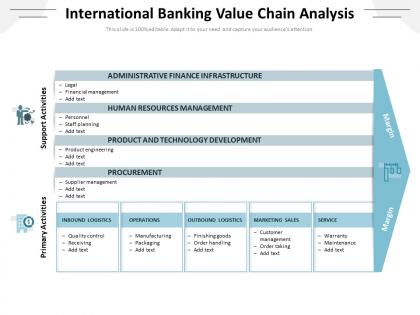
International banking value chain analysis




Try Before you Buy Download Free Sample Product
 Impress Your
 Audience
 100%
100% Editable
 Save Hours
 of Time


Our International Banking Value Chain Analysis have a familiar feel. Your audience wll be less chary of your views.
People who downloaded this PowerPoint presentation also viewed the following :
International banking value chain analysis with all 2 slides:
Create some chatter with our International Banking Value Chain Analysis. Your thoughts will spread by word of mouth.

FAQs for International banking
International banking regulations differ significantly from domestic frameworks through cross-border compliance requirements, multi-jurisdictional oversight, currency exchange controls, anti-money laundering protocols, and capital adequacy standards across different nations. These complex regulatory environments require banks to navigate varying legal systems, reporting structures, and risk management protocols, with many financial institutions finding that strategic regulatory expertise ultimately delivers competitive advantage and seamless global operations.
Currency risk significantly impacts international banking through potential losses from exchange rate fluctuations, reduced profit margins on cross-border transactions, and increased hedging costs. Banks mitigate these challenges using forward contracts, currency swaps, and diversified portfolios, while many financial institutions find that strategic risk management ultimately delivers competitive advantages and enhanced client confidence in volatile markets.
International banks facilitate global trade by providing trade financing, letters of credit, foreign exchange services, documentary collections, and supply chain financing solutions. Through these specialized services, banks enable exporters and importers to manage payment risks, currency fluctuations, and cross-border transactions seamlessly, with many manufacturers and retailers finding that international banking partnerships ultimately streamline their global operations while reducing financial uncertainties.
Emerging markets benefit from international banking services through enhanced access to capital, advanced financial technologies, and global trade financing solutions. These services enable local businesses to scale internationally, attract foreign investment, and modernize payment systems, while financial institutions gain competitive advantages through improved risk management and operational efficiency, ultimately accelerating economic development.
Latest fintech trends in international banking include blockchain for cross-border payments, AI-powered fraud detection, digital currencies, open banking APIs, and real-time settlement systems. These technologies streamline international transactions by reducing processing times, minimizing costs, and enhancing regulatory compliance, with many global banks finding that automated systems deliver faster customer services and significant competitive advantages in increasingly digital markets.
International banks manage AML compliance across jurisdictions through centralized compliance frameworks, automated transaction monitoring systems, standardized reporting protocols, and dedicated regional compliance teams. These institutions leverage advanced analytics and AI-driven detection tools to identify suspicious activities, while maintaining robust documentation processes and cross-border information sharing mechanisms, ultimately ensuring consistent regulatory adherence and minimizing operational risks.
Cross-border lending risks include credit risk from borrower defaults, foreign exchange volatility, political instability, regulatory compliance challenges, and economic fluctuations in different markets. These risks require sophisticated risk management frameworks, with many international banks implementing enhanced due diligence, currency hedging strategies, and diversified portfolio approaches to maintain profitability while minimizing exposure across global markets.
International banks assess foreign borrower creditworthiness through comprehensive financial analysis, credit bureau reports, collateral evaluation, country risk assessments, and local regulatory compliance checks. These institutions leverage advanced credit scoring models, cross-border financial data verification, and partnership with local banks, ultimately enabling faster loan approvals while minimizing default risks across diverse international markets.
Geopolitical events significantly reshape international banking strategies by forcing institutions to reassess risk exposure, diversify operational footprints, and strengthen compliance frameworks. These developments compel banks to enhance regional partnerships, accelerate digital transformation initiatives, and implement more sophisticated hedging mechanisms, ultimately enabling greater resilience and competitive positioning in an increasingly volatile global financial landscape.
International banks can leverage technology to improve customer experience through mobile banking platforms, AI-powered chatbots, real-time transaction processing, personalized financial recommendations, and seamless digital onboarding processes. These technologies streamline operations by reducing wait times, enhancing accessibility, and delivering 24/7 support, with many institutions finding that automated services and data analytics ultimately enable faster loan approvals and more tailored banking solutions.
International banking due diligence faces challenges including varying regulatory frameworks across jurisdictions, complex cross-border compliance requirements, currency fluctuation risks, differing accounting standards, and limited transparency in some markets. These complexities require banks to navigate multiple legal systems, enhanced monitoring protocols, and sophisticated risk assessment tools, with many financial institutions finding that strategic partnerships with local experts ultimately streamline compliance while ensuring regulatory adherence.
International banks address financial inclusion through mobile banking platforms, microfinance partnerships, agent banking networks, simplified account opening procedures, and digital payment solutions. These initiatives enable banks to reach underserved populations by reducing operational costs, eliminating geographical barriers, and offering tailored products, with many institutions finding that technology-driven approaches deliver sustainable growth while expanding access to essential financial services.
International payment systems enable cross-border transactions by providing standardized protocols, secure networks, and regulatory compliance frameworks that connect banks globally. These systems, including SWIFT, correspondent banking networks, and digital payment rails, streamline currency exchanges, reduce settlement times, and enhance transaction transparency, ultimately delivering faster international services and competitive advantages for financial institutions operating across multiple markets.
Economic sanctions significantly impact international banks by restricting cross-border transactions, limiting correspondent banking relationships, requiring enhanced compliance monitoring, and affecting credit facilities in sanctioned regions. These measures compel banks to invest heavily in sanctions screening technology, restructure global operations, and implement rigorous due diligence processes, ultimately reshaping international finance flows and increasing operational costs while ensuring regulatory compliance.
Blockchain technology enables secure, transparent cross-border transactions by eliminating intermediaries, reducing settlement times from days to minutes, and providing immutable transaction records. Through smart contracts and distributed ledgers, international banks can streamline compliance processes, minimize fraud risks, and deliver faster, cost-effective services, ultimately enhancing competitive advantage in global markets.
No Reviews