


Investment banking collection powerpoint presentation slides




Try Before you Buy Download Free Sample Product
 Impress Your
 Audience
 100%
100% Editable
 Save Hours
 of Time


Our Investment Banking Collection Powerpoint Presentation Slides are topically designed to provide an attractive backdrop to any subject. Use them to look like a presentation pro.
People who downloaded this PowerPoint presentation also viewed the following :
Content of this Powerpoint Presentation
Slide 1: This slide displays title i.e. 'Investment Banking Collection'.
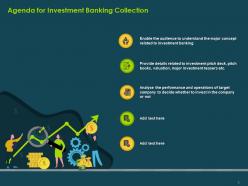
Slide 2: This slide presents agenda.
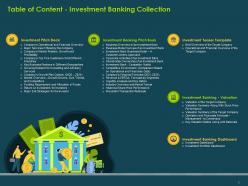
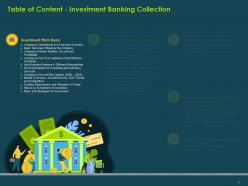
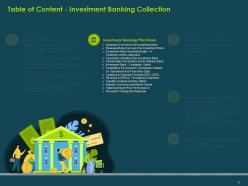
Slide 3: This slide exhibits table of contents.
Slide 4: This slide shows title for 'Finacial & company overview'.
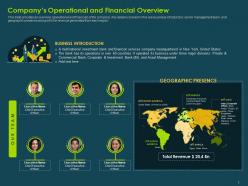
Slide 5: This slide provides an overview (operational and financial) of the company.
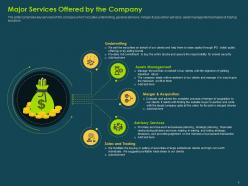
Slide 6: The slide comprises key services of the company.
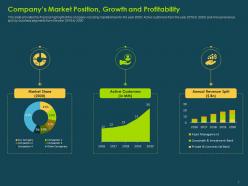
Slide 7: This slide provides the financial highlight of the company including market share for the year 2020.
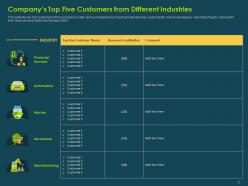
Slide 8: This slide the top five customers of the company.
Slide 9: The slide provides the name of key business partners of the company.
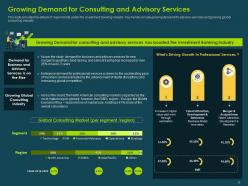
Slide 10: This slide provides the details of major trends under the investment banking industry.
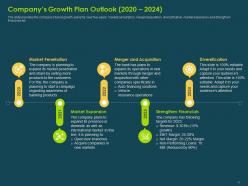
Slide 11: The slide provides the company’s future growth plans for next five years.
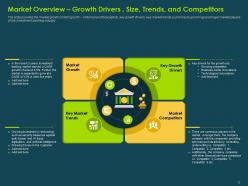
Slide 12: The slide provides the market growth CAGR growth – historical and forecasted, etc.
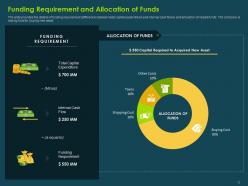
Slide 13: The slide provides the details of funding requirement.
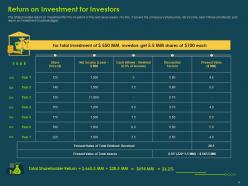
Slide 14: The slide provides return on investment for the investors in the next seven years.
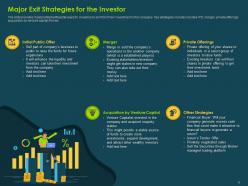
Slide 15: The slide provides most profitable/feasible ways for investors to exit from their investment in the company.
Slide 16: This slide shows title for 'Business overview of an investment bank'.
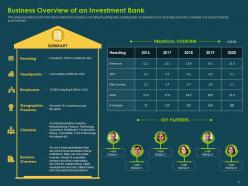
Slide 17: The slide provides a brief information about the company.
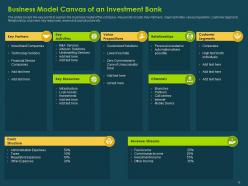
Slide 18: The slides covers the key points to explain the business model of the company.
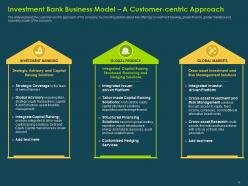
Slide 19: This slide explains the customer-centric approach of the company by providing details about key offerings.
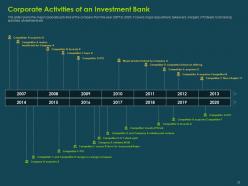
Slide 20: The slide covers the major corporate activities of the company from the year 2007 to 2020.
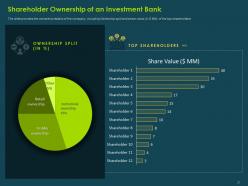
Slide 21: The slide provides the ownership details of the company, including Ownership split, etc.
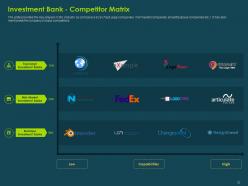
Slide 22: The slide provides the key players in the industry by company’s size.
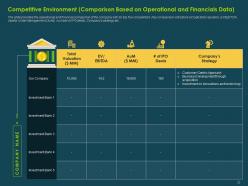
Slide 23: The slide provides the operational and financial comparison of the company with its top five competitors.
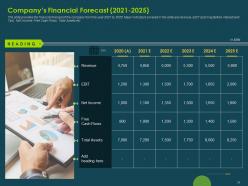
Slide 24: The slide provides the financial forecast of the company from the year 2021 to 2025.
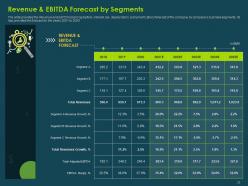
Slide 25: The slide provides the Revenue and EBITDA (Earning before, interest, tax, depreciation, and amortization) forecast of the company.
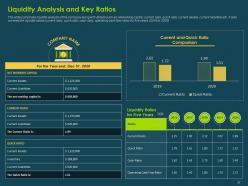
Slide 26: The slide comprises liquidity analysis of the company.
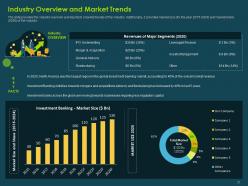
Slide 27: The slide provides the industry overview and key facts (market trends) of the industry.
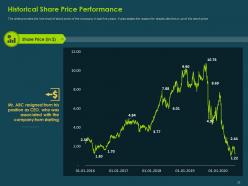
Slide 28: The slide provides the line chart of stock price of the company in last five years.
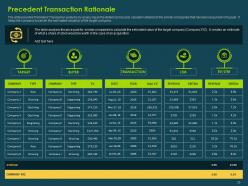
Slide 29: The slide provides Precedent Transaction analysis by analyzing all the details (price paid, valuation details) of the similar companies.
Slide 30: This slide depicts title for 'Overview of target company'.
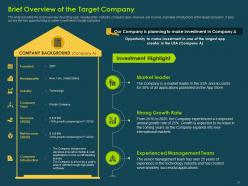
Slide 31: The slide provides the brief overview (founding year, headquarter, industry, company type, etc.
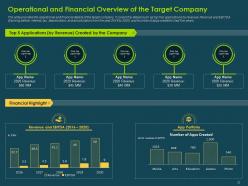
Slide 32: The slide provides the operational and financial details of the target company.
Slide 33: This slide highlights title for 'Investment banking valuation'.
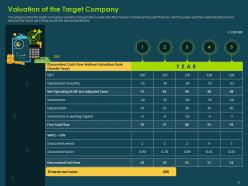
Slide 34: The slide provides the target company’s valuation through discounted cash flow method.
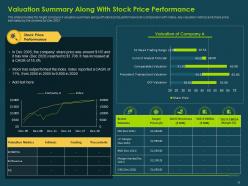
Slide 35: The slide provides the target company’s valuation summary.
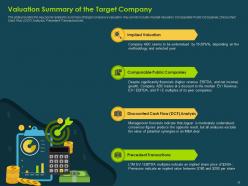
Slide 36: The slide provides the key points related to summary of target company’s valuation.
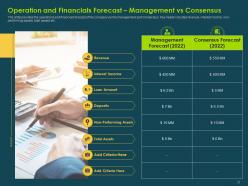
Slide 37: The slide provides the operations and financials forecast of the company by the management and Consensus.
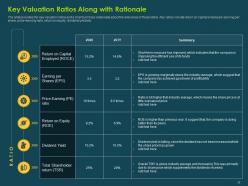
Slide 38: The slide provides the key valuation ratios and a brief summary (rationale) about the relevance of those ratios.
Slide 39: This slide displays title for 'Banking dashboard'.
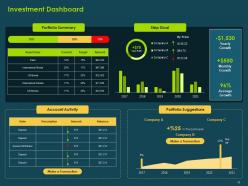
Slide 40: This slide presents 'Investment dashboard'.
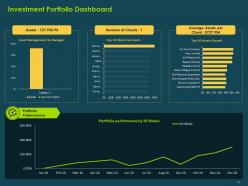
Slide 41: This slide exhibits 'Investment Portfolio Dashboard'.
Slide 42: This is the icons slide.
Slide 43: This slide presents title for additional slides.
Slide 44: This slide presents your company's vision, mission and goals.
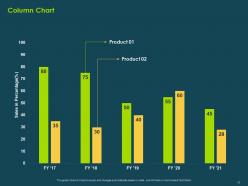
Slide 45: This slide exhibits yearly sales column charts for different products. The charts are linked to Excel.
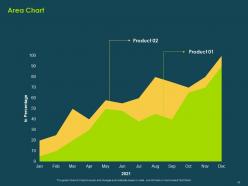
Slide 46: This slide displays monthly area charts for different products. The charts are linked to Excel.
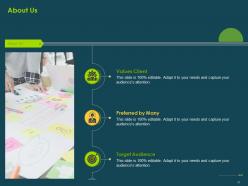
Slide 47: This slide shows about your company, target audience and its client's values.
Slide 48: This slide shows details of team members like name, designation, etc.
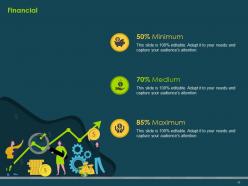
Slide 49: This slide showcases financials.
Slide 50: This slide displays Venn.
Slide 51: This slide displays puzzle.
Slide 52: This slide depicts posts for past experiences of clients.
Slide 53: This slide exhibits ideas generated.
Slide 54: This is thank you slide & contains contact details of company like office address, phone no., etc.
Investment banking collection powerpoint presentation slides with all 54 slides:
Use our Investment Banking Collection Powerpoint Presentation Slides to effectively help you save your valuable time. They are readymade to fit into any presentation structure.








FAQs for Investment banking collection
So investment banks are basically expensive matchmakers for companies that want to buy or sell each other. They'll help value the target company and handle all the messy negotiations between both sides. Honestly, the regulatory paperwork alone would be a total nightmare without them - I can't even imagine dealing with that stuff. Plus they've got connections to find buyers or sellers you'd never think of. My cousin works at one and says the fees are insane, but companies still pay because the deals are so complex. Just make sure you budget for their costs upfront if you're ever doing M&A.
So investment banks are basically your IPO guides - they've walked tons of companies through this process. They'll help price your shares, hunt down institutional investors, and deal with all that SEC paperwork (which is honestly a nightmare). Plus they underwrite the whole thing, so if investors bail, they're buying your shares themselves. That's pretty huge for risk management. The downside? Their fees are brutal - we're talking 3-7% of everything you raise. My buddy's startup paid like $2M just in bank fees. But honestly, most companies can't navigate an IPO without them.
So bulge brackets like Goldman and JPM are these huge global firms doing massive deals everywhere - billion-dollar M&A, giant IPOs, the works. Boutiques are way smaller and focus on specific industries or deal types. Here's the thing though - you'll probably get better mentoring at a boutique since there's way less red tape. You get thrown into real work faster. But bulge brackets pay more and give you broader exit ops down the road. My cousin went the boutique route and loved it, but depends what you want. Do you care more about specializing deep in something or getting that broad exposure first?
So basically investment banks buy securities from companies and then resell them to investors - they're taking on all that risk. First step is due diligence where you analyze financials, market conditions, pricing, all that fun stuff. Most deals involve multiple banks in a syndicate because nobody wants to shoulder everything alone (honestly makes sense). Lead underwriter handles pricing and does roadshows to pitch institutional investors. Here's the thing though - if you're working on one of these deals, start building those investor relationships super early. That's literally what determines if you can actually place the securities or not.
Dude, Excel and financial modeling are absolutely essential - you'll basically live in spreadsheets. Being able to present well matters too since you're always pitching clients. The 80-hour weeks are brutal though, so definitely work on your stamina now. Critical thinking and attention to detail are must-haves when deals are worth millions. PowerPoint becomes your second language pretty quickly. Oh, and you need thick skin because the pressure is intense and some clients can be... difficult. Honestly start practicing modeling ASAP - that's what'll set you apart early on.
Investment banks dig deep into financials - debt ratios, cash flow, all that stuff. They're basically financial detectives looking at management teams, market conditions, industry trends. Stress testing is huge too - they'll run scenarios to see how things might tank or soar. Credit ratings matter a ton, plus they compare you to competitors constantly. Here's the thing though - they care way more about predicting future problems than your current numbers. It's honestly pretty intense. If you're pitching them, figure out their due diligence checklist first. That'll save you headaches later.
Economic cycles pretty much control everything in investment banking. Good times = crazy M&A activity, IPOs everywhere, companies throwing money around. Then recession hits and deal flow just dies. Nobody's buying anything or going public when the market's a disaster (honestly, terrible timing). Advisory fees tank because fewer deals obviously means less cash coming in. But here's the thing - restructuring work actually gets busier during downturns, which is kinda ironic. Watch those economic indicators though, they'll give you a heads up for planning staffing and what your revenue's gonna look like.
Dude, the whole finance game has changed so much. AI can rip through due diligence docs in hours now - stuff that used to take us weeks. Markets are way more efficient thanks to algorithmic trading, plus we've got crazy good data analytics for reading clients and assessing risk. All that tedious compliance work? Mostly automated now, which honestly saves my sanity. Electronic platforms opened up market access to pretty much everyone too. I swear, if you don't keep up with the latest fintech tools, you'll be eating dust while everyone else moves ahead.
So basically regulatory changes mess with how investment banks run everything - capital requirements, trading limits, the whole deal. Banks gotta hold way more cash in reserves now. The Volcker Rule made them split up proprietary trading from client stuff too. Compliance teams are huge now, which is wild - we're talking hundreds of millions just to stay legal. Short sentences hit different sometimes. Revenue takes a hit since they can't do the risky trades that used to make bank. Honestly though, the banks that figure out how to pivot quick usually come out ahead of everyone else.
Honestly, IB ethics get messy fast. Conflicts of interest are huge - your firm might rep both sides of a deal, or they'll push stuff that makes them money over what's actually good for clients. Insider info is another landmine that catches people way more than you'd think. Plus there's crazy pressure to hit numbers, which can make you bend toward sketchy advice or deals that are too aggressive. I'd say just keep asking yourself if you're really looking out for your client. Sounds basic but it works.
So investment banks basically crush it with data analytics in three ways: risk assessment, market predictions, and understanding their clients better. They're crunching huge datasets to spot trading patterns and credit risks way before their competition catches on. Pretty smart if you ask me. All this number-crunching helps them figure out which deals are worth chasing, how to price stuff, and perfect timing for trades. Oh and if you want in on this world - SQL and Python are must-haves, plus you'll need solid financial modeling skills. That combo's like a golden ticket right now.
Dude, financial modeling is literally what you'll live and breathe in IB. DCF models, comps, merger models - you're building these constantly to value companies and structure deals. Your Excel game better be strong because that's your main tool for answering stuff like "should we buy this company?" or "what's it actually worth?" I swear, learn those shortcuts now or you'll hate yourself during those 3am model reviews. The crazy part is these spreadsheets drive million-dollar decisions. More accurate models = more confident clients. Pro tip: get comfortable with getting very comfortable in Excel.
So basically they assign relationship managers to handle specific big clients - pension funds, mutual funds, that whole crowd. These managers are constantly checking in about market stuff and new deals coming through. The trick is really getting what each client actually wants and their risk tolerance. Some are super conservative, others not so much. Then you can pitch them the right opportunities instead of wasting everyone's time. Honestly reminds me of managing any demanding client relationship. Oh and they track everything in their CRM systems so if someone's out sick, another person can jump in without looking clueless.
So investment banking is changing pretty fast right now. Digital stuff is everywhere - they're automating deal sourcing, client onboarding, all that. ESG and sustainable finance are massive money makers now. Banks are using AI for research and risk stuff, though some of it's still hit or miss honestly. Fintech companies are breathing down everyone's necks, especially with payments. Remote work changed how deals happen too (which I actually think is way better). My advice? Learn tech skills on top of your finance background. That's what everyone wants these days.
Dude, culture matters SO much in IB. Asia's all about relationships first - you're basically eating dinner with clients for months before touching any deal stuff. Europe's super formal and process-heavy, which honestly can be exhausting. Americans? They just want the numbers, but they're weirdly social too sometimes. Middle East gets tricky with family politics and religious stuff affecting deal structures. My advice? Do your homework on local etiquette before jumping into cross-border work. I learned that the hard way. Understanding how people make decisions in different cultures will literally save you from bombing meetings and help you close way more deals.
-
Much better than the original! Thanks for the quick turnaround.
-
The content is very helpful from business point of view.
-
Very unique, user-friendly presentation interface.
-
Thanks for all your great templates they have saved me lots of time and accelerate my presentations. Great product, keep them up!
-
Innovative and attractive designs.
-
Attractive design and informative presentation.
-
Good research work and creative work done on every template.