


Investment strategies for stock portfolio management powerpoint presentation slides




Try Before you Buy Download Free Sample Product
 Impress Your
 Audience
 100%
100% Editable
 Save Hours
 of Time


We have got the perfect investment strategies for stock portfolio management slide presentation to step up your next investment portfolio strategy PowerPoint presentation. The only thing that is left now is to quickly download our completely pre built financial portfolio management PPT presentation templates. Coming to its application, then you can use this PPT example to train investors about portfolio strategies for managing financial risks so as to reduce assets volatility. Furthermore, with support of this PowerPoint presentation slide deck you can share insights about the financial roadmap of your company to magnetize investors and partners. Besides this, our PPT model helps to cast spotlight on mix of various investments. Additionally, you can portray various other concepts like asset management, corporate governance, trading strategy, portfolio optimization etc. To make it more precise we have included exclusive presentation slides like risk tolerance analysis, risk reward matrix, target modeling, key driver analytics, investment approaches, security analysis and many more. With our readymade investment strategies and portfolio management PowerPoint show now you will not find it hard to get started. Simply click to quickly download. Refine your thoughts with our investment ppt slides. Narrow them down to the very best.
People who downloaded this PowerPoint presentation also viewed the following :
Content of this Powerpoint Presentation
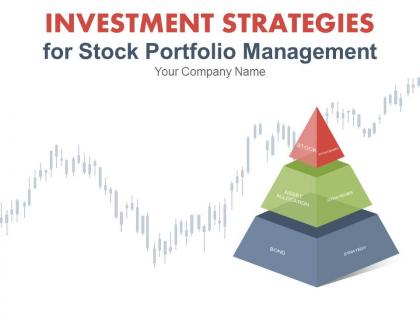
Slide 1: This slide introduces Investment Strategies for Stock Portfolio Management. State your company name and proceed.
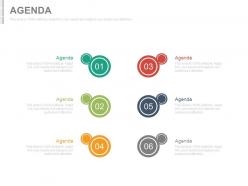
Slide 2: This slide presents Agenda. Add your comapany agenda and use it.
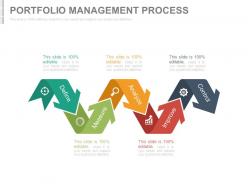
Slide 3: This slide shows Portfolio Management Process flow diagram with these five stages- Measure, Improve, Analyze, Define, Control.
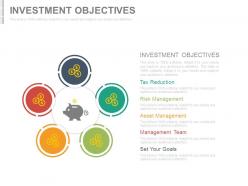
Slide 4: This slide shows Investment Objectives containing- Tax Reduction, Risk Management, Asset Management, Management Team, Set Your Goals.
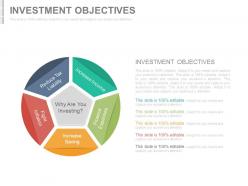
Slide 5: This slide also shows Investment Objectives such as- Increase Income, Finance Expenses, Increase Saving, Fight Inflation, Reduce Tax Liability.
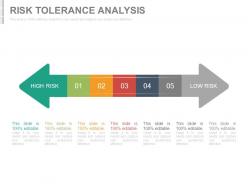
Slide 6: This slide presents Risk Tolerance Analysis with a scale showing- HIGH RISK, LOW RISK.
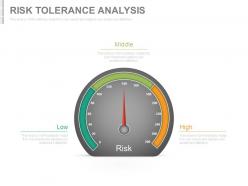
Slide 7: This slide also shows Risk Tolerance Analysis with metric imagery.
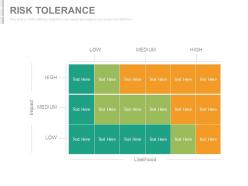
Slide 8: This slide presents Risk Tolerance in a matrix form ranging from High, Medium to Low.
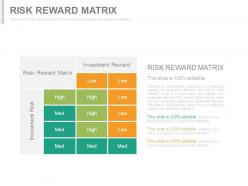
Slide 9: This is Risk Reward Matrix slide showing- Investment Reward, Investment Risk.
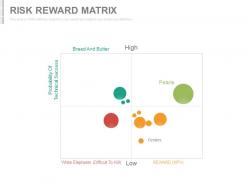
Slide 10: This slide also shows Risk Reward Matrix.
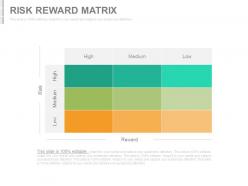
Slide 11: This is another slide showing Risk Reward Matrix presented with High, Medium and Low parameters.
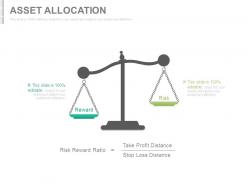
Slide 12: This slide showcases Asset Allocation . You can compare the reward and risk in it.
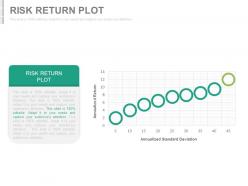
Slide 13: This slide presents Risk Return Plot showing- Annualized Return, Annualized Standard Deviation.
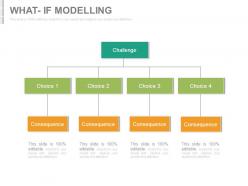
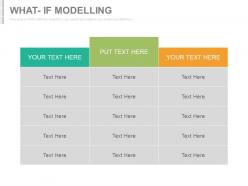
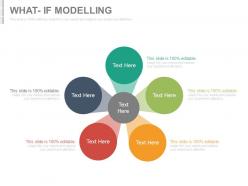
Slide 14: This slide presents What- If Modelling which further shows challenge, choice and consequences.
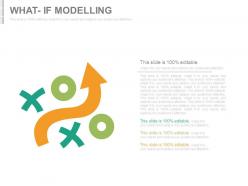
Slide 15: This slide also shows What- If Modelling.
Slide 16: This is another slide showing What- If Modelling.
Slide 17: This slide shows What-If Modelling in a circular diagram form.
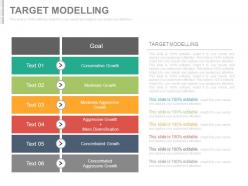
Slide 18: This slide presents target modelling with these six points- Conservative Growth, Moderate Growth, Moderate AggressiveGrowth, Aggressive Growth More Diversification, Concentrated Growth, Concentrated Aggressive Growth.
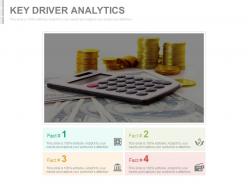
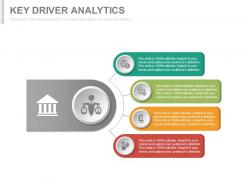
Slide 19: This slide presents Key Driver Analytics with four facts to state.
Slide 20: This slide also shows Key Driver Analytics. You can state them here in the given text boxes.
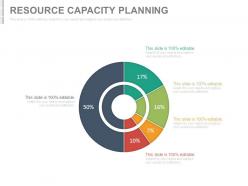
Slide 21: This slide showcases Resource Capacity Planning with a pie chart. We have added percentages for your reference which you can alter as per your own resource capacity planning.
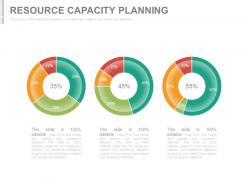
Slide 22: This slide also displays Resource Capacity Planning pie charts to add information.
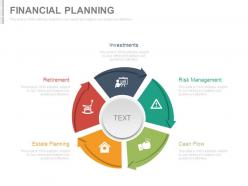
Slide 23: This slide shows Financial Planning with the following attributes- Estate Planning, Cash Flow, Retirement, Risk Management, Investments.
Slide 24: This slide presents Scheduling in a circular image form. Add your schedule here.
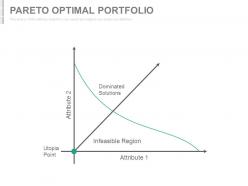
Slide 25: This slide presents Pareto Optimal Portfolio showing two attributes.
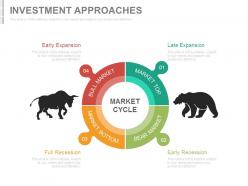
Slide 26: This slide shows Investment Approaches with respect to the Market Cycle.
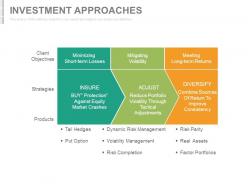
Slide 27: This slide also shows Investment Approaches.
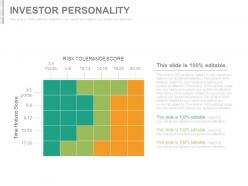
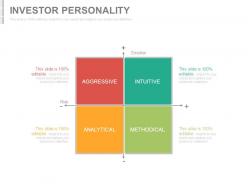
Slide 28: This slide presents Investor Personality in a matrix form showing risk tolorance score and time horizon score.
Slide 29: This slide also shows Investor Personality. We have provided four personality traits, which you can alter as per your business requirement.
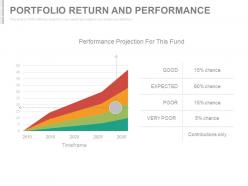
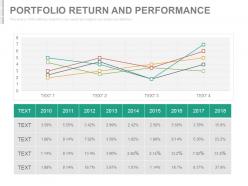
Slide 30: This slide shows Portfolio Return And Performance graph.
Slide 31: This slide also shows Portfolio Return And Performance. You can add the content in the table and edit the graph as per your requiement.
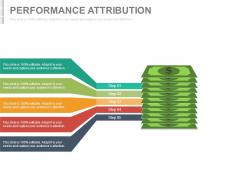
Slide 32: This slide shows Performance Attribution. We have added five text boxes for you to add relevant text.
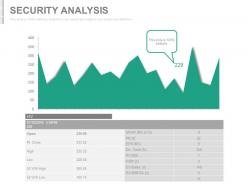
Slide 33: This slide shows Security Analysis with a graph along with a table. You can use as per your business needs.
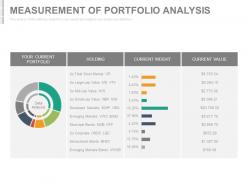
Slide 34: This slide showcases Measurement Of Portfolio Analysis. You can use this table to add your own content.
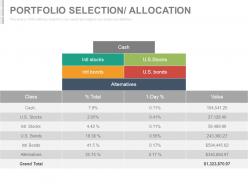
Slide 35: This slide presents PORTFOLIO SELECTION/ ALLOCATION. Add the cash, stock and bond details in it.
Slide 36: This slide also shows PORTFOLIO SELECTION/ ALLOCATION.
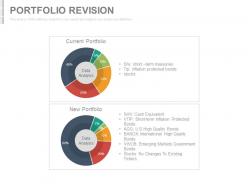
Slide 37: This is Portfolio Revision slide with two pie charts showing- Current Portfolio, New Portfolio.
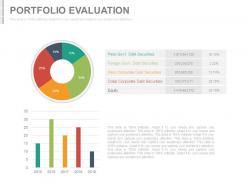
Slide 38: This slide presents Portfolio Evaluation in a bar graph and pie chart form.
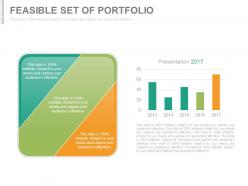
Slide 39: This slide shows the Feasible Set Of Portfolio.
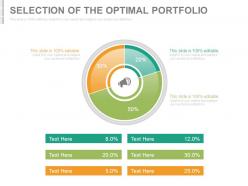
Slide 40: Thi slide shows Selection Of The Optimal Portfolio in which you can add your data.
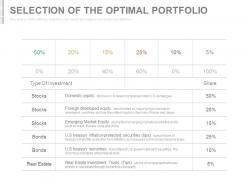
Slide 41: This is also Selection Of The Optimal Portfolio slide showing Type Of Investment and Share %.
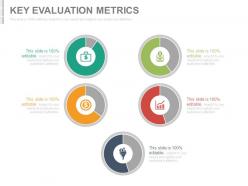
Slide 42: This slide showcases Key Evaluation Metrics with relevant icons.
Slide 43: This slide is titled Additional Slides to move forward. You can change the slide content as per need.
Slide 44: This is Our Mission slide. State your mission, vision and values here.
Slide 45: This is Our Team slide with image boxes to fill name, designation.
Slide 46: This is Our Goal slide. State goals etc. here.
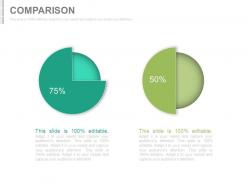
Slide 47: This is a Comparison slide to compare product/ enitities etc.
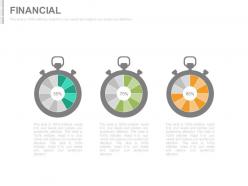
Slide 48: This is a Financial score slide. State financial aspects etc. here.
Slide 49: This is a Quotes slide. State business message, beliefs etc. here.
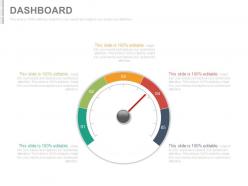
Slide 50: This is a Dashboard slide to show growth factors etc.
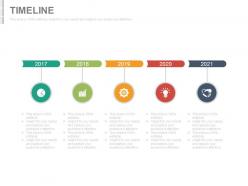
Slide 51: This is a Timeline slide to present important dates, journey, evolution, milestones etc.
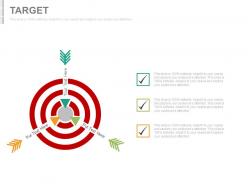
Slide 52: This is a Target image slide. State targets, etc. here.
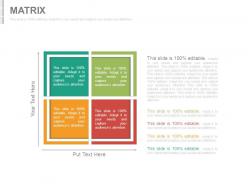
Slide 53: This is a Matrix slide to show information, specifications etc.
Slide 54: This is a Lego box image slide to show information, specifications etc.
Slide 55: This is Magnifier Glass image slide to show information, specifications etc.
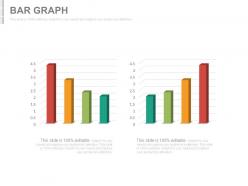
Slide 56: This is a Bar Graph slide to show product/ entity comparison, specifications etc.
Slide 57: This is a Thank You slide with Address# street number, city, state, Contact Numbers and Email Address.
Investment strategies for stock portfolio management powerpoint presentation slides with all 57 slides:
Handle ineffectual effort with our Investment Strategies For Stock Portfolio Management Complete Powerpoint Deck With Slides. Bring about changes that derive the desired impact.










FAQs for Investment strategies for stock portfolio management
So value investing is basically finding companies trading way below what they're actually worth - like spotting $20 bills on sale for $10. Look for businesses with strong cash flow and manageable debt that the market's temporarily ignoring. Buffett's whole thing, right? I'd focus on low P/E ratios and consistent earnings in companies you actually get. The tricky part is being patient enough to wait for everyone else to catch on. Honestly, screening for stocks below book value or with P/Es way under industry averages is a solid starting point.
Basically you're spreading risk around so one bad investment doesn't kill your whole portfolio. Like that old eggs in a basket thing - sounds cheesy but it works. Mix up stocks, bonds, different sectors, maybe some international stuff. Poor performance here gets offset by wins over there. Markets are crazy unpredictable, honestly drives me nuts sometimes, but diversification helps smooth out those roller coaster rides. Check if you're too loaded up in one stock or sector first. Then slowly rebalance to spread things around better.
Dude, think of economic indicators as your crystal ball for market moves. GDP growth, unemployment, inflation, consumer spending - these tell you where things are heading before stocks catch up. Honestly, I'm borderline obsessed with the monthly jobs report because it's so damn reliable. When the data looks good, I lean into growth stocks and cyclicals. Bad news? Time for bonds and utilities. Oh, and never make moves off just one indicator - you need the full picture. It's like trying to predict the weather from one cloud, you know?
First thing - grab their 10-K and last few quarterly reports. Yeah, they're boring as hell but that's where the real info is. Look at revenue growth over 5+ years, debt levels, cash flow. Their annual reports actually tell you tons about strategy if you read the management section (I always end up doing this at like midnight for some reason). See how they're handling competition and if they're investing in R&D. Are they adapting to changes or just coasting? Check if their competitive advantage is getting stronger or weaker. Way more useful than whatever marketing stuff they put out.
Honestly, passive is the way to go for most people. Index funds are dirt cheap - like 0.03-0.20% fees - and you literally just buy and forget. Active funds charge way more (1%+) and most managers can't even beat the market anyway, which is kinda embarrassing when you think about it. Sure, active investing gives you that chance to potentially outperform, and some funds do well in certain market conditions. But long-term? It's pretty rare. I'd start with broad market index funds and maybe dabble in active stuff later if you're into it.
So behavioral finance is basically about how our brains sabotage our money decisions. Like, you'll panic and sell everything when the market tanks, or hold onto garbage stocks because admitting you were wrong sucks. People also jump on trends way too late - classic FOMO stuff. The main culprits are overconfidence, hating losses more than loving gains, and just following what everyone else does. Honestly, we're all pretty predictable when it comes to making dumb choices. Setting up automatic investments helps though - takes your emotions out of it. Same with having rules about when to buy or sell before you're actually in the moment.
So there's a few ways to tackle tactical asset allocation. Momentum is probably the most popular - you basically pile into whatever's been winning lately and dump the losers. Mean reversion does the opposite, betting that crappy performers will bounce back. I'm personally a big fan of volatility targeting since it's dead simple to understand. You can also use economic indicators like yield curves or GDP data to guide your moves. Oh, and relative value stuff where you compare how assets are performing vs their normal relationships. My advice? Pick one approach first and really test it out. Don't overcomplicate things right away.
Track sector rotation and volume spikes - that's where the smart money moves first. I've noticed Reddit actually catches some shifts before Wall Street research does, which is wild. Look for themes building steam (remember when clean energy was exploding?). Set up Google alerts for hot sectors and see which stocks keep hitting new highs. Earnings calls sometimes drop hints too. The trick is connecting big picture trends to companies that'll actually benefit from them. Social media sentiment helps, but don't go all-in based on Twitter hype alone.
Markets freak out whenever there's geopolitical drama - trade wars, conflicts, political chaos, you name it. Investors usually run to gold, Treasury bonds, or the dollar when things get messy. Emerging markets take the biggest hit since they're riskier bets. Defense and energy stocks might pop while travel and luxury stuff crashes. Honestly, don't panic and sell everything right away. That's when mistakes happen. Wait for things to calm down a bit, then look for buying opportunities. Also worth checking if your portfolio isn't too concentrated in one region - learned that one the hard way.
Honestly, index funds crush regular mutual funds in almost every way. Fees are way lower - like 0.1% instead of 1%+. Most fund managers can't even beat the market anyway, which is kinda embarrassing when you think about it. Index funds just buy everything in the market, so you get instant diversification without paying some expensive "expert" to pick stocks. No research needed on your end either. Look, if you're starting out, just dump it all in a cheap S&P 500 index fund. Boring but it works.
So basically you want to spread your money around - different types of investments, industries, countries, whatever. Don't dump everything into one stock (learned that lesson the expensive way lol). I usually cap myself at like 5-10% max per company. Stop-losses are clutch for limiting how much you can lose. Rebalancing is kinda boring but you gotta do it to stay on track. Oh and honestly? Write down how much risk you can actually handle and your timeline first. That stuff determines everything else. Match your strategy to those two things and you'll be way better off.
Honestly, AI and machine learning stuff is where I'd start looking. Biotech too - gene therapy and personalized medicine are blowing up right now. Renewable energy tech is pretty solid, and don't sleep on EV infrastructure and battery companies since that's still early days. Quantum computing could be massive but I'll be real - half the time I read about it and my brain just glazes over lol. But seriously, don't go all-in on one thing. Maybe grab some emerging tech ETFs first before you start picking individual stocks? Way safer that way.
So ESG is basically making everyone look at investments differently now. Instead of just profits, you're checking stuff like carbon emissions, how they treat workers, board diversity - the whole picture. I'll be honest, it felt pretty optional a few years back. But companies with strong ESG scores tend to perform better long-term and have less risk. Millennials and Gen Z are pushing for it hard too. Here's the thing - ESG is already moving markets and affecting stock prices. You can ignore it, but it's happening with or without you. Might as well start factoring it in.
Okay so when markets go crazy, rebalancing is clutch - basically sell the stuff that's doing well and buy what's tanked to get back to your target mix. Also try dollar-cost averaging where you just invest the same amount every month no matter what's happening. I know it sounds boring but whatever. Don't panic sell though, that's how people lose money. Maybe add some bonds or dividend stocks for stability? Keep cash around too for good deals. The whole thing is staying calm and sticking to your plan instead of freaking out.
So basically you just invest the same amount every month no matter what the market's doing. When stocks are cheap, you're buying more shares. Prices high? You get fewer shares but they're worth more. The whole point is you don't have to stress about timing anything perfectly - which honestly nobody can do anyway, even the "experts." Just set it to auto-invest and forget about it. I do mine quarterly but monthly works too. The consistency part is what makes your average cost smooth out over time, especially when things get crazy.
-
Unique design & color.
-
Excellent template with unique design.