


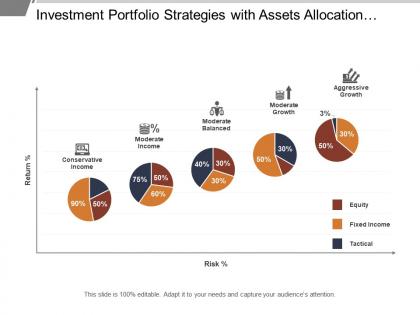
Investment portfolio strategies with assets allocation based on risk and return analysis




Try Before you Buy Download Free Sample Product
 Impress Your
 Audience
 100%
100% Editable
 Save Hours
 of Time


Delve on the importance of first aid with our Investment Portfolio Strategies With Assets Allocation Based On Risk And Return Analysis. Brief folks on the contents of the box.
People who downloaded this PowerPoint presentation also viewed the following :
Investment portfolio strategies with assets allocation based on risk and return analysis with all 5 slides:
Our Investment Portfolio Strategies With Assets Allocation Based On Risk And Return Analysis generate instant interest. Be able to connect in a jiffy.




FAQs for Investment portfolio strategies with assets allocation based on risk
A diversified investment portfolio includes stocks, bonds, real estate investments, commodities, and international securities across various sectors and risk levels. These strategic allocations enhance returns by spreading risk, reducing volatility, and capturing growth opportunities in different market conditions, with many financial advisors finding that balanced diversification ultimately delivers more consistent long-term performance and protects against market downturns.
Investors can determine risk tolerance by evaluating their financial situation, investment timeline, emotional comfort with market volatility, and specific goals like retirement or major purchases. Through risk assessment questionnaires, consultation with financial advisors, and reviewing past reactions to market downturns, individuals create portfolios balancing growth potential with acceptable loss levels, ultimately enabling strategic asset allocation that aligns with their long-term objectives.
Effective portfolio balancing strategies include asset allocation laddering, strategic rebalancing, diversified time horizons, tactical adjustments, and risk-weighted positioning across investment categories. These approaches enable investors to capture immediate opportunities while building wealth systematically, with many financial institutions finding that combining liquid assets with growth investments ultimately delivers both cash flow flexibility and long-term appreciation.
Asset classes serve as the foundational building blocks of diversified investment portfolios, including equities, fixed income, real estate, commodities, and alternative investments like private equity. These categories enable strategic risk distribution across different market sectors, with many institutional investors finding that proper asset class allocation delivers enhanced returns, reduced volatility, and improved portfolio resilience during market fluctuations.
Index funds serve as core portfolio holdings by providing broad market exposure, low costs, instant diversification, and consistent performance tracking. Through strategic allocation, investors streamline portfolio management while minimizing fees and research requirements, with many financial advisors finding that index funds deliver reliable long-term growth and reduced volatility compared to active stock picking.
Portfolio rebalancing maintains your target asset allocation by selling overperforming investments and buying underperforming ones, preventing any single asset class from dominating your risk profile. Financial advisors typically recommend quarterly or semi-annual rebalancing, though many institutional investors and retirement funds find that annual rebalancing delivers optimal risk management while minimizing transaction costs and tax implications.
Market trends influence portfolio allocation by signaling sector rotations, economic cycles, and risk-reward opportunities that guide strategic asset rebalancing. Investment managers analyze emerging trends like technology adoption, demographic shifts, and regulatory changes to reallocate between equities, bonds, and alternative investments, with many institutional portfolios finding that trend-responsive allocation delivers enhanced returns while managing downside risk.
Passive strategies offer lower fees, broad market exposure, and consistent long-term returns, while active strategies provide potential for outperformance, tactical flexibility, and downside protection during market volatility. While passive investing delivers cost efficiency and eliminates manager risk, active management enables strategic adjustments and sector rotation, with many institutional investors finding that combining both approaches optimizes risk-adjusted returns across market cycles.
Investors can integrate sustainable investments through ESG screening, impact investing, green bonds, sustainable mutual funds, and shareholder advocacy initiatives. These approaches enable portfolio diversification while supporting environmental and social goals, with many institutional investors finding that ESG-focused strategies deliver competitive returns while reducing long-term risks and enhancing brand reputation.
Cash allocation serves as a defensive buffer by providing liquidity during market downturns, reducing overall portfolio volatility, and creating opportunities for strategic rebalancing when assets are undervalued. This approach enables investors to maintain financial flexibility while weathering economic uncertainty, with many institutional portfolios finding that strategic cash reserves, typically 5-15% of total holdings, ultimately deliver stability and enhanced long-term returns.
Investors utilize options and derivatives to hedge portfolio risks through protective puts, covered calls, futures contracts, and currency hedging instruments that minimize downside exposure. These strategies enable portfolio managers to lock in profits, limit losses during market volatility, and maintain strategic positions, with many institutional investors finding that systematic hedging delivers enhanced risk-adjusted returns and competitive advantage.
Key indicators for evaluating portfolio performance include total return, risk-adjusted returns like Sharpe ratio, alpha and beta measurements, volatility metrics, and benchmark comparisons. These metrics enable investment managers to assess risk exposure, measure outperformance against market indices, and optimize asset allocation strategies, with many institutional investors finding that comprehensive performance analytics ultimately deliver better client outcomes and competitive advantage.
During economic downturns, investors should diversify across asset classes, increase cash reserves, focus on defensive sectors like utilities and consumer staples, and consider value stocks trading below intrinsic value. This strategic rebalancing helps minimize volatility while positioning for recovery, with many institutional investors finding that maintaining quality dividend-paying stocks ultimately delivers stability and long-term growth opportunities.
Tax considerations for investment portfolios include asset location optimization, tax-loss harvesting, holding period management, account type selection, and timing of distributions. These strategies enhance after-tax returns by minimizing current tax burdens, maximizing tax-deferred growth, and optimizing withdrawal sequencing, with many investors finding that strategic tax planning significantly improves long-term portfolio performance.
Technology and financial tools aid portfolio management by providing real-time analytics, automated rebalancing, risk assessment algorithms, and performance tracking dashboards. Through robo-advisors and AI-powered platforms, investors streamline asset allocation, minimize emotional decision-making, and enhance diversification strategies, while financial institutions increasingly find that these tools deliver improved client outcomes and operational efficiency.
-
Helpful product design for delivering presentation.
-
The Designed Graphic are very professional and classic.