


Investment Strategy Flowchart With Risk And Return Information




Try Before you Buy Download Free Sample Product
 Impress Your
 Audience
 100%
100% Editable
 Save Hours
 of Time


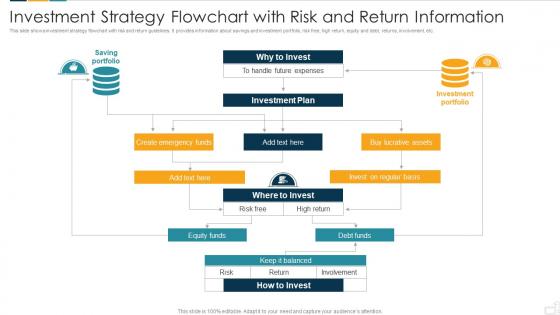
This slide shows investment strategy flowchart with risk and return guidelines. It provides information about savings and investment portfolio, risk free, high return, equity and debt, returns, involvement, etc.
People who downloaded this PowerPoint presentation also viewed the following :
Investment Strategy Flowchart With Risk And Return Information with all 6 slides:
Use our Investment Strategy Flowchart With Risk And Return Information to effectively help you save your valuable time. They are readymade to fit into any presentation structure.






FAQs for Investment Strategy Flowchart With Risk
Start with your goals and how much risk you can stomach - that's your foundation. From there, map out asset allocation based on your timeline. I'd add decision points for different market scenarios and specific percentage triggers for rebalancing. Most people go overboard with complexity though. When you're panicking about a market crash, you won't follow some 20-step flowchart. Keep it visual and simple. Don't forget about taxes either - they'll bite you if you're not careful. Test it out with fake scenarios first so you know it actually works.
Honestly, flowcharts are a game changer for investment stuff. When you draw out your strategy visually, suddenly everyone gets it - you can point to each decision and explain your logic without confusing anyone. It's way better than trying to explain complex allocation rules verbally (trust me on this one). The best part? You'll spot holes in your thinking that you totally missed before. I always catch something when I map things out. Your next strategy meeting will be so much smoother if you sketch it as a flowchart first. People love having that visual roadmap to follow.
Don't get too attached to your flowchart—markets change and you gotta adapt. Keep it simple too, because those crazy complex decision trees? Total nightmare when you're trying to make quick calls. Oh and just because it says "buy" doesn't mean you should if you can't handle the stress. I learned that one the hard way lol. The worst thing you can do is constantly mess with it every time you have a bad week. Review it maybe quarterly. It's just a guide, not some sacred text you follow blindly.
Look, your risk tolerance and goals are literally what build your whole flowchart. Risk tolerance creates the boundaries - like do you go conservative bonds or chase aggressive stocks when things get crazy? Your actual goals determine timing too. Saving for retirement vs a house down payment? Totally different timelines and decision points. I honestly can't stress this enough - people who skip defining this stuff always regret it later. Goals also tell you when to rebalance or bail out. Without nailing these down first, you'll end up with some cookie-cutter flowchart that won't help when you actually need to make decisions.
Oh man, you'll love how much easier this is with tech. I started with Lucidchart for the drag-and-drop stuff - super intuitive. Your whole team can jump in and edit at the same time instead of emailing files back and forth like it's 2005. Some platforms pull in live market data too, so your charts actually update themselves. Excel works great for running different scenarios quickly. The time you save is honestly ridiculous compared to doing it by hand. I'd say just pick a basic online tool first and mess around with it.
Think of economic indicators as your investment GPS. GDP growth, inflation, unemployment - they're all telling you which direction to go. When the economy's expanding, you might lean toward growth stocks. Recession signals? Time for safer, defensive stuff. I personally track about 3-4 indicators max because honestly, more than that gets overwhelming. Pick the ones that actually matter for your timeline and how much risk you can stomach. It's kinda like checking traffic before you leave the house - you're just adjusting your route based on what's happening out there.
Start with your total investment at the top, then branch it out into stocks, bonds, real estate, whatever else you're doing. Each branch gets a percentage. Then break those down further - like splitting stocks into domestic vs international, growth vs value, all that. Honestly, different colors for each category makes it way easier to read. The cool part is showing how your money flows from the big picture down to specific investments. Oh, and throw in some decision diamonds like "high risk tolerance?" to help guide where the splits happen. Makes diversification super clear visually.
Look, quarterly reviews make sense, but don't go crazy adjusting every time the market freaks out. Major life stuff or when your asset mix drifts 5-10% off target? Yeah, that's when you actually change things. I keep notes on what I tweaked and why - saves me from second-guessing later. The tricky part is ignoring daily market drama vs real changes in your situation. Big policy shifts or life events are your real triggers. Honestly, most people mess this up by overthinking short-term noise when they should focus on whether their goals actually changed.
So basically add decision points that loop back to earlier steps when things aren't working. After quarterly reviews, throw in a "targets met?" check - if no, circle back to tweak your risk tolerance or rebalance stuff. Simple beats complicated every time, trust me on this. The key thing is tracking WHY you looped back each time. Market crash? Life changes? Just crappy performance? I started doing this last year and honestly, seeing those patterns helps way more than just randomly adjusting things when you panic.
So strategic stuff is your long-term game - like 5-10 years out, figuring out your basic portfolio setup based on what you want and how much risk you can handle. Tactical is different though, more like tweaking things based on what's happening right now in the market. You'll probably want both in your flowchart honestly. Make the strategic part your main path, then add smaller tactical branches that loop back in. Oh and definitely use different colors so people don't mix up the big foundational decisions with the smaller adjustments - that always trips people up.
Dude, flowcharts are actually pretty clutch for trading decisions. Map out your key trigger points first - RSI levels, moving averages, whatever indicators you use. Then add clear entry and exit rules so you're not just winging it based on emotions. I learned this the hard way after some questionable trades, honestly. Different market scenarios need separate paths in your flowchart. The whole point is having predetermined logic instead of panic-selling or FOMO-buying. Oh, and definitely backtest it with old data before you start using real money - saves you from discovering flaws when it actually matters.
Just stick with the basics - rectangles for actions, diamonds for yes/no stuff, arrows showing where to go next. Dollar signs and percentages work great since everyone gets those immediately. I swear, half the flowcharts I see are so overcomplicated they're useless. Keep your text short in each box. Maybe use green for good outcomes, red for risks or whatever. The whole thing should flow top to bottom or left to right - don't make people hunt around. Oh, and definitely test it on someone first. If they squint at it for more than two seconds, you need to simplify more.
So regulatory stuff basically sets the boundaries for your whole investment flowchart - think of them as guardrails. Every decision point has to comply with fiduciary duties, disclosure rules, risk management requirements. Can't just throw in "high-risk speculation" without proper warnings and suitability checks built right in. Honestly? It's kind of annoying but you've got to do it. Your flowchart structure needs to show you're following a process regulators won't hate. Oh, and definitely build in compliance checkpoints at the major decision spots - saves headaches later.
Look, behavioral finance is basically why that flowchart exists in the first place. Your brain constantly sabotages good investing - panic selling when markets crash, chasing whatever's hot right now, being way too scared of losses. I swear, our emotions are terrible at making financial decisions. The flowchart forces you to think systematically instead of just reacting. But here's the thing - even following it means fighting against every instinct you have. You'll feel overconfident one day, overly cautious the next. That's exactly when you need to stick with the structured approach most.
Honestly, just dig into your historical data to set up realistic trigger points. Past market cycles and volatility patterns will show you when to rebalance or go defensive. Like if your portfolio historically tanks 15% under certain conditions, build that into your risk management decisions. Sure, we can't predict the future, but data gives you decent guidelines. Backtest your flowchart against different market periods - see how it would've actually performed. Then adjust your thresholds based on what you find. It's kind of like fine-tuning a recipe until it works.
-
Amazing slides! Unique, attractive, and easy to understand.
-
“I always have a wonderful experience with SlideTeam. It's my ""go to"" when I need a template.”