


Kaizen 4m checklist material and method ppt sample




Try Before you Buy Download Free Sample Product
 Impress Your
 Audience
 100%
100% Editable
 Save Hours
 of Time


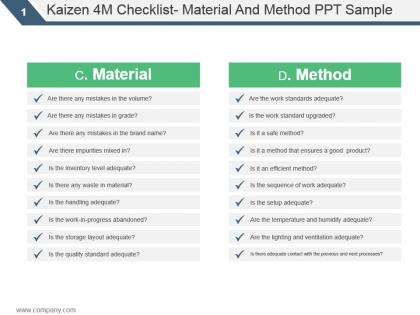
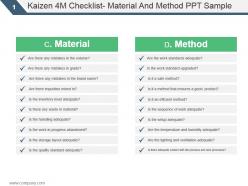
Are you planning to create a plan that can help your business to improve? Not sure how to showcase it to the management and team members? Do not panic! Represent your creative business plans and strategies with our predesigned kaizen 4m checklist material and method PowerPoint template slide. The best graphics and presentation designers have crafted this business improvement PPT slide. This editable business improvement kaizen presentation slide highlights two different columns representing the headings which are material and method. These two headings highlight various essential questions with a tick mark symbol. This continuous improvement PPT template slide will let you explain the concept that how one can improve the organizational activities and can bring the changes. You can design a professional presentation on topics like business continuous improvement, six sigma, lean manufacturing, wastage refining, business process re-engineering, total quality management, business quality assurance, and overall productive maintenance, kaizen process, business improvement methodology, and process improvement strategies. Download this kaizen 4m checklist material and method PowerPoint template to impress the audience. Our Kaizen 4m Checklist Material And Method Ppt Sample will fill in the gaps. They ensure everything is complete.
People who downloaded this PowerPoint presentation also viewed the following :
Kaizen 4m checklist material and method ppt sample with all 5 slides:
Get through to them with our Kaizen 4m Checklist Material And Method Ppt Sample. They will be completely absorbed in your thoughts.

FAQs for Kaizen 4m checklist material and
So the 4M thing is pretty simple - Man, Machine, Material, Method. Basically you're checking people/skills, equipment, your raw materials, and processes. What I like about it is you just work through each category when something's going wrong or you want to improve stuff. Material covers quality issues and waste (that's usually where I find the most problems tbh). Method is your procedures, Machine is obvious, and Man is your team's capabilities. Just pick whichever M seems like the biggest headache and start there. Works great for kaizen events too.
So the 4M thing is actually pretty brilliant - it stops you from just throwing ideas at the wall. Man, Machine, Material, Method. Sounds cheesy but it works. Your team will check people issues, equipment problems, supply chain stuff, and process gaps without missing anything obvious. I've watched so many meetings where people just argue in circles because they don't have structure. Each M connects to the others too, which is wild when you start seeing the patterns. Forces you past surface-level symptoms into real systemic stuff. Honestly, just grab a whiteboard next time you're stuck and literally map out all four categories.
Start with daily huddles where you check Man, Machine, Material, and Method stuff from the last shift. Put up visual boards right by the workstations - makes it dead simple for people to catch problems as they happen. I'd do weekly walks through the floor using that checklist too. Honestly, supervisors miss way more than they think they do. Make it feel automatic, like brushing your teeth or whatever. Don't try to roll it out everywhere at once though - pick one department first, get some solid wins, then spread it around. Way less headache that way.
Look, without management backing your 4M Checklist is pretty much useless paperwork. Your team will spot this immediately - they'll see problems getting identified but nothing actually changes. That kills motivation fast. Leadership needs to put their money where their mouth is: budget for fixes, participate in the process themselves, and actually implement what gets found. When people see real improvements happening, they'll start caring about finding issues instead of just checking boxes. Honestly? Don't even bother rolling it out unless management commits upfront to acting on the results. You'll just breed cynicism otherwise.
So here's what actually works - pick your baseline metrics first across the 4Ms (Man, Machine, Material, Method). Track stuff like productivity, defects, cycle times before you change anything. Data collection is honestly boring as hell, but you need it. After implementing changes, compare the numbers to see your improvements. Most teams notice results in 2-4 weeks if they stick with it. Oh, and don't go crazy measuring everything - just focus on 2-3 solid KPIs per category. Keep it simple or you'll drown in spreadsheets.
Honestly, the biggest pain you'll deal with is people rolling their eyes and going "ugh, more paperwork." Plus everyone wants to fix everything at once across all the 4Ms instead of being smart about it. Teams I've worked with will find like 50 problems, then get completely paralyzed because they don't know where to start. Don't do that to yourself. Pick one process first and show some quick wins - that's how you get people actually caring. Focus on maybe 2-3 things that'll make a real difference. And yeah, make it super clear this isn't about pointing fingers at anyone.
You just tweak each category based on what matters in your field. Like in manufacturing, "Machine" might mean production equipment, but healthcare? That's medical devices or computer systems. Methods change too - retail focuses on customer service stuff while finance cares about transaction flows. I think the whole point is how adaptable it is, honestly. Materials and workforce challenges will look totally different depending on your industry. Oh, and start by figuring out your biggest headaches first, then just match them up with whichever M fits best. Way easier than trying to force some generic template.
Honestly, your 4M checklist pairs amazingly with a few other tools I've used. Value stream mapping shows you the big picture - where those Man, Machine, Material, and Method problems actually sit in your whole process. For digging deeper into root causes, 5 Why analysis is perfect. Those two together? Chef's kiss for problem-solving. Gemba walks let you double-check what you're seeing on paper against reality (trust me, there's always a difference). Standard work templates help you capture Method improvements once you find them. My advice? Pick just one tool to start with. Don't overwhelm your team right away.
Honestly, the 4M thing works because it's dead simple - your people can actually use it without their eyes glazing over. Man, Machine, Material, Method... anyone can remember that. What's cool is employees start hunting for problems themselves instead of just waiting around for someone else to notice stuff. Each person focuses on one M at a time in their own area, which beats trying to fix the whole world at once (we've all been there). I'd probably start small - maybe have your team spend 10 minutes weekly on just one category. It's like handing out detective badges, and people genuinely seem to dig having that kind of ownership.
Toyota's the classic example here - they cut setup times from hours down to minutes using that 4M thing. Cross-trained workers, standardized tools, better material placement, new procedures. Amazon's obsessed with this stuff too in their warehouses. Even tiny manufacturers get massive results though, which is kinda crazy. I'd just pick one process you deal with and go through each M one by one. You'll probably find obvious fixes you've been walking past every day. Sometimes the simplest changes make the biggest difference.
Honestly, skip the boring presentations and just throw them into real scenarios. Get your team doing actual workshops where they walk through workplace problems using the 4M thing - Man, Machine, Material, Method. Have them spot issues from their own jobs, not some made-up example. Pair your newbies with experienced people for coaching. Visual aids help too - something they can actually reference later. Your managers need to use the checklist themselves or nobody else will take it seriously. Practice is everything here. They've got to do it over and over until it clicks naturally.
You need to track the four M's but don't go crazy with it. For people stuff - training rates, safety incidents, how many suggestions workers actually submit. Equipment metrics are downtime, maintenance costs, and OEE (though honestly OEE can be a pain to calculate right). Waste reduction and inventory turnover cover your materials. Methods get measured by cycle times and cost per unit. Here's the thing though - pick maybe 2-3 metrics per category that actually move the needle for YOUR operation. I've seen companies track like 47 different things and then wonder why nothing improves. Get your baseline first, then check monthly to see what's trending up or down.
So the 4M thing basically makes your team into detectives, you know? They start questioning everything instead of just going "eh, whatever." Man, Machine, Material, Method - when people look at all four regularly, they actually notice stuff that's broken or could work better. Honestly it gets addictive once they're in the groove. Here's what works: let different people run the sessions and make a big deal when someone catches a real problem. That way everyone owns the improvements, not just the managers. Pretty cool how it shifts the whole mindset.
Once you've spotted improvements with your 4M Checklist, pick the low-hanging fruit or big wins first. Make a basic action plan - who's doing what and by when. Start small though, nobody wants to feel swamped. Document your current numbers before changing anything, then maybe test it out if it's a major shift. Roll it out, measure against your baseline, and if it works, make it the new standard. Oh and here's what most people mess up - actually follow up to make sure the change stuck. Don't just implement and walk away hoping for the best.
Build feedback loops into all 4Ms - super important. After changes, do regular team check-ins and make it safe for people to actually speak up (not just pretend to listen, you know?). Each M needs its own channel: worker suggestions for Man stuff, maintenance reports for Machine issues, supplier feedback for Materials, process observations for Methods. Here's the thing though - you gotta act on feedback fast and visibly. People will keep sharing ideas when they see real improvements happen from their input. Otherwise they'll just stop bothering. Keep that cycle going and your Kaizen stays alive.
-
Enough space for editing and adding your own content.
-
Informative presentations that are easily editable.