


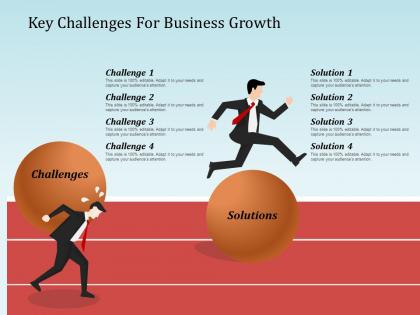
Key challenges for business growth powerpoint slide background image




Try Before you Buy Download Free Sample Product
 Impress Your
 Audience
 100%
100% Editable
 Save Hours
 of Time


Are you looking for PowerPoint design to display major business growth issues and their solutions in PowerPoint? We are presenting our professionally designed key challenges for business growth PowerPoint slide background image presentation design template to let you do it without any hassle. This business challenges and solutions PPT template is perfect to display various global problems and their solutions such as impact of culture on business, technical, financial, ethical or business startup challenges that are acting as a barrier in business growth. Businessmen, sales and marketing professionals use this wonderful challenges and opportunities PPT template for making markets work got business and income growth by developing business strategies keeping all the growth, current market trend, opportunity and challenges factors in mind. The design structure is amazing and will make you audience stick to the presentation till the end of the presentation. So, don’t wait for it, just download this powerful overcoming challenges PowerPoint template and use in your future presentations to display all the business aspects in most comprehensive way. Acquire a charismatic air with our Key Challenges For Business Growth Powerpoint Slide Background Image. Conduct events with great aplomb.
People who downloaded this PowerPoint presentation also viewed the following :
Key challenges for business growth powerpoint slide background image with all 5 slides:
Feel the gladdest with our Key Challenges For Business Growth Powerpoint Slide Background Image. Your abilities will get the biggest boost.





FAQs for Key challenges for business growth powerpoint
Honestly, cash flow hits hardest when you're scaling fast. Then there's finding good people quickly enough - way harder than it sounds. What really caught me off guard was how systems that worked perfectly for 10 people just completely fell apart at 50. Your customer service gets inconsistent, operational stuff becomes a nightmare, and suddenly everyone's competing for your attention as a leader. Oh, and competition gets brutal once you're bigger. My advice? Document everything now while you still remember how things work, and build systems that can actually grow with you instead of constantly firefighting later.
Honestly, start mapping out your cash needs way before you actually hit a wall. Growth is tricky - you're spending to scale but waiting forever for customers to pay up. Set up credit lines or talk to investors while you're still in decent shape, not when you're panicking. I'd also get aggressive about collections and maybe throw in early payment discounts to speed things up. Build those cash flow projections now even if everything seems fine. Trust me, scrambling for money when you're already stretched thin is absolutely miserable.
Market research is basically your way out of being stuck - shows you where the real opportunities are hiding. You'll find customer segments you didn't know existed, plus figure out what gaps your competitors are missing. Honestly, way too many businesses just guess instead of actually asking people what they want (which seems crazy to me but whatever). Quick customer surveys or even basic competitor stalking will beat making decisions blind. The data helps you stop wasting money on stuff that won't work. Even simple research gives you way better odds than just hoping for the best.
Dude, cultural stuff will absolutely make or break you when going international. I've seen it happen - had a client whose humor bombed spectacularly because it just didn't translate. Your marketing approach? Probably won't work. Even your actual products might need tweaking for local tastes. Communication styles are totally different too. Honestly, the biggest mistake is just copying what worked at home. Do your homework on the culture first, then hire locals who actually get it. They'll save you from so many facepalm moments. Trust me on this one.
Honestly, tech can save your sanity when you're scaling up. Automate the boring stuff that's eating your team's time. Cloud solutions are clutch - they'll handle traffic spikes without everything crashing. I'm obsessed with good CRM and project management tools when things get messy (which they will). Data analytics shows you exactly where the bottlenecks are hiding. Digital marketing tools let you reach tons more customers without building some massive sales team. Oh, and don't try to fix everything at once - pick your biggest headache right now and solve just that first.
Dude, customer feedback is everything for growth. Your customers literally tell you what's broken and what they'd actually pay for - way better than guessing in meetings. I've watched so many companies waste money on stuff that sounded brilliant but customers couldn't care less about. Collect feedback however you can: surveys, support chats, just asking people directly. The trick is actually using those insights to make real changes to your product. Sounds obvious but you'd be surprised how many teams skip that part. Short answer: listen to your customers or you're basically flying blind.
Track your CAC, churn rate, monthly recurring revenue, and cash burn - those are your must-haves. Revenue per customer matters too, plus how long your sales cycles are running. Both catch problems way before they tank your numbers. Don't sleep on employee turnover either since losing good people can absolutely wreck everything. Honestly, I've seen too many founders obsessing over vanity metrics while missing the stuff that actually moves the needle. Set up a weekly dashboard with maybe 6-7 key things max. More than that and you'll just get overwhelmed and stop checking it.
So many companies mess this up - they scale first, figure out systems later. Big mistake. Get your processes locked down before you hire more people. Write down what actually works and build real training programs so new people can hit the same quality standards. I'd also do regular check-ins because stuff always falls through the cracks when you're growing fast. It's way better to create systems that can handle growth instead of just throwing bodies at problems. Figure out your non-negotiable quality stuff first, then build backwards from there.
Dude, you've gotta play to your strengths - big companies are drowning in red tape while you can change direction overnight. They can't give that personal touch or really get what your specific customers want. Most successful small businesses I've seen don't even go head-to-head with the giants. Find those weird little gaps they ignore. Social media's your best friend for showing personality (something corporate accounts totally suck at). Build real connections locally. Don't spread yourself thin trying to compete on everything - just be ridiculously good at whatever makes you different.
Honestly? Engaged employees are your secret weapon for growth. They're way more productive and actually give a damn about solving problems. People who care about their job will stick around longer too - saves you from constantly hiring and training new folks. Your customers notice the difference when employees are genuinely happy to help. But when morale tanks, it's brutal. Quality goes downhill, your best people bail, and suddenly everything feels like an uphill battle. I learned this the hard way at my last job. Regular feedback and recognition work wonders - way cheaper than dealing with constant turnover.
Dude, expanding is such a headache with all the legal stuff. Each state has different rules you gotta follow, and don't even get me started on international expansion. Employment laws are totally different everywhere - you could accidentally break labor laws without knowing it. Industry licenses usually don't transfer either, which sucks. IP protection gets messy when you're dealing with multiple places too. That's probably why those business consultants charge so much, honestly. Get a lawyer who actually knows this stuff before you do anything. Trust me, don't try figuring it out yourself.
Look, you gotta do a real risk assessment first - figure out where cash flow might tank, ops could break down, or you'll lose key people. Map out different growth scenarios because honestly, most companies that scale fast end up face-planting when reality hits. Build in cushions everywhere - extra cash, flexible hiring, systems that won't crash under pressure. Set up those early warning bells too, like when customer satisfaction starts dropping or your margins get squeezed. Monthly check-ins with your team will catch the nasty stuff before it spirals. Stay paranoid but ready.
Cash flow is everything - seriously, track it weekly if you aren't already. During good times, stash away whatever you can and try getting better payment terms from suppliers. Don't put all your money in one place either, diversify however you can. Lines of credit beat big loans most of the time since they're more flexible. Oh and those efficiency upgrades that seem expensive? They usually pay off down the road. Stay lean but don't be so cheap you miss good opportunities. I probably should've learned this stuff sooner honestly.
Honestly, partnerships are clutch for breaking through growth walls. You're stuck getting customers? Find someone who already talks to your ideal audience daily. Missing skills or resources? Team up with people who crush what you're struggling with. Way faster than hiring everyone or blowing your budget - I've seen companies double their reach in months this way. Testing new markets becomes less scary too since you're splitting the risk. Start by figuring out your biggest bottlenecks first, then hunt for partners who are already killing it in those exact areas.
Honestly, I'd audit what you've got first and find your top 2-3 channels. Way too many companies I know just scatter their efforts when things start taking off - it's like watching someone juggle too many balls at once. Double down on whatever's crushing it right now before you even think about new stuff. Once you've maxed that out, then test new channels but do it properly with tracking so you actually know what's working. Your messaging will probably need tweaking for different audiences too. Create a testing plan and stick to it.
-
Top Quality presentations that are easily editable.
-
Out of the box and creative design.