


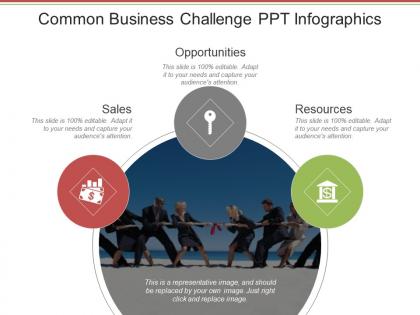
Common business challenge ppt infographics
You must be logged in to download this presentation.




Try Before you Buy Download Free Sample Product
 Impress Your
 Audience
 100%
100% Editable
 Save Hours
 of Time


Do you want to highlight major business challenges that you might have to face in the organizational growth? We are offering our one of the most innovative modern business oriented common business challenge PPT infographics PPT design template to let you do it efficiently. You can easily highlight the common challenges of entrepreneurship and small business such as financial issues, time management issues, market problems, legal issues with this powerful business challenges PPT template. Design template is appropriate to display business startup challenges, most common challenges faced by ecommerce business, top growth challenges your business will face in a well structured format. Portraying business challenges in advance will increase the chances of avoiding them and it will be easy for entrepreneurs to create more opportunities for business growth. So, just download this wonderful overcoming challenges PowerPoint design template and use it to highlight critical challenges and solutions to achieve strategic business goals. Get the audience fully engaged with our Common Business Challenge Ppt Infographics. They establish a direct connection.
People who downloaded this PowerPoint presentation also viewed the following :
Common business challenge ppt infographics with all 5 slides:
Fix the deal with our Common Business Challenge Ppt Infographics. Bring an end to any disagreement.



FAQs for Common business
Cash flow's probably gonna be your biggest headache, plus finding good people fast enough. Quality control gets messy when you're growing quickly too. All those systems that worked fine before? They'll start breaking down under the pressure - I've seen it happen so many times. Oh, and suddenly you're not doing the actual work anymore, you're managing other managers which feels super weird at first. Infrastructure costs can get crazy if you don't plan ahead. Honestly, figure out where your weak spots are now, not when you're already drowning.
Dude, start with a weekly cash flow forecast - sounds boring but it'll save your ass. Invoice the second you finish work, then chase down late payers hard. Don't feel bad about being pushy on payments either. Try to stash away any cash you can for emergencies, and honestly? Get a line of credit set up now while things are stable, not when you're panicking. Oh, and work on better payment terms with suppliers. The forecasting thing is key though - once you see the patterns, everything else gets way easier to handle.
Honestly, differentiation is everything - figure out what makes you special and go all-in on that. Price, quality, service, whatever it is. I've watched so many businesses try to be good at everything and just end up... meh. Focus on building real customer loyalty by actually listening to what people want (crazy concept, right?). Sure, watch your competitors, but don't just copy their moves. Stay flexible and ready to pivot when the market shifts. Being nimble beats being big most of the time in competitive spaces.
Yeah, you totally can! Honestly, it's more about how you think than what you spend. Try small experiments instead of betting big - like let your team mess around with new ideas for maybe 10-15% of their time. Google does this too, so you're in good company. Get different departments talking to each other because fresh perspectives don't cost anything. Maybe partner up with other companies who are also scraping by? The biggest thing is making sure people aren't scared to pitch crazy ideas. Oh, and psychological safety sounds fancy but it just means don't shoot down suggestions immediately. Pick one small thing to test this month and see what sticks.
Dude, engaged employees are literally your best bet for solving business problems. They'll catch issues before they blow up and actually care enough to fix them instead of just shrugging it off. I've watched this happen - when people are invested, they become your problem-solvers instead of adding to the chaos. Plus they handle change way better and don't let quality slip when things get crazy. Honestly, just start by asking what's bugging them at work. Actually listen though - they probably know exactly what's broken and how to fix it.
Honestly, you've gotta stay curious about what's coming next. I set up Google alerts for our industry stuff and actually force myself to sit through those webinars - most are terrible but you'll find some gems. Following the right people on LinkedIn helps too. Build flexibility into how your team works so you can switch directions fast. Don't overthink it - just pick one new tool this quarter and run a small test with it. The biggest thing? Make sure people aren't scared to try something that might totally flop. Sometimes the failures teach you more anyway.
Honestly, you gotta jump on this stuff before it blows up. Get everyone together and stick to the actual issue - not who's being annoying or whatever. Let each person say their piece without getting interrupted, then figure out what's really going on underneath all the drama. Stay neutral when you're running the conversation, don't pick favorites. I learned this the hard way at my last job lol. Set some ground rules for moving forward and check back in later to see if it's actually fixed. Trust me, ignoring it just makes everything so much messier down the road.
Honestly, you gotta weave compliance into your day-to-day stuff instead of treating it like some yearly chore. Get automated alerts set up for regulatory changes - trust me, manually checking is a nightmare. Have someone actually dedicated to watching this stuff and making sense of it. Quarterly reviews sound super tedious but they'll save you from massive headaches later. Partner with lawyers who know your industry inside out. They catch the weird details you'd totally miss. Map out what regulations hit you now, then build a tracking system. The whole point is staying ahead of changes rather than scrambling when you're already screwed.
Economic chaos hits local businesses in ways that honestly suck. Supply costs jump around when currencies go nuts, and customers just stop spending when they're worried. Banks get stingy with loans too - even for stuff you actually need. It's wild how that anxiety spreads everywhere. You'll want to save cash during the good months and spread your customers across different groups so you're not screwed if one market tanks. Oh, and definitely run some worst-case numbers on your cash flow. Better to know now than get blindsided later.
Honestly, just start with one problem that's bugging you - like why deliveries are always late or why you're constantly short-staffed. Dig into whatever data you've got on that specific issue. Customer patterns, inventory numbers, productivity stuff. I mean, you're probably already tracking more than you think. The trick is actually looking at it instead of flying blind. Pick through the numbers and you'll spot where things keep breaking down. Way better than just guessing what's broken. Once you nail one area, move to the next. It's not rocket science, just takes some detective work.
Honestly, don't put everything with one supplier - that's disaster waiting to happen. Keep extra stock of your must-have items around. Good communication with partners matters way more than people think. Get some tracking systems so you're not flying blind when stuff goes sideways. The companies that survive have backup plans already written down, not something they're figuring out mid-crisis. Oh and map your weak spots this week - like actually sit down and do it. Then write contingency plans for each one.
Honestly? Stop just reacting to problems and start getting ahead of them. Look at what your customers bought before and suggest stuff they'll actually need. Your team training matters way more than you think - I've seen one awful interaction completely tank a customer relationship. Map out where people get frustrated in your process first, then fix those spots. Data's your friend here for spotting issues before customers even complain. The whole point is making people feel like humans, not ticket numbers. Short version: be proactive, train well, fix the worst problems first.
Honestly? Leadership can totally save or sink you when everything goes sideways. Clear communication is huge - your team needs to know what's happening, even when you don't have all the answers. Quick decision-making matters too, plus keeping everyone from losing their minds when things get stressful. The best leaders I've worked with spot trouble coming from a mile away and pivot before it's too late. Way too many companies just freeze up instead of adapting. Practice this stuff during smaller problems first - you don't want your first real test to be during a major crisis. Stay visible with your people and be straight with them about where you're headed next.
Honestly, you can't just wait for disasters to build resilience - it's gotta be baked into how you operate daily. Get people talking openly about problems without the blame game BS. Cross-training is huge too (learned that one the hard way when half my team got COVID last winter). I always tell people to treat small screw-ups as learning opportunities instead of catastrophes. Oh, and run those "what if" scenarios with your team regularly - like what happens if our main supplier ghosts us? When people know their roles ahead of time, they don't panic when things actually hit the fan.
Look, pay them well first - that's baseline stuff. People aren't stupid, they know what they're worth. But beyond that? Give them somewhere to actually go career-wise. Nobody wants to feel stuck doing the same job forever. Flexible schedules help too, and maybe don't be weird about remote work if the job allows it. Oh, and skip the ping pong tables - invest in real mentorship instead. Your current team probably has opinions on what sucks most, so just ask them directly. Culture can't be faked anyway.
-
Design layout is very impressive.
-
Amazing product with appealing content and design.