


Key result area sales training program network expansion




Try Before you Buy Download Free Sample Product
 Impress Your
 Audience
 100%
100% Editable
 Save Hours
 of Time


Introducing our key result area sales training program network expansion PPT template to give your sales and organizational growth a digital push. SlideTeam understands that your attitude, more than your aptitude, determines your altitude. To elevate your altitude, we have designed this sales training module PPT slideshow to walk you through the facets of the sales drill aligned with key result areas. It helps you highlight and work on operational shortcomings and improve your bottom line. Our sales key result areas PPT layout is structured keeping in mind the essential sales skills, customer experience, and other factors that play an important role in boosting sales. Educate your team members about this pivotal subject using our aesthetically appealing key result areas of sales success PPT theme. It works wonders given in the setting the tone of your presentation right with its structure built to support the free flow of information and, of course, compelling visuals. Download our sales fundamentals training PPT set today.
People who downloaded this PowerPoint presentation also viewed the following :
Content of this Powerpoint Presentation
Description:
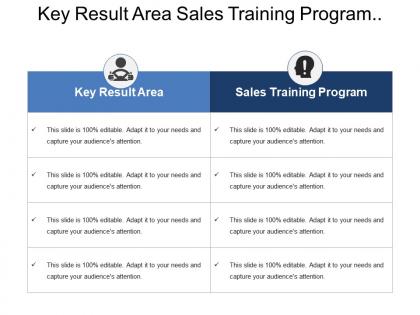
The image is a PowerPoint slide with the title "Key Result Area Sales Training Program." It appears to be divided into two sections, each with a title and a corresponding icon: "Key Result Area" is paired with an icon of a person in a cogwheel, and "Sales Training Program" is paired with an exclamation mark icon. Both sections contain bullet points with the recurring text "This slide is 100% editable. Adapt it to your needs and capture your audience's attention," indicating that the content beneath each title can be customized to fit specific training needs and focal points within the sales training program.
The placeholders suggest that details about the key result areas in sales and specifics of the sales training program should be inserted here by the presenter, tailored to the organization's objectives.
Use Cases:
Customizable sales training programs are pivotal for developing effective sales strategies and are widely applicable across various industries.
1. Retail:
Use: Training for improved customer engagement.
Presenter: Sales Trainer
Audience: Sales Associates, Store Managers
2. Automotive:
Use: Enhancing dealership sales techniques.
Presenter: Training Coordinator
Audience: Sales Representatives, Dealership Staff
3. Real Estate:
Use: Cultivating negotiation skills for agents.
Presenter: Professional Development Manager
Audience: Real Estate Agents, Brokers
4. Pharmaceuticals:
Use: Educating on product knowledge and compliance.
Presenter: Pharma Sales Trainer
Audience: Medical Sales Reps, Marketing Team
5. Technology:
Use: Strategies for selling tech products and services.
Presenter: Sales Enablement Lead
Audience: Tech Sales Teams, Account Managers
6. Financial Services:
Use: Training for selling financial products.
Presenter: Financial Advisor Trainer
Audience: Financial Advisors, Investment Salespeople
7. Hospitality:
Use: Improving booking and upselling techniques.
Presenter: Guest Service Trainer
Audience: Front Desk Staff, Reservation Agents
Key result area sales training program network expansion with all 5 slides:
Build up the adrenaline with our Key Result Area Sales Training Program Network Expansion. Inject the desire for immediate action.

FAQs for Key result area sales training
Effective sales training programs include product knowledge mastery, consultative selling techniques, objection handling strategies, CRM system proficiency, and performance measurement frameworks. These components work together by building foundational expertise, enhancing customer relationship skills, and streamlining sales processes, with many organizations finding that comprehensive training ultimately delivers higher conversion rates and sustained revenue growth.
Role-playing scenarios enhance sales training effectiveness by simulating real customer interactions, allowing salespeople to practice objection handling, refine communication skills, and build confidence in a safe environment. Through structured simulations, sales teams can rehearse complex negotiations, test different approaches with challenging prospects, and receive immediate feedback, ultimately improving close rates and customer relationship management across diverse industries.
Sales training success metrics include conversion rates, average deal size, sales cycle length, quota attainment, customer retention rates, and revenue per representative. These performance indicators enable organizations to track both immediate improvements and long-term outcomes, with many companies finding that comprehensive measurement across multiple touchpoints delivers clearer insights into training ROI and competitive advantage.
Sales trainers can tailor their approach by incorporating visual aids like charts and infographics, auditory elements such as group discussions and role-playing, and kinesthetic activities including hands-on simulations and interactive exercises. Through adaptive training methods, organizations enhance knowledge retention, improve skill development, and accelerate performance outcomes, with many sales teams finding that personalized learning approaches ultimately deliver higher conversion rates and stronger client relationships.
Common challenges include resistance to change from established routines, difficulty adapting generic techniques to specific customer situations, lack of consistent practice opportunities, insufficient follow-up coaching, and pressure to maintain short-term numbers while learning. These obstacles often result in sales teams reverting to familiar methods, with many organizations finding that ongoing reinforcement, personalized coaching, and gradual implementation schedules significantly improve technique adoption and ultimately deliver sustained performance improvements.
Ongoing training proves essential for sales professionals, enabling them to adapt to evolving market conditions, refine techniques, and maintain competitive performance levels. Through continuous development programs, sales teams enhance product knowledge, master new technologies, and strengthen relationship-building skills, with many organizations finding that regular training significantly improves conversion rates and revenue growth.
Technology revolutionizes modern sales training through CRM integration, AI-powered simulations, virtual reality practice environments, mobile learning platforms, and data analytics tracking. These digital tools enhance learning retention by providing personalized coaching, real-time performance feedback, and scalable training delivery, with many organizations finding that technology-enabled programs reduce training costs while significantly improving sales team effectiveness and faster skill development.
Organizations align sales training with corporate goals by conducting strategic assessments, mapping training objectives to business outcomes, integrating company values and messaging, and establishing measurable performance metrics. Through regular leadership collaboration and feedback loops, companies like technology firms and financial services streamline this alignment process, ensuring sales teams understand strategic priorities while delivering consistent customer experiences that ultimately drive revenue growth and competitive advantage.
Incorporating real-life case studies into sales training delivers enhanced learning retention, practical application skills, improved problem-solving abilities, and stronger team engagement through relatable scenarios. These authentic examples enable sales teams to understand successful strategies, learn from actual client interactions, and develop confidence in handling complex situations, with many organizations finding that case-study-based training significantly accelerates performance improvements and deal closure rates.
Sales training adapts to B2B versus B2C differences by focusing on relationship-building, longer sales cycles, and technical presentations for B2B, while emphasizing quick rapport, emotional triggers, and immediate decision-making for B2C. These strategic approaches enable organizations to streamline their training programs, enhance sales effectiveness across different markets, and ultimately deliver improved conversion rates and customer experiences.
Current trends shaping sales training include virtual reality simulations, AI-powered coaching platforms, microlearning modules, social selling techniques, and data-driven performance analytics. These technologies enhance training effectiveness by personalizing learning paths, providing real-time feedback, and simulating customer interactions, with many organizations finding that modern approaches deliver faster skill development and improved sales performance.
Feedback mechanisms can be integrated through real-time coaching platforms, peer review sessions, manager observation scorecards, customer interaction recordings, and performance analytics dashboards. These systems enable sales teams to receive immediate insights on presentation skills, objection handling, and closing techniques, while managers track progress across multiple metrics, ultimately accelerating skill development and improving conversion rates.
Company culture significantly influences sales training effectiveness by shaping employee engagement, knowledge retention, and behavioral adoption across teams. Organizations with collaborative, learning-focused cultures see higher training completion rates, better skill application, and improved sales performance, while supportive environments enable continuous development, peer mentoring, and ultimately stronger revenue outcomes and competitive advantage.
Collaboration between sales and marketing teams is crucial for creating effective sales training content, as it ensures messaging consistency, aligns customer journey understanding, and leverages real market insights from both perspectives. This strategic partnership enables organizations to develop more targeted training materials, streamline lead handoffs, and ultimately deliver higher conversion rates, with many companies finding that integrated sales-marketing training approaches significantly enhance overall revenue performance.
Best practices for conducting virtual sales training sessions include interactive breakout rooms, role-playing exercises, gamified learning modules, real-time polling, and recorded session access for reinforcement. These approaches enhance engagement by creating collaborative environments, providing immediate feedback, and enabling flexible learning paths, with many organizations finding that virtual formats deliver cost-effective training while maintaining consistent messaging across global sales teams.
-
Enough space for editing and adding your own content.
-
Informative design.