


Door to door sales training powerpoint presentation slides





Try Before you Buy Download Free Sample Product
 Impress Your
 Audience
 100%
100% Editable
 Save Hours
 of Time


Introducing our content ready Door To Door Sales Training PowerPoint Presentation Slides. Train your door to door sales team with the help of this professionally designed face to face marketing presentation deck. Showcase steps of training process like training needs analysis, objective, deliver and evaluation using the easy-to-use face to face sales training PPT visuals. The professionally designed direct sales process training PowerPoint presentation contains self-explanatory templates such as sales by region, competitor’s analysis, competitive advantage, training evaluation, quick tips of door-to-door selling, sales evaluation and so on. Streamline your marketing procedures with the help of our ready-to-use direct sales training techniques presentation graphics. You can also utilize the easy-to-understand door to door marketing coaching PowerPoint templates to nurture your sales team with training based on consumer feedback. Download the high quality visually appealing direct sales training methods slides deck to save your time and efforts. Get the agenda going with our Door To Door Sales Training Powerpoint Presentation Slides. Elaborate, discuss and arrive at conclusions.
People who downloaded this PowerPoint presentation also viewed the following :
Content of this Powerpoint Presentation
Slide 1: This slide introduces Door to Door Sales Training. State Your Company Name and begin.
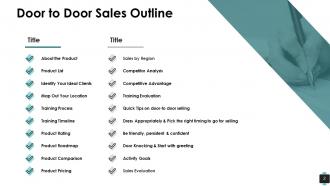
Slide 2: This slide presents Door to Door Sales Outline in a tabular form. This table consists of two coumns title and slide number which you can add as per your business needs.
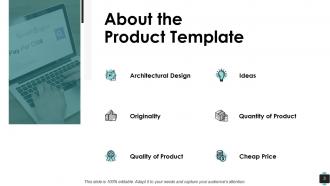
Slide 3: This slide provides a brief introduction About the Product. It also shows the following points- Business, Renew, Portfolio, Help, Creativity, Maps, Creative, Tools with icon imagery. You can also add your logo in the empty space provided.
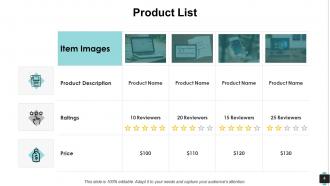
Slide 4: This slide displays a Product List consisting of Item Image, Product Description, Ratings and Price. You can also add images of your products here if you desire to.
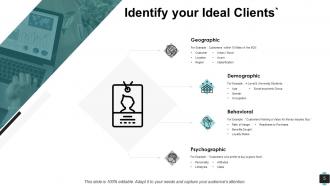
Slide 5: This slide helps to Identify Your Ideal Clients by dividing them into the following four categories- Behavioral, Psychographic, Demographic, Geographic.
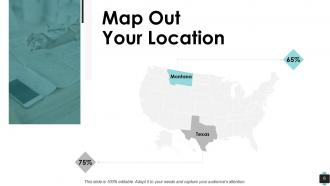
Slide 6: This is Map Out Your Location slide showing US map imagery which you can use as per your business requirement.
Slide 7: This slide explains Hire & Train Marketing Team step of door to door selling. You can add the names and designations of your team members in the given tet boxes.
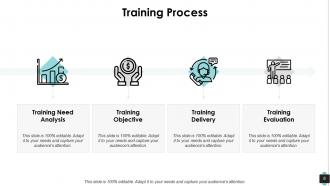
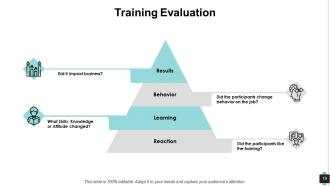
Slide 8: This slide explains the four major steps involved in the Training Process- Training Need Analysis: What are the training needs for this person and/or job? Training Objective: Objective should be measurable & observable Training Delivery: Techniques include on- the-job- training, action, learning, etc. Training Evaluation: Measure reaction, learning, behaviour, and results.
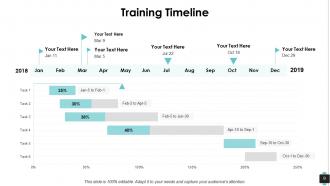
Slide 9: This slide shows a Training Timeline in which you can add training aspects like milestones, journey etc. You can also edit and alter the text as per your requirement.
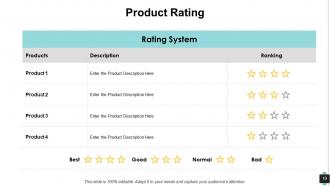
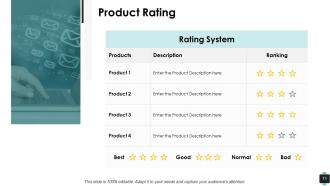
Slide 10: This slide shows Product Rating along with description and ranking.
Slide 11: This is an optional slide for Product Rating.
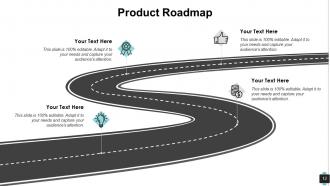
Slide 12: This slide displays a Product Roadmap. Add growth prospects, milestones, journey etc. with reference to the product here.
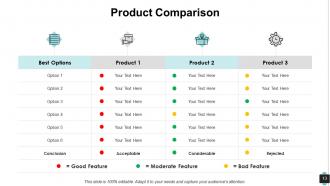
Slide 13: This slide shows Product Comparison on the basis of Moderate Feature, Good Feature and Bad Feature. Also on the basis of this comparison, you can draw product conclusion as being acceptable, considerable and rejected.
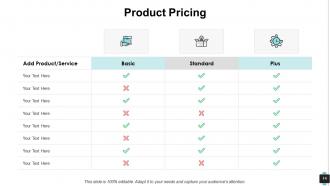
Slide 14: This slide shows Product Pricing with three parameters- Basic, Standard, Plus.
Slide 15: This slide shows Sales By Region by making use of a world map image. You can mark your respective sales locations on this map and use it.
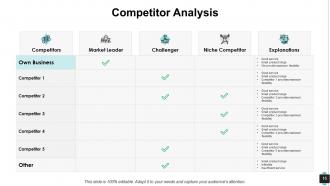
Slide 16: This slide shows Competitor Analysis with the following sub headings- Competitors, Market Leader, Challenger, Niche Competitor, Explanations.
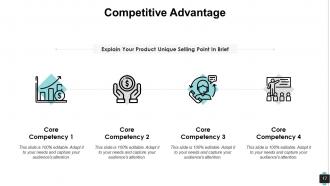
Slide 17: This is a Competitive Advantage slide to explain your product's unique selling point in brief. It also shows core competencies which you can add.
Slide 18: This is a Training Evaluation slide showing its four levels- Results, Reaction, Behavior, Learning. It also explains Did it impact business? Did the participants change behaviour on the job? What Skills, Knowledge or Attitude changed? Did the participants like the training?
Slide 19: This slide is titled Quick Tips on Door-to door Selling with background imagery.
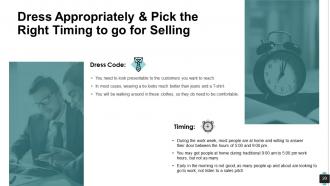
Slide 20: This is Dress Appropriately and Pick The Right Timing Go For Selling slide showing Dress Code and Timings with relevant imagery.
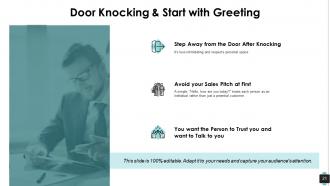
Slide 21: This is Door Knocking & Start with Greeting slide showing the following three points- Step away from the door after knocking, Avoid your sales pitch at first, A simple, "Hello, how are you today?" treats each person as an individual rather than just a potential customer You want the person to trust you and want to talk to you This slide is 100% editable. Adapt it to your needs and capture your audience's attention.
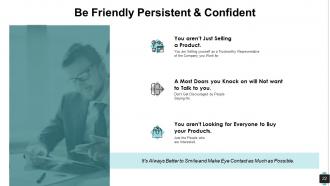
Slide 22: This slide explains Be Friendly, Persistent & Confident by listing the following three reasons- Most doors you knock on will not want to talk to you You aren't just selling a product,.. You aren't looking for everyone to buy your products.
Slide 23: This is an optional slide explaining to Be Friendly Persistent & Confident.
Slide 24: This slide is titled Set and Evaluate Goals with background imagery.
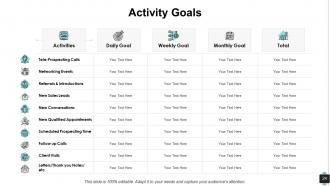
Slide 25: This slide presents a table showing daily, monthly and weekly Activity Goals.
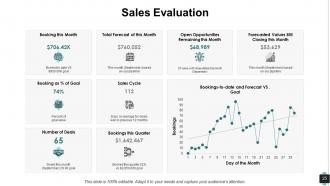
Slide 26: This slide presents Sales Evaluation in charts and graphs.
Slide 27: This slide displays Door to Door Sales Training Icons.
Slide 28: This slide reminds about a 15 minutes coffee break.
Slide 29: This slide is titled as Additional Slides for moving forward.
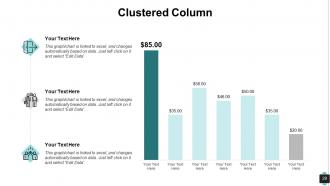
Slide 30: This slide shows Clustered Column chart.
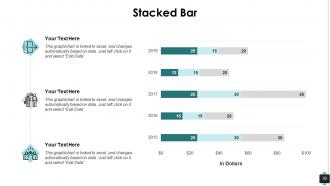
Slide 31: This slide presents Stacked Bar chart. You can add or edit data as per requirements.
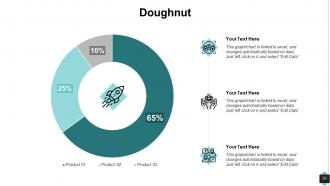
Slide 32: This slide displays Doughnut pie chart with data in percentage.
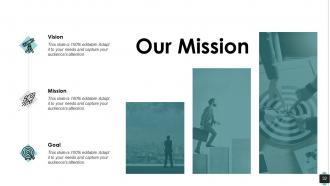
Slide 33: This is Our Mission slide with related imagery and text.
Slide 34: This is Meet Our Team slide with names and designation.
Slide 35: This is About Us slide to show company specifications etc.
Slide 36: This is a Comparison slide to state comparison between commodities, entities etc.
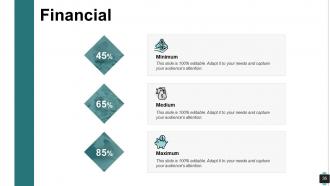
Slide 37: This is a Financial slide. Show your finance related stuff here.
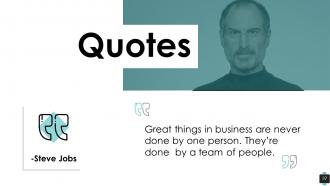
Slide 38: This is a Quotes slide to convey message, beliefs etc.
Slide 39: This is a Timeline slide to show information related with time period.
Slide 40: This is another slide continuing Timeline.
Slide 41: This slide is titled as Post it Notes. Post your important notes here.
Slide 42: This is a Puzzle slide with text boxes to show information.
Slide 43: This is a Target slide. State your targets here.
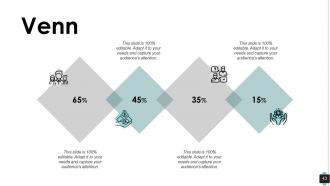
Slide 44: This is a Venn slide with text boxes.
Slide 45: This is an Idea Generation slide to state a new idea or highlight information, specifications etc.
Slide 46: This is a Thank You slide with address, contact numbers and email address.
Door to door sales training powerpoint presentation slides with all 45 slides:
Use our Door To Door Sales Training Powerpoint Presentation Slides to effectively help you save your valuable time. They are readymade to fit into any presentation structure.





FAQs for Door to door sales training
Honestly, focus on three things: listening way more than talking, bouncing back from rejection, and connecting with people fast. The listening part is clutch - you'll actually figure out what they want instead of just rambling about your pitch. Rejection sucks, especially when people literally shut doors on you, but shake it off quick. Next house, fresh attitude. Building rapport is everything though - people won't buy if they don't trust you, and you've got like 30 seconds max. Practice your opener until it flows naturally, not like you memorized some script.
Here's what works for me - first, actually listen to figure out what they're really worried about. Don't just wait for your turn to talk. Say something like "yeah, I can see why that would concern you" so they know you heard them. Then tackle their specific issue with an example or benefit that makes sense. The magic happens when you ask follow-up questions instead of steamrolling ahead. Something like "what would make this feel better for you?" usually gets them opening up about the real stuff that's bugging them. Honestly, most objections aren't even about what they first mention anyway.
Just copy whatever vibe they're putting out - casual or formal, match that energy. Don't jump straight into your pitch though. Ask them open questions about their situation first and actually listen to what they say back. I always try to compliment something real about their place (nothing fake, people can tell). Once you get their name, use it. Oh and if you have a quick story about helping someone similar, that usually works well if it feels natural. Honestly the whole thing is just being curious about them before worrying about the sale. Works way better than the pushy stuff.
Honestly, you NEED to know your product inside and out for door-to-door sales. Nothing kills a sale faster than looking clueless when someone asks a tough question. Study every detail, know how you stack up against competitors, and practice explaining stuff so even my mom would get it. Role-play the worst-case scenarios with your team - trust me, customers will try to stump you just to see if you're legit. The confidence that comes from really knowing your stuff? That's what actually closes deals. Oh, and definitely have your top 5 selling points memorized cold before you even knock on the first door.
Dude, your body language is like 90% of the game before you even open your mouth. Most people see a salesperson and immediately think "sketchy" - can't blame them honestly. So you've gotta nail the basics: stand relaxed, smile like you actually mean it, and don't do that weird intense stare thing. Mirror how they're standing once they start talking to you. Oh, and this is huge - step back from their door a bit. Gives them space and shows you're not some pushy weirdo trying to force your way in.
Dude, you've got like 10 seconds max before they shut the door on you. Don't waste time explaining what your company does - nobody cares yet. Hit them with something that actually matters to THEM, like "I help people in this neighborhood cut their energy bills in half." Make it conversational, maybe reference something specific about their street or house if you notice anything. Most people are bracing for some pushy sales guy, so just being real will catch them off guard. Practice until it doesn't sound robotic. Oh, and always end with a question to get them talking instead of just asking if they're "interested" - that's weak.
Ugh, rejection sucks but honestly it's just a numbers game. Each "no" literally gets you closer to someone saying yes. Don't take it personally though - way easier said than done, trust me. I'd prep a few go-to responses like "no worries, thanks anyway" so you can bounce back gracefully. Track your rejection vs success rate too. Helps you spot patterns and keeps you motivated when things get rough. The real trick? Don't let it kill your energy for the next person. Maybe take quick breaks after brutal ones to reset your head before knocking again.
Track your conversion rates, deal size, and close times - that's the obvious stuff. But honestly? The role-play scores and how confident they sound handling objections matter just as much. Don't skip the ride-alongs either, those first few weeks tell you everything. Real calls hit different than training scenarios. Set up some basic scorecard for 90 days so you're not just guessing what worked. Oh and actually listen to trainee feedback - they catch things we totally miss sometimes.
Dude, just be straight with people - don't lie about what you're selling or promise stuff you can't deliver. I made that mistake when I started out, ugh. Be honest about pricing upfront too. The biggest thing though? Read the room. If someone's clearly not interested or looks uncomfortable, just back off nicely. You're literally at their house, so don't be that pushy salesperson everyone hates. High-pressure tactics are the worst and they never work long-term anyway. Even if they don't buy, try to leave things on a good note. Trust me on this one.
Dude, CRMs are seriously clutch for door-to-door stuff. You can actually track which houses you hit and what people said - saves you from that awkward "didn't I just talk to you yesterday?" moment. What's really cool is seeing the patterns emerge. Like, Tuesday mornings might crush it in certain neighborhoods while others are total duds. Set up reminders so you don't forget to circle back to maybes. I'd honestly start super basic though - just map your territory and log wins/losses from each stop. The conversion tracking comes naturally once you get in the habit.
Honestly, speed is everything here - hit them up within 24 hours while they actually remember you. I do this three-touch thing that works pretty well: quick follow-up right away, then again after 3-5 days, final attempt in a week or two. Call instead of emailing though, since door-to-door people expect that personal touch. Reference something specific from your chat so they know you weren't just going through the motions. Keep it short and focus on whatever value you discussed. Oh, and definitely set CRM reminders - I've lost too many good leads just forgetting to circle back.
Definitely do your homework first. Check out census data and real estate sites for income levels, homeownership rates - that kind of stuff. Drive around different neighborhoods at various times to see who's actually home and what the vibe is like. Honestly, I'm always looking for signs of money - nice cars, well-kept yards, that sort of thing. Your current customers can be super helpful too - just ask where they live since similar people tend to cluster together. Oh, and test a small area first before you waste time canvassing somewhere that won't pan out.
Focus on activity goals first - like doors knocked and conversations - rather than just sales closed. I bombed my first month setting crazy unrealistic targets lol. Track your ratios weekly so you know how many doors = your numbers. Break daily goals into chunks by hour, keeps you sane. Honestly the mental game is brutal so celebrate small wins. Map out backup territories ahead of time too. Oh and definitely start tracking when you perform best - I was shocked to find my sweet spot was like 2-4pm, not mornings like I thought. Door-to-door rejection rates are just different so your goals need to reflect that reality.
Honestly, stories work way better than just rattling off features. Start with something like "I just helped someone three blocks over with this exact issue." Our brains are wired to connect with stories - it's weird but true. Make sure you've got a clear problem, how you fixed it, and the happy ending that relates to what you're selling. Don't drag it out though, maybe 60 seconds max since people get antsy at their door. Practice like 2-3 solid stories until they roll off your tongue naturally instead of sounding rehearsed.
Dude, timing is everything with door-to-door. Spring and early fall are absolute gold - people actually answer their doors and aren't totally miserable. Summer's the worst though, everyone's either on vacation or cranky from the heat. Can't say I blame them honestly. Winter's hit or miss depending what you're selling, but most folks just aren't in the mood. Here's the thing about holidays - avoid the week right before big ones, but you can totally work the gift-buying angle other times. I'd track your conversion rates each month so you know when YOU do best in your area.
-
Great quality slides in rapid time.
-
Design layout is very impressive.