


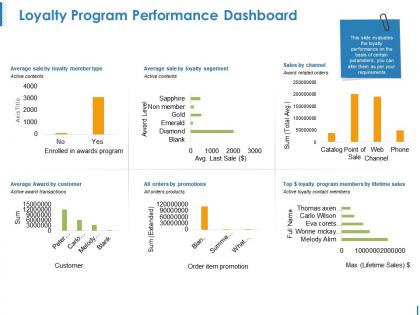
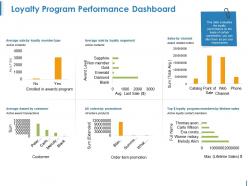
Loyalty program performance dashboard ppt icon




Try Before you Buy Download Free Sample Product
 Impress Your
 Audience
 100%
100% Editable
 Save Hours
 of Time


Our Loyalty Program Performance Dashboard Ppt Icon ensure amicable behaviour. Your thoughts encourage genial interaction.
People who downloaded this PowerPoint presentation also viewed the following :
Loyalty program performance dashboard ppt icon with all 5 slides:
Our Loyalty Program Performance Dashboard Ppt Icon allow for an informal exchange. Ideas get discussed in an amicable fashion.
FAQs for Loyalty program performance
Key loyalty program metrics include customer retention rates, program enrollment growth, average transaction values, point redemption rates, and member lifetime value. These metrics enable businesses to track engagement effectiveness, identify high-value customer segments, and optimize reward structures, with many retail and hospitality organizations finding that comprehensive dashboards ultimately drive stronger customer relationships and increased revenue per member.
Data visualization enhances loyalty program understanding by transforming complex metrics into clear charts, graphs, and heat maps that reveal customer behavior patterns, engagement trends, and program ROI instantly. Through interactive dashboards, retail managers can identify high-value customer segments, track redemption rates, and optimize reward structures, ultimately delivering improved customer retention and increased program profitability.
Customer behaviors most indicative of loyalty program success include frequent repeat purchases, high engagement with program communications, active point redemption, cross-category spending, and consistent participation over extended periods. Through tracking these metrics, retailers and service providers streamline customer retention strategies, enhance lifetime value calculations, and deliver personalized experiences, with many organizations finding that engaged members generate 20-30% higher revenue than non-participants.
Dashboard insights determine loyalty program ROI by tracking member acquisition costs, repeat purchase rates, average transaction values, and customer lifetime value increases. Through automated analytics, businesses calculate cost-per-acquisition versus retention revenue, monitor redemption patterns, and measure incremental sales growth, with many retail and hospitality companies finding that comprehensive tracking delivers 15-25% higher program profitability and clearer strategic optimization opportunities.
Customer segmentation enables targeted analysis of loyalty program performance by dividing members into distinct groups based on demographics, purchasing behavior, engagement levels, and program participation patterns. This strategic approach allows businesses to identify high-value segments, tailor personalized rewards and communications, and optimize program features for different customer types, ultimately delivering enhanced retention rates and increased program ROI.
Loyalty program performance dashboards should be updated daily for operational metrics like redemptions and sign-ups, weekly for engagement trends and campaign performance, and monthly for comprehensive ROI analysis. This tiered approach enables program managers to respond quickly to immediate issues while tracking long-term strategic outcomes, with many retail and hospitality brands finding that real-time visibility drives significantly better program optimization.
Data collection challenges include inconsistent customer information across touchpoints, integration difficulties between multiple systems, privacy compliance requirements, and incomplete transaction tracking. These obstacles can significantly impact dashboard accuracy, though many retailers find that implementing unified customer data platforms and automated collection processes ultimately streamlines operations while enhancing program effectiveness.
Businesses can leverage dashboard data for loyalty program A/B testing by comparing reward structures, communication timing, personalization strategies, and engagement mechanisms across different customer segments. Through real-time analytics, retailers and hospitality companies can test point multipliers, tier benefits, and promotional offers, ultimately optimizing program performance while delivering enhanced customer experiences and increased retention rates.
Business intelligence platforms like Tableau and Power BI, customer data platforms such as Segment, analytics tools including Google Analytics, CRM systems like Salesforce, and specialized loyalty software such as LoyaltyLion excel at dashboard creation. These technologies streamline performance tracking by integrating customer data, automating reporting, and delivering real-time insights, with many retailers finding enhanced program optimization and strategic decision-making capabilities.
Integrating social media data enhances loyalty program dashboards by revealing customer sentiment patterns, engagement preferences across platforms, brand advocacy levels, and demographic insights beyond traditional purchase behavior. This strategic combination enables retailers and hospitality brands to identify their most influential customers, predict churn risks more accurately, and personalize rewards based on social engagement, ultimately delivering deeper customer understanding and competitive advantage.
A loyalty program dashboard reveals emerging customer preference trends through real-time redemption pattern analysis, demographic behavior shifts, engagement metric changes, and purchase frequency variations across different reward categories. By tracking these data points, retailers and service providers can identify shifting preferences like sustainability focus or experiential rewards, enabling proactive program adjustments that enhance customer satisfaction and competitive positioning.
Comparative benchmarks are highly effective for evaluating loyalty program performance, providing essential context through industry standards, competitor analysis, and cross-sector comparisons that reveal strengths and improvement opportunities. These benchmarks enable retailers, hospitality brands, and financial institutions to identify performance gaps, optimize reward structures, and enhance member engagement strategies, ultimately delivering improved customer retention and competitive advantage in increasingly crowded markets.
When interpreting low engagement metrics, focus areas should include member onboarding effectiveness, reward relevance and attainability, communication frequency and channels, program complexity, and competitive positioning analysis. These assessments enable organizations to identify specific friction points, optimize reward structures, and enhance member experiences, with many retail and hospitality brands finding that targeted improvements in these areas significantly boost participation rates and long-term customer retention.
Customer feedback from loyalty programs enhances dashboards by integrating satisfaction scores, preference data, and behavioral insights directly into performance metrics, enabling real-time sentiment tracking and personalized campaign optimization. Through advanced analytics, retailers and hospitality brands can identify service gaps, predict churn risks, and tailor rewards offerings, ultimately delivering improved customer experiences and stronger program engagement rates.
Ethical considerations include ensuring transparent data collection practices, protecting customer privacy through robust security measures, obtaining proper consent for data usage, and presenting metrics without manipulation or bias. While comprehensive tracking enhances program effectiveness, organizations must balance analytical insights with customer trust, ensuring data transparency and avoiding discriminatory practices that could alienate participants.
-
Perfect template with attractive color combination.
-
Perfect template with attractive color combination.