

Managing input process output powerpoint graphics




Try Before you Buy Download Free Sample Product
 Impress Your
 Audience
 100%
100% Editable
 Save Hours
 of Time


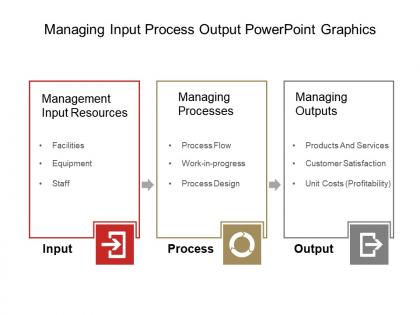
For maximizing your team's performance and understating their performance, you need to incorporate our managing input process output PowerPoint slideshow. This presentation template highlights a visual process which explains the management of processes that transform inputs into goods and services that add value for the customer. The slide is fully editable with text boxes where you can add your own content as per your need. Management of input resources include facilities, equipment and staff. Managing processes includes process flow, work in progress and process design. And managing outputs includes final products and services produced, customer satisfaction and profitability. You can also showcase the concept of operations management and workflow management with the help of our managing input process output PPT visual. Make a mark on your team and audience with our input output model presentation slide and showcase the steps needed to manage and control your business operations. Download the slideshow now. Assessments are accurate to the core with our Managing Input Process Output Powerpoint Graphics. They help eradicate errors.
People who downloaded this PowerPoint presentation also viewed the following :
Managing input process output powerpoint graphics with all 5 slides:
Click away and achieve your goal with our Managing Input Process Output Powerpoint Graphics. They are a boon of the digital age.

FAQs for Managing input process
The fundamental components of the IPO model include inputs (raw materials, data, resources), processes (transformation activities, operations, procedures), and outputs (final products, results, deliverables). This framework enables organizations to streamline operations by identifying resource requirements, optimizing transformation workflows, and measuring deliverable quality, with many businesses finding that systematic IPO analysis enhances operational efficiency and strategic decision-making.
The IPO model enhances project management efficiency by clearly defining inputs like resources and requirements, establishing structured processes for task execution and quality control, and specifying measurable outputs with success criteria. This systematic approach streamlines resource allocation, minimizes scope creep, and ensures consistent deliverables, with many organizations finding that IPO implementation reduces project timelines while improving stakeholder alignment and accountability.
Feedback in the IPO model creates continuous improvement loops by monitoring outputs, identifying process inefficiencies, and refining inputs to enhance overall system performance. Through real-time feedback mechanisms, organizations streamline operations, reduce errors, and optimize resource allocation, with many manufacturing and service companies finding that systematic feedback ultimately delivers enhanced quality control, faster response times, and sustained competitive advantage.
Yes, the IPO model can significantly streamline software development operations by clarifying inputs like requirements and resources, defining structured processes for coding and testing, and establishing clear output specifications. Development teams in fintech, healthcare software, and enterprise applications use this framework to minimize rework, enhance collaboration between stakeholders, and accelerate delivery timelines while maintaining quality standards.
The IPO model helps identify bottlenecks by systematically examining each stage—input acquisition, processing efficiency, and output delivery—to pinpoint where delays, resource constraints, or quality issues occur. Through this structured analysis, organizations can isolate specific problem areas, whether it's inadequate raw materials, inefficient workflows, or output quality control, ultimately streamlining operations and enhancing overall productivity.
Best practices for defining inputs in the IPO framework include identifying all data sources, establishing clear input specifications, implementing validation protocols, documenting input requirements, and creating feedback mechanisms for continuous improvement. These practices enable organizations to streamline data collection, minimize processing errors, and enhance output quality, with many businesses finding that structured input definition ultimately delivers improved operational efficiency and more reliable business outcomes.
Organizations measure IPO model effectiveness through key performance indicators like cycle time, quality metrics, cost per unit, and output accuracy, combined with input efficiency ratios and process variance analysis. Many businesses implement dashboard systems tracking these metrics across departments, enabling real-time optimization and continuous improvement while identifying bottlenecks that impact overall operational performance.
Common IPO model implementation challenges include unclear input specifications, inconsistent process documentation, inadequate output measurement systems, poor stakeholder alignment, and insufficient resource allocation. These obstacles can significantly impact operational efficiency and decision-making accuracy, with many organizations finding that thorough planning, cross-functional collaboration, and iterative refinement ultimately deliver streamlined processes and measurable business outcomes.
The IPO model differs from other process modeling techniques by offering simplified linear progression, focusing purely on transformation stages rather than complex workflows, and emphasizing clear input-output relationships without detailed intermediate steps. While techniques like BPMN or flowcharts map intricate processes, the IPO model streamlines understanding for stakeholders across manufacturing, software development, and service industries, ultimately delivering clearer communication and faster conceptual grasp.
The IPO model adapts to service industries by treating customer requests, information, and resources as inputs, service delivery processes as transformations, and customer satisfaction, completed services, and outcomes as outputs. Banks use this framework for loan processing, hospitals for patient care workflows, and retail companies for customer service interactions, ultimately streamlining operations and enhancing service quality while delivering measurable customer experiences.
The IPO model assists in data analysis and decision-making by structuring raw data collection as input, applying analytical techniques and algorithms as processing, and generating actionable insights as output. This systematic approach enables organizations to transform complex datasets into strategic recommendations, streamline decision workflows, and minimize analytical errors, with many financial services and retail companies finding that structured IPO frameworks ultimately deliver faster, more reliable business intelligence and competitive advantage.
Tools facilitating IPO model implementation include process mapping software like Visio, workflow automation platforms such as Zapier, project management systems like Asana, business intelligence tools including Tableau, and enterprise resource planning solutions. These technologies streamline operations by standardizing inputs, automating processes, and generating consistent outputs, with many organizations finding that strategic integration ultimately delivers enhanced efficiency and competitive advantage.
The IPO model supports continuous improvement by creating systematic feedback loops between outputs and inputs, enabling organizations to identify inefficiencies, measure performance gaps, and implement targeted process refinements. Through structured analysis of each component, businesses in manufacturing, healthcare, and financial services can streamline operations, reduce waste, and enhance quality control, ultimately delivering measurable improvements and sustained competitive advantage.
The IPO model effectively supports educational settings by structuring curriculum design, lesson planning, assessment strategies, and learning management systems. Educational institutions leverage this framework to transform student inputs like prior knowledge and learning materials into desired outputs such as improved test scores, skill development, and academic achievements, while teachers use systematic processing methods including interactive lectures, collaborative projects, and formative assessments to maximize learning outcomes.
McDonald's exemplifies successful IPO application by transforming raw ingredients (inputs) through standardized cooking processes into consistent meals (outputs), achieving global scalability and operational efficiency. Similarly, Toyota's production system converts materials and labor through lean manufacturing processes into reliable vehicles, while Amazon transforms customer orders through automated fulfillment processes into rapid deliveries, ultimately delivering competitive advantage through streamlined operations.
-
Awesomely designed templates, Easy to understand.
-
Unique design & color.