


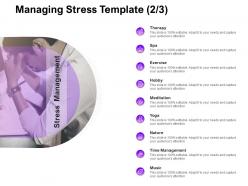
Managing stress time management ppt powerpoint presentation pictures





Try Before you Buy Download Free Sample Product
 Impress Your
 Audience
 100%
100% Editable
 Save Hours
 of Time


You have the co-ordinates for your destination of sucess. Let our Managing Stress Time Management Ppt Powerpoint Presentation Pictures map out your journey.
People who downloaded this PowerPoint presentation also viewed the following :
Managing stress time management ppt powerpoint presentation pictures with all 2 slides:
Our Managing Stress Time Management Ppt Powerpoint Presentation Pictures are like the strings of a tennis racquet. Well strung to help you serve aces.
FAQs for Managing stress time management ppt
Effective presentation techniques for managing workplace stress include clear visual storytelling, structured problem-solution frameworks, interactive stress assessment tools, mindfulness integration slides, and actionable coping strategies. These approaches streamline communication by engaging audiences emotionally, providing practical implementation steps, and creating shared understanding across teams, with many organizations finding that visual stress management presentations enhance employee wellbeing while improving overall productivity.
Visual aids enhance stress management presentations by transforming abstract concepts into digestible formats through infographics, flowcharts, before-and-after scenarios, interactive timelines, and symptom-solution matrices. These tools streamline complex psychological processes, enable audiences to visualize techniques like breathing exercises or workflow optimization, and ultimately deliver better retention and practical implementation, with many organizations finding that visual presentations significantly improve employee engagement and stress reduction program adoption.
Storytelling transforms abstract stress management concepts into relatable, memorable experiences by creating emotional connections, illustrating real-world applications, and demonstrating practical outcomes through narrative examples. Through compelling case studies and personal journeys, organizations enhance employee training programs, healthcare providers improve patient education, and wellness coaches deliver more impactful interventions, ultimately increasing engagement and long-term behavioral change.
Presenters can tailor stress management messages by analyzing audience demographics, professional roles, stress triggers, and preferred communication styles, then customizing content accordingly. Healthcare workers might need strategies for high-pressure environments while corporate executives require time management techniques, with many presenters finding that interactive workshops and role-specific examples deliver significantly better engagement and practical outcomes.
Common misconceptions about stress management include believing stress is always harmful, that elimination is the goal, that one-size-fits-all solutions work universally, and that stress management requires extensive time commitments. These misunderstandings can be addressed by presenting evidence-based approaches that demonstrate how controlled stress enhances performance, with healthcare organizations and corporate wellness programs finding that targeted, personalized strategies deliver sustainable outcomes.
**INPUT**: How can mindfulness practices be incorporated into a presentation on stress reduction? **OUTPUT**: Mindfulness practices can be incorporated through guided breathing exercises, body scan demonstrations, meditation techniques, visualization activities, and progressive muscle relaxation segments. These interactive elements enhance audience engagement by providing immediate stress relief tools, with many organizations finding that hands-on mindfulness experiences during presentations ultimately deliver better retention and practical application in workplace settings.
Effective visuals for illustrating stress's physiological effects include body system diagrams, before-and-after comparison charts, infographic flowcharts, anatomical cross-sections, and data visualization dashboards showing biomarker changes. These visual tools streamline complex medical concepts by highlighting affected organs, mapping stress pathways, and displaying measurable impacts like cortisol levels, ultimately enhancing audience comprehension and engagement across healthcare, corporate wellness, and educational presentations.
Interactive elements in presentations foster engagement and stress relief by encouraging active participation, creating collaborative environments, and shifting focus from performance anxiety to audience connection. Through polls, Q&A sessions, and hands-on activities, presenters reduce their own stress while enhancing audience involvement, ultimately delivering more memorable experiences and building confidence for future presentations.
Statistical data supporting stress management claims should include workplace stress prevalence rates, productivity loss percentages, healthcare cost impacts, absenteeism figures, and employee turnover statistics. These metrics enable organizations to demonstrate ROI potential through reduced medical expenses, improved performance outcomes, and enhanced retention rates, with many companies finding that comprehensive stress management programs deliver measurable cost savings and competitive advantages.
Presenters can ensure sensitivity by using inclusive language, acknowledging diverse stress experiences across cultures and backgrounds, avoiding assumptions about personal circumstances, and creating safe spaces for optional participation. They should research cultural differences in stress perception, provide multiple coping strategies rather than one-size-fits-all solutions, and emphasize that stress responses vary significantly, with many organizations finding that culturally aware approaches enhance employee engagement and psychological safety.
Humor can be effectively integrated through relatable anecdotes about workplace stress, self-deprecating stories about personal stress experiences, light-hearted analogies comparing stress to everyday situations, and interactive elements like funny polls or quizzes. These approaches help healthcare professionals, corporate trainers, and wellness coaches create engaging presentations that reduce audience anxiety while delivering serious stress management techniques, ultimately making educational content more memorable and actionable.
Follow-up resources should include practical stress assessment tools, guided meditation apps, downloadable coping strategy worksheets, recommended reading lists, and access to employee assistance programs. These materials enhance presentation impact by enabling ongoing skill development, providing immediate stress relief techniques, and connecting employees with professional support services, ultimately delivering sustained workplace wellness and improved organizational productivity.
Presenters can measure effectiveness through audience feedback surveys, pre-and post-presentation stress assessments, engagement metrics like participation rates, and follow-up evaluations tracking behavior changes. These measurement approaches enable organizations to enhance employee wellbeing programs, reduce workplace stress-related costs, and improve productivity, with many companies finding that systematic evaluation ultimately delivers better stress management outcomes and stronger employee retention.
A compelling stress management presentation outline includes clear problem identification, evidence-based solutions, practical implementation strategies, real-world case studies, and measurable outcomes. These components work together by establishing credibility through data, providing actionable techniques like mindfulness and time management, and demonstrating success stories from healthcare organizations and corporate wellness programs, ultimately delivering improved productivity and employee wellbeing.
Technology enhances stress management presentations through interactive meditation apps, biometric monitoring demonstrations, virtual reality relaxation scenarios, and real-time stress tracking tools. These digital solutions streamline audience engagement by providing hands-on experiences, personalized wellness assessments, and immediate feedback mechanisms, with many healthcare organizations and corporate wellness programs finding that interactive presentations deliver significantly improved participant retention and practical skill adoption.
No Reviews