


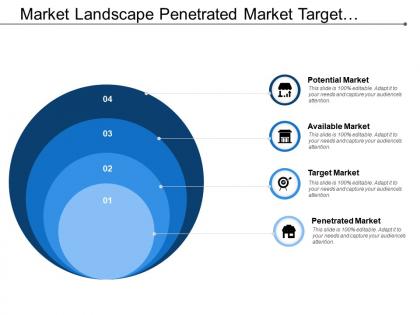
Market landscape penetrated market target market available market




Try Before you Buy Download Free Sample Product
 Impress Your
 Audience
 100%
100% Editable
 Save Hours
 of Time


Be assured of having the correct facts and figures with our Market Landscape Penetrated Market Target Market Available Market. Get all calculations bang on.
People who downloaded this PowerPoint presentation also viewed the following :
Market landscape penetrated market target market available market with all 5 slides:
Every individual feels included due to our Market Landscape Penetrated Market Target Market Available Market. It helps handle feelings of alienation.

FAQs for Market landscape penetrated market target
Effective market segmentation criteria include measurability, accessibility, substantiality, actionability, and differentiability. These criteria ensure segments can be quantified, reached through marketing channels, and generate sufficient revenue, while enabling businesses across industries like retail, healthcare, and financial services to develop targeted strategies, optimize resource allocation, and ultimately deliver personalized customer experiences that drive competitive advantage.
Businesses identify target audiences through demographic analysis, psychographic profiling, behavioral tracking, geographic mapping, and needs-based research to understand customer preferences, purchasing patterns, and pain points. Through data analytics and market research, companies can segment customers by age, income, lifestyle, location, and buying behavior, ultimately creating focused marketing strategies that deliver higher conversion rates and customer satisfaction.
Demographic segmentation divides markets by age, income, gender, and education, while psychographic segmentation focuses on lifestyle, values, and personality traits, and behavioral segmentation examines purchase patterns, brand loyalty, and usage frequency. These strategic approaches enable organizations to tailor marketing messages more precisely, with retail companies increasingly finding that combining all three methods delivers enhanced customer targeting and competitive advantage.
Geographic segmentation significantly impacts marketing strategies by enabling location-specific targeting, cultural adaptation, climate-based product positioning, and regional pricing optimization. Through geographic insights, companies tailor messaging for local preferences, adjust distribution channels for accessibility, and customize promotions for regional events, ultimately delivering more relevant customer experiences and competitive advantage in diverse markets.
Market segmentation analysis utilizes demographic surveys, psychographic profiling, behavioral analytics, geographic mapping, and customer journey analysis to identify distinct consumer groups. These techniques enable businesses to streamline targeting strategies, enhance personalized marketing campaigns, and optimize resource allocation, with many retail and financial services organizations finding that strategic segmentation ultimately delivers improved customer experiences and competitive advantage.
Companies can measure segmentation success through customer acquisition costs, retention rates, conversion metrics, revenue per segment, and lifetime value analysis. By tracking engagement levels, purchase frequency, and campaign response rates across different segments, organizations can identify which approaches deliver higher profitability and stronger customer relationships, ultimately optimizing resource allocation and competitive positioning.
Data analytics enables businesses to refine market segmentation by analyzing customer behavior patterns, purchase histories, demographic trends, and engagement metrics to identify distinct consumer groups. Through advanced analytics tools, organizations can uncover hidden segments, predict customer preferences, and optimize targeting strategies, ultimately delivering more personalized marketing campaigns and improved ROI.
Cultural factors significantly influence market segmentation by shaping consumer preferences, purchasing behaviors, communication styles, and value systems across different demographic groups. Companies increasingly adapt their segmentation strategies to account for cultural nuances, language preferences, and social customs, with businesses in retail, food services, and technology finding that culturally-informed segmentation delivers more targeted marketing and stronger customer connections.
Common market segmentation pitfalls include over-segmenting markets, creating segments too small to be profitable, relying on outdated demographic data, ignoring behavioral patterns, and failing to validate segment viability. These missteps often result from insufficient research or rigid assumptions, with many organizations finding that regular segment analysis and customer feedback ultimately deliver more accurate targeting and sustainable competitive advantage.
Small businesses can implement market segmentation through cost-effective methods like social media analytics, customer surveys, Google Analytics data, and direct customer feedback to identify distinct customer groups. By focusing on one or two profitable segments initially, small businesses streamline their marketing efforts, reduce costs, and achieve higher conversion rates than broad-targeting approaches.
Niche market segmentation enables startups to maximize limited resources, build deeper customer relationships, reduce marketing costs, and establish competitive differentiation in focused areas. By targeting specific customer segments, startups can develop specialized expertise, command premium pricing, and achieve faster market penetration, with many technology and service companies finding that concentrated efforts deliver stronger brand recognition and customer loyalty than broad-market approaches.
Market segmentation contributes to personalized marketing by enabling businesses to divide their audience into distinct groups based on demographics, behaviors, preferences, and purchasing patterns. Through targeted messaging and customized content, companies in retail, financial services, and healthcare deliver more relevant campaigns, improve customer engagement rates, and increase conversion effectiveness, ultimately enhancing customer experiences while maximizing marketing ROI.
Market segmentation evolves through dynamic demographic shifts, behavioral pattern analysis, psychographic profiling updates, and real-time preference tracking. As consumer values change, companies leverage advanced analytics and AI-driven insights to identify emerging micro-segments, enabling more personalized targeting strategies that deliver enhanced customer experiences and competitive advantage in increasingly fragmented markets.
Artificial intelligence transforms market segmentation through enhanced data analysis, predictive modeling, real-time personalization, automated customer clustering, and behavioral pattern recognition. These AI capabilities enable businesses to identify micro-segments with unprecedented precision, deliver personalized experiences at scale, and adapt segmentation strategies dynamically, with retailers and financial services finding significantly improved customer targeting and conversion rates.
Businesses maintain relevant segmentation through continuous market research, regular customer data analysis, and periodic strategy reviews to adapt to evolving consumer behaviors and preferences. By monitoring demographic shifts, purchasing patterns, and competitive landscapes, companies like retail chains and financial services can proactively adjust their segments, ultimately delivering more targeted marketing and sustained competitive advantage.
-
Appreciate the research and its presentable format.
-
Perfect template with attractive color combination.