


Marketing Team Hierarchy Structure Model Optimizing E Commerce Marketing Program




Try Before you Buy Download Free Sample Product
 Impress Your
 Audience
 100%
100% Editable
 Save Hours
 of Time


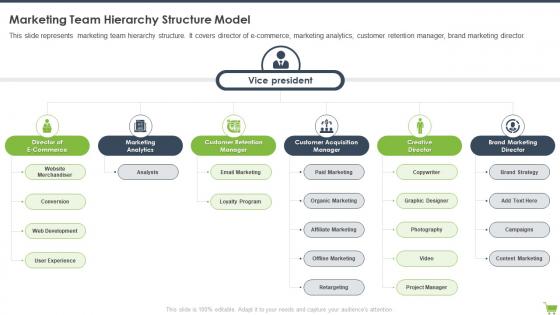
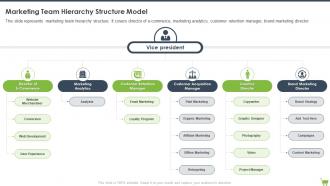
This slide represents marketing team hierarchy structure. It covers director of e commerce, marketing analytics, customer retention manager, brand marketing director.
People who downloaded this PowerPoint presentation also viewed the following :
Marketing Team Hierarchy Structure Model Optimizing E Commerce Marketing Program with all 6 slides:
Use our Marketing Team Hierarchy Structure Model Optimizing E Commerce Marketing Program to effectively help you save your valuable time. They are readymade to fit into any presentation structure.





FAQs for Marketing Team Hierarchy Structure Model Optimizing E
Key components include brand positioning, customer segmentation, channel optimization, content strategy, and performance analytics. These elements work together by establishing clear market positioning, targeting specific customer groups through optimized digital channels, and delivering personalized content experiences, with many e-commerce businesses finding that this integrated approach significantly enhances conversion rates and customer lifetime value.
Understanding customer personas significantly influences e-commerce marketing strategies by enabling targeted messaging, personalized product recommendations, optimized channel selection, and strategic content creation. Through detailed persona analysis, e-commerce businesses streamline their marketing efforts, enhance customer experiences with relevant communications, and ultimately deliver higher conversion rates and improved ROI across their campaigns.
Data analytics play a crucial role in optimizing e-commerce marketing hierarchies by identifying high-performing channels, measuring customer acquisition costs, tracking conversion rates across touchpoints, and revealing attribution patterns between marketing layers. Through advanced analytics platforms, retailers can reallocate budgets strategically, personalize customer journeys, and streamline campaign performance, ultimately delivering improved ROI and competitive advantage in increasingly data-driven markets.
Businesses integrate social media by establishing consistent brand messaging across platforms, leveraging targeted advertising for customer acquisition, using social commerce features for direct sales, and implementing influencer partnerships for broader reach. These strategies work together within the marketing hierarchy by driving awareness at the top funnel, nurturing consideration through engaging content, and ultimately converting followers into customers through seamless shopping experiences.
E-commerce SEO best practices include optimizing product pages with detailed descriptions, implementing structured data markup, creating category-specific landing pages, building high-quality backlinks, and ensuring fast site speed. These strategies enhance search visibility by improving product discoverability, reducing bounce rates, and increasing organic traffic, with many retailers finding that comprehensive SEO integration ultimately delivers higher conversion rates and sustainable competitive advantage.
Email marketing drives e-commerce success through personalized product recommendations, automated cart abandonment sequences, segmented customer campaigns, and targeted promotional offers based on purchase history. These strategies enhance customer retention and conversion rates, with many online retailers finding that personalized email campaigns generate significantly higher revenue per recipient than generic broadcasts, ultimately delivering measurable ROI and sustained customer engagement.
Common pitfalls include creating too many management layers, unclear role definitions, inadequate communication channels, lack of cross-functional collaboration, and misaligned KPIs across teams. These structural issues often result in slower decision-making, duplicated efforts, and conflicting campaign messages, with many e-commerce companies finding that streamlined hierarchies with clear accountability ultimately deliver faster market responses and improved customer experiences.
Mobile optimization serves as a foundational element in e-commerce marketing strategy by enhancing user experience, improving search rankings, and increasing conversion rates across all customer touchpoints. With mobile commerce driving significant revenue growth, retailers like fashion brands and electronics stores find that responsive design, fast loading speeds, and streamlined checkout processes ultimately deliver higher engagement and competitive advantage.
User experience significantly impacts e-commerce conversions by influencing every stage of the marketing hierarchy, from initial awareness through final purchase and retention decisions. Through streamlined navigation, faster load times, and intuitive checkout processes, retailers enhance customer satisfaction, reduce cart abandonment rates, and increase repeat purchases, with many e-commerce businesses finding that superior UX delivers measurable competitive advantage and revenue growth.
Businesses balance brand awareness and direct sales by implementing a tiered approach that combines upper-funnel brand building through content marketing, social media engagement, and thought leadership with lower-funnel conversion tactics like retargeting, email campaigns, and promotional offers. This strategic combination enables companies to build long-term customer relationships while driving immediate revenue, with many retail and e-commerce organizations finding that consistent brand messaging across all hierarchy levels ultimately delivers both sustained growth and competitive market positioning.
Essential metrics vary by hierarchy level, including conversion rates, customer acquisition costs, return on ad spend, lifetime value, and attribution analysis across touchpoints. Through comprehensive tracking systems, e-commerce businesses monitor funnel performance, campaign effectiveness, and customer journey optimization, while advanced analytics enable strategic decisions that ultimately enhance profitability and competitive positioning.
Content marketing enhances e-commerce strategies by building brand authority, driving organic traffic, nurturing customer relationships, and supporting conversion optimization throughout the buyer's journey. Through strategic blog posts, product guides, and social content, retailers create valuable touchpoints that educate prospects, reduce acquisition costs, and ultimately increase customer lifetime value and retention rates.
Customer retention strategies hold critical significance in e-commerce marketing hierarchies because they cost significantly less than acquisition, generate higher lifetime values, and create sustainable revenue streams through repeat purchases and referrals. These strategies enable businesses to maximize existing customer relationships while reducing marketing spend, with many retailers finding that loyal customers spend 67% more than new ones, ultimately delivering improved profit margins and competitive advantage in increasingly crowded digital marketplaces.
Partnerships and collaborations elevate e-commerce marketing by expanding reach, sharing resources, and accessing new customer segments through cross-promotion, co-branded campaigns, and strategic alliances. These relationships enable businesses to leverage complementary strengths, reduce marketing costs, and enhance credibility, with many retailers finding that collaborative efforts deliver significantly higher conversion rates and market penetration than standalone campaigns.
Emerging trends include AI-powered personalization, omnichannel customer journey mapping, social commerce integration, voice search optimization, and sustainable marketing practices. These developments are reshaping how businesses structure their marketing priorities, with many companies finding that data-driven automation and authentic brand storytelling increasingly drive customer acquisition and retention in competitive digital markets.
-
Illustrative design with editable content. Exceptional value for money. Highly pleased with the product.
-
I downloaded some of the presentations for work. They were simple to modify and saved me a lot of time and effort.