


Marketing Department Organizational Structure Offline Marketing Guide To Increase Strategy SS




Try Before you Buy Download Free Sample Product
 Impress Your
 Audience
 100%
100% Editable
 Save Hours
 of Time


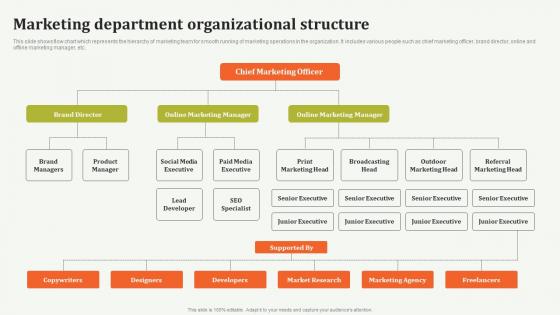
This slide shows flow chart which represents the hierarchy of marketing team for smooth running of marketing operations in the organization. It includes various people such as chief marketing officer, brand director, online and offline marketing manager, etc.
People who downloaded this PowerPoint presentation also viewed the following :
Marketing Department Organizational Structure Offline Marketing Guide To Increase Strategy SS with all 6 slides:
Use our Marketing Department Organizational Structure Offline Marketing Guide To Increase Strategy SS to effectively help you save your valuable time. They are readymade to fit into any presentation structure.





FAQs for Marketing Department Organizational Structure Offline Marketing Guide To
So basically every marketing team needs a few key people. Someone has to run strategy - that's your marketing manager or director. Content creators are huge too, handling blogs, social posts, all that copy work. Digital marketing is its own beast with SEO and paid ads. Marketing coordinators might not sound glamorous but trust me, they're literally holding everything together with project management magic. Bigger companies usually add specialists like brand managers, PR people, or analysts diving into performance data. I'd honestly figure out which gap is killing you most right now and start there.
Honestly, your marketing structure makes or breaks everything. Too many layers? Decisions take forever and you miss opportunities. No structure at all? Total chaos with everyone stepping on each other's toes. What works is having clear owners for different areas - someone owns digital, another handles content, etc. They can make quick calls but still talk to each other. I've seen teams go from launching campaigns in months to weeks just by fixing this. Oh, and your sales team will actually like you when leads aren't all over the place.
So basically it comes down to who's calling the shots on marketing stuff. Centralized means one team (usually at corporate) controls everything - all the campaigns, messaging, budget decisions. With decentralized, different regions or product teams can do their own thing and create campaigns that actually make sense for their local market. Centralized keeps your branding consistent and saves money, but decentralized lets you move faster and connect better with specific audiences. Most companies I've seen do a mix honestly - like they'll keep brand guidelines centralized but let regions handle their own social media or local events. Really depends on how big you are and whether you're selling to totally different markets.
So cross-functional teams are basically about getting marketing, sales, and product to actually talk to each other instead of working in separate bubbles. You'll see way better results when your marketing team collaborates directly with sales on campaigns - no more of that "throw it over the wall" nonsense. Having different expertise in the room helps too, like getting a data analyst to optimize campaigns instead of just winging it. Honestly, I'd start small though. Pick one project, maybe a product launch, and loop in sales and customer success from the beginning. It's a game changer once people get used to it.
Marketing leadership is all about balancing strategy with people management. Numbers are your best friend - you'll be diving deep into analytics to figure out what's actually working. Plus there's tons of presenting to executives and working with other teams, which honestly gets draining sometimes. The stakeholder stuff? Ugh, some days it's a lot. You need to keep up with digital trends and really get customer psychology too. My biggest tip: get solid with presentation skills and learn analytics tools like Google Analytics or Tableau now. Those will save you later.
So digital transformation basically breaks down all those old marketing silos - you know how brand, digital, and product teams used to barely talk? That's gone now since everything flows through digital anyway. The crazy thing is junior people suddenly get access to analytics that only executives could see before. Instead of having separate teams for email, social, whatever, you're looking at customer journey pods now. Oh and definitely figure out who can learn multiple platforms - honestly that's where you'll see the biggest wins. Your whole org just gets flatter and way more data-driven.
Honestly, you gotta track the stuff that actually matters - like how fast your team can pump out campaigns and whether people are collaborating or just siloing themselves. Revenue attribution is obvious but don't sleep on employee satisfaction scores. Miserable people = high turnover = constant chaos. Decision-making speed matters too, plus knowledge sharing between teams. The trick is measuring before and after you change things up (kinda like A/B testing your whole org structure, which sounds weird but works). That way you'll know if you're fixing problems or just creating new ones.
Try breaking your campaigns into 2-week chunks with specific goals instead of those marathon planning sessions. Daily 15-minute check-ins are a game changer - you'll catch issues before they blow up. I learned this the hard way when our whole team was blindsided by a bottleneck nobody mentioned. Trello works great for keeping track of everything visually. After each sprint, spend 30 minutes figuring out what sucked and what didn't. Honestly, the retrospectives are where you actually improve. Start with just one team first - don't go crazy trying to change everything at once.
Honestly, the hardest part is losing those random creative moments - you know when someone just blurts out "what if we..." and suddenly you've got gold? That stuff barely happens on Zoom calls. Time zones become a nightmare for keeping everyone aligned, and creative reviews feel so awkward when you're all staring at screens instead of gathered around layouts. Client pitches definitely hit different virtually too (and not in a good way). My advice? Block out actual brainstorming time on calendars and communicate project timelines way more than feels necessary. Oh, and accept that maintaining creative energy with a scattered team takes real effort.
Dude, you absolutely need marketing and other teams talking to each other. Sales will tell you what customers actually complain about - that stuff is gold. Product team keeps you in the loop about new features or if something's getting delayed. Otherwise you'll promise things that don't exist yet (been there, super awkward). I've watched campaigns completely bomb because marketing had no clue what was happening elsewhere. Quick sync meetings work well. Maybe weekly? Just make sure everyone's chasing the same numbers at the end of the day.
Dude, marketing teams are getting totally flipped upside down by all this tech stuff. Those old department walls are crumbling fast - your content people actually have to talk to the data nerds now (which honestly makes way more sense). Everyone's gotta be way more flexible and understand at least basic analytics. Marketing automation tools basically force teams to collaborate whether they want to or not. The companies doing it right? They're organizing around the actual customer experience instead of just "social media team" vs "email team." Oh, and make sure your whole crew has some tech skills or they'll get left behind pretty quick.
Honestly, forget rigid department structures - you need teams that can actually pivot when things change. Set up cross-functional pods instead of those annoying silos everyone gets trapped in. Weekly sentiment tracking is clutch, plus you'll want dedicated people watching trends and competitors (trust me on this one). Most companies get stuck planning quarterly while the market shifts every few weeks, which is just... ugh. Create workflows where insights hit your creative teams fast. Oh, and let people experiment without freaking out about failures - that's literally how you stay ahead instead of scrambling to catch up all the time.
Honestly, start with dedicated Slack channels and regular stand-ups - sounds basic but it works. Keep those weekly meetings short though, nobody needs another hour of rambling about metrics (been there, suffered through that). Document everything somewhere everyone can actually see it. Oh, and don't forget about other teams - sales, product, customer success. They're not the enemy, promise. Pick your communication tools and actually stick with them. The whole thing only works if people make it a habit instead of just winging it every time.
Honestly, having different types of people on your team is a game-changer. You'll catch stuff you'd totally miss otherwise - like when campaigns go completely sideways because nobody thought about how they'd land with actual customers. Different backgrounds mean people tackle problems in ways you wouldn't even think of. Brainstorming gets so much better when everyone's not coming from the same place, you know? I've seen teams where everyone thinks alike and their ideas are just... bland. When you're hiring, actually look for diverse voices and make sure people feel comfortable speaking up in meetings.
Honestly, everything's moving toward these flat, agile team structures now. Instead of the old department silos, companies are doing cross-functional "pods" - like having content people, paid ads folks, and analysts all working together on acquiring new customers. Makes way more sense if you ask me. Remote work isn't going anywhere either (thank god). Oh, and there's this big push to hire more tech-savvy people in-house for marketing ops and data stuff. Teams are organizing around actual customer journeys instead of just channels. You should try some small cross-functional projects with your team - see how differently everyone works together.
-
If you have visited their site and failed to find the products, try reaching the customer service because it will be the case that you didn't use the search bar well.
-
SlideTeam is the way to go when you are in a time crunch. Their templates have saved me many times in the past three months.