


Matrix For Prioritising Tech Pain Points




Try Before you Buy Download Free Sample Product
 Impress Your
 Audience
 100%
100% Editable
 Save Hours
 of Time


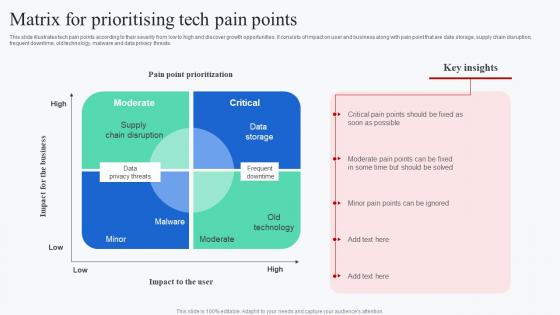
This slide illustrates tech pain points according to their severity from low to high and discover growth opportunities. It consists of impact on user and business along with pain point that are data storage, supply chain disruption, frequent downtime, old technology, malware and data privacy threats.
People who downloaded this PowerPoint presentation also viewed the following :
Matrix For Prioritising Tech Pain Points with all 6 slides:
Use our Matrix For Prioritising Tech Pain Points to effectively help you save your valuable time. They are readymade to fit into any presentation structure.





FAQs for Matrix For Prioritising
Honestly, prioritization saves your ass in project management. It keeps your team focused on stuff that actually matters instead of getting buried in random tasks. I've watched so many projects fail because managers called everything "urgent" - which is basically useless, right? You gotta be brutal about ranking things by impact and how quickly they need done. Then stick to it when people try adding more crap to your plate. My rule? Pick 3 must-dos each week. Everything else goes on the back burner. Sounds simple but it works.
Honestly, these frameworks are game-changers because they stop those annoying "everything's urgent!" fights before they start. Your team gets on the same page about what actually matters. We've been using MoSCoW at work and it's wild how much smoother things run - no more confusion about why something got delayed or fast-tracked. People just get it. Short sentences make decisions faster too. Pick one method and stick with it for your next sprint. I'm telling you, the clarity is insane and you'll wonder why you waited so long to try it.
Honestly? Most people use the Eisenhower Matrix - you know, urgent vs important stuff. There's also MoSCoW (Must have, Should have, etc) and RICE scoring, though half the teams I've worked with just go with their gut anyway lol. Value vs Effort matrices work great for product stuff. ICE framework is dead simple if you need something fast - Impact, Confidence, Ease. Oh, and there's the Kano model for customer satisfaction things. My take? Just pick whatever actually fits how your team operates and don't overthink it. Consistency matters way more than finding the "perfect" system.
Having a solid prioritization system is honestly a lifesaver when dealing with stakeholders. You can point to actual criteria - business impact, deadlines, resources - instead of looking like you're playing favorites. People get way less defensive when they see the logic behind your decisions. I always share my prioritization method early on so everyone knows what we're optimizing for. That way when someone's pet project gets pushed back, they can't really argue with where it landed on the list. Makes those "no, not right now" conversations so much easier to navigate.
So many good options out there! Asana and Trello are pretty solid for ranking stuff and seeing everything visually. Monday.com's another one. If you want something more structured, Productboard works great for product teams - though it might be overkill depending on what you're doing. MindMeister's good for priority mapping too. Honestly? Sometimes I just use a basic spreadsheet with impact vs effort columns and it does the trick. The real thing is finding whatever your team won't abandon after two weeks. Start simple with what feels right, then you can always switch later.
Honestly, I swear by the 70-30 split - spend most of your time on urgent stuff that keeps the lights on, but carve out 30% for bigger picture work. Here's the key though: block out time for the long-term projects FIRST. Otherwise the fires will eat up everything (trust me on this one). Also look for ways to kill two birds with one stone. Like if you're fixing some broken process anyway, why not rebuild it to actually support your bigger goals? Try planning both types of work each week so nothing gets totally ignored.
Honestly, I just focus on three things when my to-do list gets crazy. First - what's actually gonna move me closer to my big goals? That's impact. Then I figure out what has real deadlines vs stuff that just *feels* urgent (guilty of this way too much). Quick wins can be worth it sometimes though, especially when you're feeling stuck. I do this weird thing where I rate everything 1-10 for impact, urgency, and how much effort it'll take, then multiply the numbers. Sounds nerdy but it works better than just going with my gut. The math isn't gonna be perfect, but at least you're not just picking randomly.
Honestly? Most people (including me for way too long) think urgent = important, but that's total BS. Urgent stuff screams for attention right NOW - like that Slack notification going off. But important tasks? Those actually move you forward on stuff that matters. I used to drop everything for every "urgent" email until I realized most were just... whatever. Now I flip it - important first, then the actually urgent stuff. Quick test: if someone says something's urgent, ask yourself if you'll even remember it next week. Usually you won't.
Honestly, you can't manage time well without knowing what actually matters first. I used to waste hours on random busy work (hello, organizing my desk for the third time) until I figured this out. Pick your top 3 things each week - that's your compass. Time management is just how you structure everything around those priorities. Short tasks here, longer focused blocks there. The game-changer? Block time for your big 3 before anything else touches your calendar. Otherwise you'll end up scheduling your life around everyone else's stuff.
Think of prioritization as your game plan when everything hits the fan. When you're drowning in competing demands, it tells you which tasks get your best people and biggest chunk of budget. Without it? You'll spread yourself way too thin and honestly, everything just turns out kinda meh. I've seen this happen so many times. Clear priorities let you confidently pull resources from less critical stuff to keep your most important deliverables moving. Quick tip - rank everything by impact and how urgent it actually is.
Honestly, think of priorities like having a good spam filter for decisions. Instead of debating every single option that comes up, you just ask "does this fit what we said matters most?" Makes choices way faster. Plus it stops that annoying thing where everyone's convinced their project is THE most important one - been there, it's exhausting. The tricky part is actually getting everyone on the same page about what those priorities are. Otherwise you're just adding another layer of confusion to an already messy situation, which defeats the whole point.
Honestly, EQ is huge for prioritization because you start picking up on things like when your team's totally fried or stakeholders are freaking out about specific projects. Yeah, deadlines and business impact still matter, but you're also factoring in what people can realistically handle well vs. what they'll half-ass. When you communicate your decisions, higher emotional intelligence helps you frame things so people actually get on board instead of fighting you. I've noticed that once you start watching for energy levels and stress signals, your prioritization gets way more realistic. People appreciate when you're not just treating them like productivity robots, you know?
Okay so when everything's going crazy, first thing - dump all your tasks on paper. Then be brutally honest: what actually blows up if you skip it today? Those are your real priorities. I always make the mistake of trying to tackle everything at once (spoiler: doesn't work). Pick maybe 3 things that matter most. Got something that takes under 2 minutes? Just do it now instead of adding it to your list. Oh, and set timers for bigger tasks so you don't spend 3 hours perfecting one email. Write your top priorities somewhere you'll see them - trust me, you'll start doubting yourself otherwise.
Don't just hand down decisions from above - get everyone involved in the process. Share whatever framework you're using (impact vs effort, customer value, etc.) then ask for their input on rankings. They usually know way more about technical stuff and dependencies than you do anyway. Dot voting is honestly pretty great for this - give everyone the same number of votes to spread around, then hash out where people disagree. Just be upfront about who's making the final call so there's no confusion later. People are way more bought-in when they feel heard, even if their top choice doesn't win.
Ugh, bad prioritization is such a trap - you'll constantly miss deadlines and burn your team out. Everyone ends up firefighting instead of actually moving forward on stuff that matters. The worst part? Critical projects get sidelined while you waste time on busy work, and then stakeholders start losing faith when you can't deliver on key milestones. Here's what helps: check in with stakeholders regularly about what's actually important right now. Impact vs effort matrices are surprisingly useful for this stuff. Oh, and get comfortable saying no to decent ideas that just aren't the right timing - honestly that's probably the hardest part but makes the biggest difference.
-
Great work on designing the presentation. I just loved it!
-
Great work on designing the presentation. I just loved it!