


Optimizing transformation strawman proposal for business problem solving




Try Before you Buy Download Free Sample Product
 Impress Your
 Audience
 100%
100% Editable
 Save Hours
 of Time


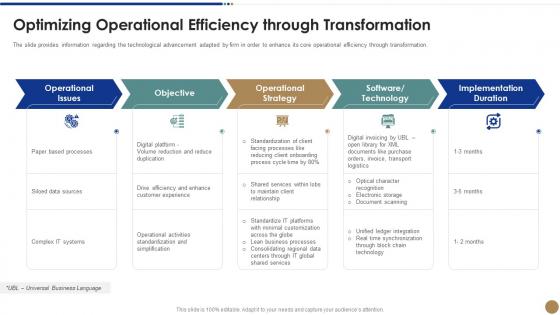
The slide provides information regarding the technological advancement adapted by firm in order to enhance its core operational efficiency through transformation.
People who downloaded this PowerPoint presentation also viewed the following :
Optimizing transformation strawman proposal for business problem solving with all 6 slides:
Use our Optimizing Transformation Strawman Proposal For Business Problem Solving to effectively help you save your valuable time. They are readymade to fit into any presentation structure.





FAQs for Optimizing transformation strawman proposal for
Honestly, start by mapping what you're actually doing right now - most people just dive into "fixing" stuff without knowing their current mess. Look for bottlenecks and anything that wastes time or doesn't help customers. Get your team involved because they deal with the annoying daily stuff way more than you do. Automate the boring repetitive tasks if you can. Always track if changes actually work or you're just spinning wheels. Oh, and don't try fixing everything at once - pick one process and nail it first. Basic stuff is eliminate waste, standardize things, keep improving.
First thing - get your baseline numbers before you change anything. Track the same stuff after (load times, conversions, whatever matters for your project). Don't get caught up in vanity metrics that look cool but are basically useless. A/B testing is clutch when you can swing it - helps you actually see what's working. Mix hard data like response times with user feedback too. Oh and honestly? Start measuring this week or you'll have nothing to compare your results against later. Both quantitative and qualitative data matter here.
Look, data analytics basically tells you what's actually working versus what you think is working. Pretty crucial difference there. You'll spot bottlenecks way faster and can measure if your changes are doing anything meaningful. Otherwise you're just throwing stuff at the wall and hoping it sticks - which honestly works sometimes but not reliably. The real value is prioritizing where to focus your energy first. Set up tracking for whatever you're optimizing before you start tweaking things. Can't tell if you're improving without a baseline to compare against.
Optimization works for basically any supply chain problem you're dealing with. Warehouse locations, inventory, delivery routes, production schedules - all that stuff. Linear programming minimizes costs while hitting your demand targets. Routing algorithms save you tons on fuel and time. The math can get crazy complicated (I barely understand half of it tbh), but decent software does the hard work. Network optimization is clutch for figuring out distribution center placement. Don't try fixing everything at once though - that's a recipe for headaches. Pick whatever's causing you the most grief first and start there.
Dude, the worst thing you can do is try fixing everything at once. Your team will burn out and you'll get nowhere fast. I've watched people waste months "improving" stuff that wasn't even broken because they went with their gut instead of looking at real data. Honestly, it's painful to watch. Don't forget to actually talk to the people doing the work - otherwise you'll create these brilliant solutions on paper that are totally impossible in real life. Pick one metric to focus on first. Get your frontline people on board. Then measure everything before you start changing things around.
Dude, manufacturing and logistics are absolute goldmines for this stuff - even tiny tweaks save them millions because of the crazy volumes they deal with. Finance too, obviously. Energy companies have been doing it forever, and telecom's getting smart about it. Retail was weirdly slow to catch on but now they're obsessed with supply chain optimization. Oh, and healthcare ops are seeing huge wins. Basically if you're in anything high-volume or where margins are razor-thin, you'd be nuts not to look into it. The math just works when you've got that many moving pieces.
Honestly, good UX is what makes or breaks your whole optimization game. If people can't figure out how to use your site or it takes forever to load, nothing else matters. I always tell people to focus on the basics first - make sure your navigation actually makes sense, fix mobile issues (seriously, test it on your phone), and don't hide your call-to-action buttons. Fast loading times are huge too. When everything flows smoothly, visitors stick around longer and actually convert instead of bouncing immediately. Oh, and definitely map out your user journey - you'll probably find some annoying friction points you didn't even realize were there.
Start with Google Analytics and Google Optimize - they're free and work great together. Hotjar's amazing for seeing how users actually navigate your site (trust me, it's painful but so helpful). Mailchimp or ConvertKit both have solid A/B testing for emails. Each ad platform has its own optimization stuff, though Optmyzr can automate bidding if you're running multiple campaigns. Unbounce makes landing page testing pretty straightforward too. Honestly, pick one tool per area instead of going crazy with everything at once. You'll actually get somewhere that way instead of drowning in data.
So ML basically finds patterns in messy data that you'd never spot manually. Pretty sweet for complex stuff with tons of moving parts - think supply chains or figuring out where to put resources. Your algorithms actually get better over time as they learn from past performance, which beats the hell out of guessing or using basic rules. Real-time predictions are where it really shines. I'd pick one problem where you've got loads of historical data and just test it against whatever you're doing now. Worst case, you learn something new.
Yeah, optimization usually helps the environment since you're cutting waste and using less energy/materials. Doing more with less basically - fewer screwups, faster cycles, better resource use. It's honestly like Marie Kondo for factories lol. But here's the thing: make sure your optimization goals actually match up with green metrics, not just saving money. The cheapest route isn't always the most eco-friendly. You'll want to balance efficiency with environmental stuff - maybe track multiple goals at once? And definitely measure your real environmental results instead of just assuming they're getting better.
Dude, most small businesses are just hemorrhaging cash without realizing it. Map out your biggest expenses first - inventory, scheduling, all that stuff. Then hunt for the weird inefficiencies. Like, I bet you're doing duplicate work somewhere or your vendor is totally ripping you off. Automation can help too, but honestly? Start small. Pick one thing this week and actually track where your money goes. You'll probably find some ridiculous waste you never noticed. Even tiny changes like negotiating better rates or cutting energy costs add up fast.
So local optimization is like climbing the tallest hill you can see nearby - finds the best solution in your immediate area. Global optimization? That's scanning the entire landscape for the actual highest peak everywhere. Local methods are super fast and honestly work fine for straightforward problems. But here's the catch - they might get stuck on something that's just "pretty good." Global takes way longer since it's checking everything, but you'll get the real best answer. My take? Start local first. If it solves your problem, great. If not, then go global.
Track different metrics for each timeframe - seriously, don't let quick wins mess up your long-term vision. I do like a 70/30 split: most energy goes toward sustainable stuff that builds over time, but save some capacity for tactical moves that give you breathing room (or keep your boss happy, let's be real). Quick fixes usually create technical debt though, so write down what shortcuts you're taking and when you'll circle back. The sweet spot? Find short-term wins that actually support your bigger strategy. Those are worth doubling down on.
Honestly, I'd start with Agile and Scrum - they break everything into these short sprints that don't feel overwhelming. Lean startup is clutch too since it's all about building quick prototypes and actually testing if people want your thing before you waste months on it. Design thinking keeps you focused on what users need instead of what you think is cool. Kanban boards help you see where stuff gets stuck in your workflow. Oh, and stage-gate processes are solid if you're dealing with something super complex that needs formal checkpoints. Really depends on your team size though - start simple with Agile basics and add other methods as you figure out what works.
You know how optimization creates this loop where you're constantly measuring and tweaking stuff? Once you start tracking what works (and what doesn't), the next improvements become super obvious. Think of it like GPS constantly finding better routes when traffic changes. The trick is building systems that highlight your weak spots automatically. Honestly, most people overthink this part. Just pick one thing you do regularly and track 2-3 metrics for a month. You'll be shocked how fast the problems jump out at you.
-
It saves your time and decrease your efforts in half.
-
Designs have enough space to add content.