


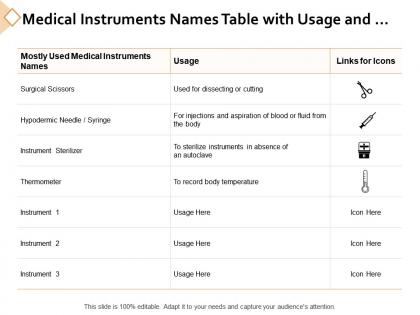
Medical instruments names table with usage and icons




Try Before you Buy Download Free Sample Product
 Impress Your
 Audience
 100%
100% Editable
 Save Hours
 of Time


Elaborate on cutting cost with our Medical Instruments Names Table With Usage And Icons. Explain how to establish a grip on expenses.
People who downloaded this PowerPoint presentation also viewed the following :
Medical instruments names table with usage and icons with all 5 slides:
Making your presentations look perfect through our ready made Medical Instruments Names Table With Usage And Icons. Timeless design in seconds.


FAQs for Medical instruments names table with
So basically, diagnostic stuff helps you figure out what's wrong - like stethoscopes, X-rays, blood pressure cuffs. Therapeutic instruments actually fix the problem. Think scalpels, defibrillators, surgical lasers. It's kinda like being a detective first, then switching to problem-solver mode. Some tools do both which honestly makes things more confusing than they need to be! But yeah, just ask yourself: does this help me diagnose or treat? That usually sorts it out pretty quickly.
Dude, surgical tech has gone absolutely nuts in the past few years. Robotic tools give surgeons crazy precision now - like way beyond what anyone thought possible before. The materials alone are insane... titanium alloys, special coatings that don't corrode. Honestly, the 3D printing stuff blows my mind the most - they can literally print custom instruments for specific patients. Minimally invasive tools mean less trauma for patients too. Oh, and everything's got sensors now for real-time feedback. If you're upgrading, just make sure whatever you get plays nice with your current digital setup.
Dude, polymers are literally everywhere in medical devices - syringes, catheters, even stuff like pacemaker leads and joint replacements. They're huge because you can tweak them to be biocompatible and sterilizable while keeping flexibility and strength. Way cheaper to manufacture than metals too, which obviously makes the money people happy. The tricky part is matching properties to what you actually need. Oh, and definitely check biocompatibility requirements and regulatory stuff first - that's like step one before picking anything. Trust me on that.
Okay so here's the deal - you've gotta match the method to what won't destroy your equipment. Fiber optic scopes and heat-sensitive stuff? Use ethylene oxide or hydrogen peroxide plasma. Regular stainless steel can handle autoclave steam just fine. Plastics are annoying though - half of them melt under heat so they need chemical sterilization instead. Honestly, always check the manufacturer specs first because nobody wants to explain to their boss why a $10k scope is now paperweight. Trust me on that one. Just double-check compatibility before you pick your cycle and you'll be good.
Oh dude, the miniaturization stuff is wild right now! MEMS technology has shrunk instruments down to like 2-3mm - crazy small but still super functional. Robotic systems are where it gets really interesting though, the precision at microscopic levels is insane. 3D printing lets them make custom tools now too. Honestly the endoscopic cameras have improved so much while getting tinier, it's kinda mind-blowing. You should definitely look up some da Vinci system videos if you're curious - they're doing minimally invasive procedures that would've been impossible just a few years back. Makes me wonder what surgery will look like in another decade.
Look, the biggest thing with electronic monitoring is catching problems early - way before they turn into emergencies. Your alerts go off the second vitals hit dangerous levels, which honestly beats manual checks by miles. Plus everything gets logged automatically so no more worrying about documentation errors between shifts. I love how it syncs with your EMR too, makes spotting patterns so much easier. Just make sure you set those alarm thresholds right and actually train everyone properly. That's really where you'll see the difference in outcomes. Trust me on this one.
So you'll mainly use laparoscopes for seeing inside, plus trocars as your entry points. Graspers and scissors are obvious ones. Electrocautery devices too. The CO2 insufflation pumps are honestly kind of boring but super important - they create the workspace by inflating everything. Benefits are pretty sweet: way smaller cuts, less bleeding, patients bounce back faster. The scarring thing is huge for people too. I'd definitely watch a few procedures first if you can swing it. Seeing how all the tools work together is different than just reading about them. Makes way more sense once you see it in action.
Honestly, regulations control your whole development timeline from the get-go. FDA requirements, CE marking for Europe - each one has different hoops and paperwork. It's kinda insane how much documentation they want. You need to figure out your device classification super early because Class I devices sail through while Class III ones get hardcore scrutiny. Don't make the mistake most people do and think about compliance later. Map out your regulatory path before you even lock down the final design specs. Trust me, retrofitting compliance is a nightmare you want to avoid.
Honestly, MRI and CT scans changed everything - we could finally see inside bodies without surgery. CT hit in the 70s with cross-sectional imaging, then MRI blew us away with soft tissue detail. Digital X-rays were massive too since you can tweak images instantly and send them anywhere. Ultrasound machines are wild now, some fit in your pocket! But the coolest part? AI is starting to catch stuff we'd totally miss. I'm still wrapping my head around how good these AI tools are getting. Check what your place has - you might be surprised.
Oh man, ergonomics can totally make or break medical instruments. Poor design leads to hand fatigue and repetitive strain - I've watched surgeons really struggle with badly designed tools. Long procedures? Forget about it if the grip sucks. Weight distribution matters too. Patient safety goes way up when healthcare workers feel confident with their instruments. Less slips, fewer mistakes. Honestly, some manufacturers still don't get this right. Before buying anything, definitely test how it feels during extended use. Your hands will thank you later, and so will your patients.
Honestly, the coolest stuff I'm seeing is all these portable diagnostic tools that sync straight to your phone - digital stethoscopes, handheld ultrasounds, those fancy wearables. AI's everywhere now too. Devices analyze your data instantly and catch weird patterns automatically. COVID totally changed the home testing game - kits are way more advanced than they used to be. Quality's actually pretty solid for what you pay. You can basically run comprehensive diagnostics from your couch now instead of just checking basic vitals. Oh, and definitely watch FDA approvals - that's where you'll spot what's coming next.
Honestly, simulators are a game-changer because you can screw up without actually hurting anyone. Like, imagine botching a catheter insertion on a real patient versus doing it wrong ten times on a simulator until you nail it. VR stuff has gotten insanely realistic too - sometimes I forget I'm not in an actual OR. Everyone learns the same scenarios, so there's consistency there. The feedback is instant, which beats the old-school methods by miles. Oh, and definitely start with the basic ones first before jumping into the fancy high-tech simulators.
Dude, 3D printing is seriously changing the game for custom medical tools. You can make patient-specific instruments now - like, actually tailored to someone's exact anatomy. The speed thing is nuts too. Traditional manufacturing takes weeks, but you can prototype stuff in hours or days. Surgeons get to physically hold and test things beforehand, which honestly seems like it should've been standard forever. Complex shapes that were impossible before? No problem now. Oh, and costs way less obviously. I'd start by looking at what custom requests keep coming up in your work, then maybe partner with a medical 3D printing service to see what's actually doable.
Honestly, these wearable devices are pretty amazing for managing chronic stuff. Your patients get 24/7 monitoring instead of just those quick doctor visits - like continuous glucose monitors or heart trackers. Early problem detection is huge. They can tweak meds faster and actually see how that late-night pizza affects their numbers (which is kind of brutal but helpful). Doctors love having all that real data too. I'd probably start by figuring out what each patient cares about tracking most, then match them with whatever device does that best. Way more personalized than the old one-size-fits-all approach.
Ugh, medical device integration is such a pain. Every manufacturer uses their own weird protocols, so nothing talks to each other properly. Legacy stuff from the 90s has to somehow work with brand new equipment - it's honestly ridiculous. Plus healthcare regulations mean any changes take forever to get approved. Security's another headache since patient data can't be messed with. I'd start talking to vendors about standards early. Oh, and definitely budget way more time than seems reasonable - this stuff always takes longer than expected.
No Reviews