

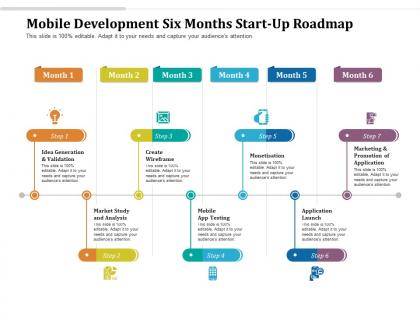
Mobile development six months start up roadmap




Try Before you Buy Download Free Sample Product
 Impress Your
 Audience
 100%
100% Editable
 Save Hours
 of Time


The success rate of business plans is hugely dependent on the plan of action, and this editable Mobile Development Six Months Start Up Roadmap rightly serves the purpose. Encapsulate all the information related to the project in a well structured manner to obtain maximum efficiency by incorporating our stunning PowerPoint theme. State the critical deliverable, steps involved, time frame, workforce allocation, and lots more in an easy to understand manner by utilizing this pre designed roadmap PowerPoint layout. You can also prioritize your tasks and discuss the problem areas with your colleagues by incorporating this tailor made PPT layout. Empower your work plan by employing this professionally designed PPT theme. Entrepreneurs can download Mobile Development Six Months Start Up Roadmap as a beneficial communication tool that facilitates in collaborating with different tasks and achieve targets.
People who downloaded this PowerPoint presentation also viewed the following :
Mobile development six months start up roadmap with all 2 slides:
Use our Mobile Development Six Months Start Up Roadmap to effectively help you save your valuable time. They are readymade to fit into any presentation structure.
FAQs for Mobile development six months
So basically there's six main stages you'll go through. First up is planning - figuring out what you actually want to build and picking your tech stack. Then comes UI/UX design where you're wireframing and prototyping everything. Development's next, and honestly that's where things get fun because you're finally building the actual features. Testing comes after - gotta check it works on different devices and OS versions, which is kind of a pain but necessary. Then you submit to app stores for deployment. Oh, and maintenance never really ends - updates, bug fixes, new features, all that stuff. I'd definitely map out your timelines early though.
Here's what I'd do - check your analytics first to see what phones your users actually have. That'll tell you everything. If they're mostly on one platform, just build native for that one. Cross-platform stuff like React Native sounds great in theory but can get messy fast (learned that the hard way). Native costs more since you're building twice, but performance is way better. Flutter's decent too if you need both iOS and Android quickly. Really depends on your budget and how fast you need to ship. What's your timeline looking like?
Start with Swift or Kotlin - they're the bread and butter. Though honestly, React Native and Flutter are pretty solid if you want to hit both platforms at once. UI/UX matters way more than people think because mobile users will delete your app in like 2 seconds if it sucks. You definitely need API integration and database stuff down pat. Git is a lifesaver for version control - trust me on that one. App store guidelines are boring but you've gotta know them or your launch will be a nightmare. Performance optimization and testing can't be skipped either. Pick one platform first, get good at it, then expand.
So you've got Swift for iOS and Kotlin for Android as your main options. Java's still around for Android but honestly, Kotlin is just better - Google's been pushing it hard for good reason. JavaScript works if you want cross-platform with React Native. Flutter uses Dart, which is weird but actually pretty nice once you get used to it. Both let you build for iOS and Android together. Really depends what you're building though. Going native? Swift or Kotlin all the way. Want to hit both platforms without learning two languages? React Native's probably your safest bet, though Flutter's getting really good lately.
Honestly, just talk to people first - like actual users, not your mom or coworkers. Surveys are fine but real conversations tell you way more. Build some basic user personas so you're not designing for everyone (which is nobody). Check out your competition too, see what they're screwing up. Get your developers involved early though - I learned this the hard way when my "simple" feature turned into a 3-month nightmare. Document everything in something everyone can actually find later. Google Forms works great for quick feedback. The research phase feels boring but trust me, it'll save your ass down the road.
Dude, you absolutely have to get your UI/UX sorted before diving into code. I learned this the hard way on my last project - we built half the app then realized users were completely confused by the flow. Such a nightmare to fix later. Design decisions actually drive your whole technical setup and feature priorities. Create user personas and wireframes first, even if it feels like extra work upfront. Trust me, it'll save you from major refactoring headaches. Too many dev teams just focus on functionality then try to make it pretty afterward. That approach never works.
Start with unit tests - they're fast and catch bugs early. Integration tests come next for your API calls and database stuff. UI tests matter but honestly they're super flaky, so don't write a million of them. Test on actual devices too, not just simulators - the performance is totally different. Get automated testing running in your pipeline so it checks every commit. Oh and definitely test offline scenarios! Nothing's worse than an app that dies when wifi cuts out. My advice? Start simple and build up your test coverage as you go.
Honestly, build security into your code from the start - trying to add it later is such a pain. Validate inputs, encrypt your sensitive stuff, use proper auth. I learned this the hard way on a project last year! Run security scans in your CI/CD pipeline so you catch problems early. Static analysis tools are your friend here. Also keep dependencies updated and don't hardcode secrets (I still see people doing this somehow). Pen testing should happen regularly too. Session management might seem boring but it'll save your butt later.
Honestly, I'd go with React Native or Flutter if I were you - cross-platform is where it's at for getting stuff done fast. Native development means Swift for iOS, Kotlin for Android, but that's double the work. Expo makes React Native way less painful to work with. You'll obviously need Git for version control, plus Xcode or Android Studio depending on what you're building for. Oh, and Firebase is pretty solid for backend stuff and auth - saves you from building that from scratch. I'd probably start with just one cross-platform framework though. Gets you the most mileage while you're figuring things out.
Dude, start by profiling your app first - that's where you'll actually find the real problems. Memory leaks will kill you, so dispose objects properly and lazy load stuff when you can. Database queries are honestly the worst culprits for slow performance, so cache what gets hit a lot and batch those network calls. Images are usually huge too - optimize those suckers. Build with modular components from the start because retrofitting scalability later is a nightmare. Oh and set up proper error handling while you're at it. CDNs help with content delivery, plus make sure your APIs can handle more traffic as you grow.
So you'll definitely want to track the basics - DAU/MAU, session length, retention rates (especially day 7 and 30). Those retention numbers are honestly the most important IMO - if people aren't sticking around, you've got bigger problems than downloads. Also keep an eye on crash rates and app store ratings since they mess with your discoverability. Business-wise, conversion rates and revenue per user are key. Oh, and don't forget cost per acquisition - I've seen too many apps blow their budget there. Set up analytics from day one though, trust me on that.
Dude, mobile dev is perfect for agile. You can push out features fast and actually listen to what users want instead of guessing. Those 2-week sprints? Game changer. When Apple drops some random iOS update that breaks half your app, you're not stuck in some massive 6-month release cycle. Just pivot in the next sprint. I always tell teams to get something - anything - in front of real users ASAP, even if it's rough around the edges. Your stakeholders will love seeing progress every couple weeks too, rather than radio silence for months. Trust me, that "perfect" release you're waiting for doesn't exist anyway.
Ugh, APIs are such a pain sometimes. Authentication is probably your biggest headache - some services randomly change their auth flow and don't tell anyone. Rate limiting will bite you too, plus mobile connections are trash so network issues are constant. Documentation? Half the time it's outdated or just wrong. When APIs update without warning, your code breaks and you're scrambling to figure out what changed. Each one has different response formats so you're writing tons of parsing logic. Definitely build wrapper functions around each API - makes swapping them way easier later. Cache everything you can and go overboard on error handling, trust me.
Dude, you NEED to think about app store optimization from the start. Don't make it an afterthought like most people do. Your app could be incredible, but if it's buried on page 47 of search results, you're screwed. Start researching keywords and checking out what your competitors are doing while you're still building the thing. Honestly, I've seen too many great apps flop because the developers ignored ASO until launch day. It directly impacts your downloads and how much you'll spend on ads later. Get your metadata and screenshots optimized before you even submit - trust me on this one.
Honestly, AI integration is gonna be everywhere soon - every app will have ChatGPT-like features built in. Cross-platform stuff like Flutter and React Native are getting crazy good too. AR/VR is finally moving past the gimmicky phase into real apps people actually use. 5G speeds are a game-changer for what's possible with mobile. Privacy laws keep getting tougher though, so you gotta think about that stuff from the start now. My advice? Start messing around with AI SDKs and get comfortable with cross-platform tools if you're not already.
No Reviews