


Mobile Security Powerpoint Presentation Slides





Try Before you Buy Download Free Sample Product
 Impress Your
 Audience
 100%
100% Editable
 Save Hours
 of Time


Grab our professionally designed Mobile Security PowerPoint presentation. It includes an introduction, importance, types of threats, and common issues faced in mobile security. It also includes features and benefits for enterprises along with guidelines and best strategies for awareness of mobile security. Additionally, this Mobile security threats Power Point presentation defines malware, phishing attacks, and their different types. It also explains other security threats, such as unsecured Wi-Fi networks, application-based threats, social engineering lifecycle, jailbreaking, and rooting. Furthermore, our Two-factor authentication presentation contains an introduction, factors, threats, and types. It also highlights the pros and cons of SMS two factor authentication. Moreover, the Patch management PPT explains the introduction, features, benefits, process lifecycle, and best practices. It also discusses the mobile platform security communication process. Lastly, this Mobile application security PowerPoint Presentation contains a 30-60-90 days plan for mobile security, training schedule, training budget, implementation budget, and roadmap of mobile security. Download our 100 percent editable and customizable template, which is also compatible with Google Slides.
People who downloaded this PowerPoint presentation also viewed the following :
Content of this Powerpoint Presentation
Slide 1: This slide introduces Mobile Security. State your company name and begin.
Slide 2: This slide states Agenda of the presentation.
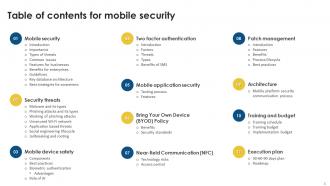
Slide 3: This slide shows Table of Content for the presentation.
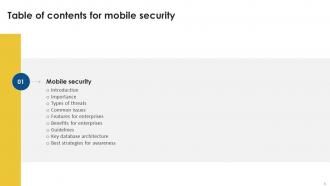
Slide 4: This slide highlights title for topics that are to be covered next in the template.
Slide 5: This slide presents Utilize mobile computers and communication hardware.
Slide 6: This slide displays Importance of mobile security protection in devices.
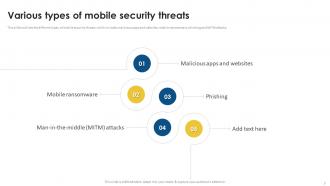
Slide 7: This slide represents Various types of mobile security threats.
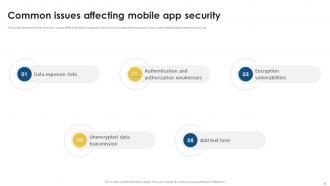
Slide 8: This slide showcases Common issues affecting mobile app security.
Slide 9: This slide shows Salient features of mobile security for businesses.
Slide 10: This slide presents Primary benefits of mobile security for enterprises.
Slide 11: This slide displays Guidelines for securing mobile device payment.
Slide 12: This slide represents Generic database architecture of mobile security.
Slide 13: This slide showcases Best strategies for creating security awareness.
Slide 14: This slide highlights title for topics that are to be covered next in the template.
Slide 15: This slide shows Different types of malware security attacks.
Slide 16: This slide presents Types of phishing attacks in mobile security.
Slide 17: This slide displays Working process of phishing attacks in devices.
Slide 18: This slide highlights the risks associated with unsecured Wi-Fi network.
Slide 19: This slide represents the different types of application based mobile security threats.
Slide 20: This slide showcases Social engineering lifecycle in mobile security.
Slide 21: This slide shows Jailbreaking and rooting in mobile device security.
Slide 22: This slide highlights title for topics that are to be covered next in the template.
Slide 23: This slide presents Major components of mobile device security.
Slide 24: This slide displays Mobile device security best practices.
Slide 25: This slide represents Biometric authentication in mobile device security.
Slide 26: This slide showcases Advantages of biometric authentication for mobile devices.
Slide 27: This slide shows Role of AI in securing mobile devices.
Slide 28: This slide highlights title for topics that are to be covered next in the template.
Slide 29: This slide presents Two factor authentication in mobile security.
Slide 30: This slide displays Key factors of authentication in mobile security.
Slide 31: This slide represents Common threats addressed by two factor authentication.
Slide 32: This slide showcases Types of two factor authentication in mobile security.
Slide 33: This slide shows Benefits of using SMS in two factor authentication.
Slide 34: This slide highlights title for topics that are to be covered next in the template.
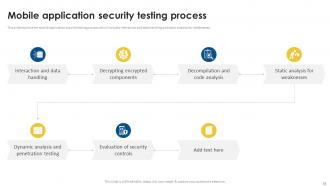
Slide 35: This slide explains the mobile application security testing process which includes interaction and data handling and static analysis for weaknesses.
Slide 36: This slide presents Core mobile app security features.
Slide 37: This slide highlights title for topics that are to be covered next in the template.
Slide 38: This slide displays Primary benefits of enacting BYOD policy.
Slide 39: This slide represents Major security standards for BYOD policies.
Slide 40: This slide highlights title for topics that are to be covered next in the template.
Slide 41: This slide showcases NFC technology risks associated with mobile security.
Slide 42: This slide represents the introduction of near field communication for access control.
Slide 43: This slide highlights title for topics that are to be covered next in the template.
Slide 44: This slide showcases Patch management in mobile device security.
Slide 45: This slide shows Salient features of patch management in security.
Slide 46: This slide presents Primary benefits of patch management in mobile security.
Slide 47: This slide displays Security patch management process lifecycle.
Slide 48: This slide represents Software update and patch management best practices.
Slide 49: This slide highlights title for topics that are to be covered next in the template.
Slide 50: This slide showcases Mobile platform security communication process.
Slide 51: This slide highlights title for topics that are to be covered next in the template.
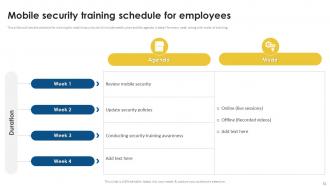
Slide 52: This slide shows Mobile security training schedule for employees.
Slide 53: This slide presents Training budget for seamless mobile security awareness.
Slide 54: This slide displays Budget allocation for mobile security implementation.
Slide 55: This slide highlights title for topics that are to be covered next in the template.
Slide 56: This slide represents 30-60-90 days plan for mobile security implementation.
Slide 57: This slide showcases Roadmap for mobile security implementation in organization.
Slide 58: This slide is titled as Additional Slides for moving forward.
Slide 59: This slide contains all the icons used in this presentation.
Slide 60: This is a Timeline slide. Show data related to time intervals here.
Slide 61: This is a Financial slide. Show your finance related stuff here.
Slide 62: This is Our Target slide. State your targets here.
Slide 63: This slide presents Roadmap with additional textboxes.
Slide 64: This slide contains Puzzle with related icons and text.
Slide 65: This is Our Mission slide with related imagery and text.
Slide 66: This slide shows Post It Notes. Post your important notes here.
Slide 67: This is a Comparison slide to state comparison between commodities, entities etc.
Slide 68: This is a Thank You slide with address, contact numbers and email address.
Mobile Security Powerpoint Presentation Slides with all 76 slides:
Use our Mobile Security Powerpoint Presentation Slides to effectively help you save your valuable time. They are readymade to fit into any presentation structure.


















FAQs for Mobile Security
Dude, there's some sketchy stuff out there. Fake apps will steal your info or mess up your phone completely. Phishing scams try tricking you with bogus texts asking for passwords - I almost fell for one last month, honestly. Public Wi-Fi is terrible for anything important since hackers love that stuff. Don't forget about OS updates either. Old software has security gaps everywhere. Stick to official app stores, keep your phone updated, and grab a VPN for public networks. Trust me on this one.
Okay so basics first - get a good passcode or use your fingerprint. Keep everything updated even though those notifications are annoying as hell. Only download apps from official stores too. Here's something most people miss - check what permissions your apps actually have. Why does a flashlight need your contacts, you know? Banking and sensitive stuff should never happen on public wifi. Two-factor authentication is clutch for important accounts. Honestly, just doing screen locks and staying updated will stop like 90% of problems. Those two things alone make a huge difference.
Honestly, app permissions are huge for keeping sketchy apps from snooping around your phone. Those pop-ups when you install something? They're telling you what the app wants - camera, contacts, location, whatever. Most people (myself included, oops) just hit "allow all" without reading. That's where we mess up. Does your flashlight app really need your contact list? Probably not. Go through your phone settings once in a while and check what you've actually given permission to. Some apps are total data hogs and you don't even realize it.
Yeah, fingerprint scanning is way better than just using a PIN or those swipe patterns. Your print is unique, so it's much harder for someone to copy compared to watching you type your passcode over your shoulder. I mean, theoretically hackers could make fake prints from photos or whatever, but that's pretty rare outside of spy movies. The real problem happens when your phone gives up on reading your finger and asks for your PIN instead - that's usually where things get sketchy. I'd definitely use both together though. Strong backup PIN plus the fingerprint thing, and maybe set it to wipe everything after too many wrong tries.
Yeah, public Wi-Fi is sketchy as hell - hackers love that stuff. They can grab your passwords, set up fake networks, basically see everything you're doing. Get a VPN if you can, that helps a ton. Don't log into your bank account or anything important while you're on it. Turn off that auto-connect thing too, otherwise your phone just jumps on random networks. Oh and only use sites with HTTPS (the little lock icon). I got burned at Starbucks once, learned my lesson real quick. Just assume everyone can see what you're doing on public networks because... they probably can.
Honestly, picking an MDM platform is such a pain at first - there's like a million options. Go with something that matches your budget and company size. Once you've got it set up, you can push out security stuff remotely: force better passwords, encrypt everything, control what apps people download. The coolest feature? Remote wipe if someone loses their phone. Just give your team a heads up about the policy first - nobody wants to feel like Big Brother is watching. Oh, and definitely test it with a small group before you unleash it on everyone. Trust me on that one.
Honestly, start with the basics - validate all your inputs and use HTTPS everywhere. OAuth 2.0 is solid for authentication, way better than rolling your own. Never hardcode API keys (seriously, I've debugged so many apps where devs did this). Encrypt sensitive data and set up certificate pinning to block those sneaky man-in-the-middle attacks. Keep dependencies updated too - old libraries are basically hacker candy. Oh, and run security scans regularly. Penetration testing sounds fancy but it'll catch stuff you'd never think of. Actually, just scan your current app first to see what you're dealing with.
So your phone basically scrambles all your data into a secret code that only you can unlock. It happens in two ways - stuff stored on your device (photos, texts, whatever) gets encrypted, plus anything you send over wifi or cellular gets scrambled too. Honestly, I'm still amazed phones do this automatically now since the math behind it is insane. Your phone's probably doing it right now without you even thinking about it. Just make sure you've got a decent password and don't ignore those software updates - that's what keeps the whole security thing running smoothly.
Okay so first thing - check if your battery's dying way faster than usual. Random apps you never downloaded? That's sketchy. Your phone might get super hot for no reason (although mine does that when it's just being dramatic lol). Performance gets sluggish, data usage goes crazy, and you'll see weird pop-ups everywhere. Sometimes it'll restart by itself or send bizarre texts from your number. Honestly the fake text thing freaks me out the most. If any of this sounds familiar, run a security scan ASAP and change your passwords.
So basically 2FA puts an extra lock on your accounts - hackers can't get in even if they steal your password. You still type your password like normal, but then you need a code from an app or text too. Yeah it's kinda annoying at first but you get used to it quick. Start with your bank and email stuff first since those matter most. Then add it to social media and whatever else. Honestly saved my butt when my email got compromised last year - they had my password but couldn't actually access anything.
Dude, seriously keep your phone updated. Those notifications are annoying as hell but they're fixing security holes that hackers love to exploit. Skip them and you're basically leaving your front door unlocked for malware and data thieves. The worst part? Cybercriminals know about these vulnerabilities too, so they're racing to hit unpatched devices. Just turn on automatic updates - I learned this the hard way after my cousin got his banking info stolen. Way easier than trying to remember to do it yourself every time.
Honestly, the big ones are data getting intercepted when you're making payments, plus malware that grabs your card info. Phishing scams targeting banking apps are everywhere now too. Man-in-the-middle attacks happen a lot on public WiFi - I got burned doing this at a coffee shop once, so learn from my mistake lol. Someone could steal your phone and access stored payment stuff. Weak passwords make it way too easy for hackers to break in. Even those tokenization systems aren't perfect. Stick with trusted payment apps that have solid encryption. Never do transactions on public networks if you can help it, and definitely turn on two-factor authentication.
Okay so first thing - download Malwarebytes or Bitdefender and run a scan. Both are solid for catching the sketchy stuff. Watch out for weird signs like your phone suddenly being super slow, random pop-ups, or your battery dying way faster than usual. The antivirus should automatically zap most threats, but sometimes you gotta go into safe mode and delete suspicious apps yourself. iPhones are actually way less of a headache for this since Apple keeps things locked down pretty tight. Honestly though, just grab one of those security apps now before you actually need it, and stick to the official app stores. Way less drama that way.
Honestly, your users are gonna make or break your mobile security. Most breaches happen because someone clicks a bad link or downloads sketchy apps without thinking. Even great security tools can't fix human curiosity - people are curious by nature! Train your team regularly on spotting phishing and understanding app permissions. Don't make it a one-time boring presentation though. Monthly security tips work better, focusing on actual threats they'll see. Also teach them about social engineering tactics since those are getting pretty sophisticated these days. Keep it ongoing and relevant to stuff they'll actually encounter.
Ugh, IoT stuff is such a headache honestly. Your attack surface just exploded with all these fitness trackers and smartwatches connecting everywhere. Start with an audit - seriously, you'll be shocked what random devices are already on your network. Network segmentation becomes way more critical now. Update your BYOD policies too since they probably don't even mention IoT yet. Device discovery tools help you see what's actually connecting, but man, the number of endpoints we're tracking these days is crazy. Every little connected gadget can potentially leak data or give someone network access.
-
“I always have a wonderful experience with SlideTeam. It's my ""go to"" when I need a template.”
-
Attractive design and informative presentation.