


Nanorobotics In Healthcare And Medicine Powerpoint Presentation Slides




Try Before you Buy Download Free Sample Product
 Impress Your
 Audience
 100%
100% Editable
 Save Hours
 of Time


This Nanorobotics in Healthcare and Medicine PowerPoint presentation briefly explains nanorobotics in medical field, techniques used and types such as DNA-based and blood-related nanobots. In this Swarm Robotics at Frontline of Medical Advancement template, we have covered challenges, potential risks, and demerits of constructing nanorobots in medicine. It also includes the solutions for the respective problems. In addition, this Evolution of Biomimetic Nanorobotics PPT demonstrates the different nanorobotic techniques that include swarm robotics and biomimetic nanorobots. It also includes its overview, benefits and types. Also, the Exploring Biologically Inspired Nanobots PPT presentation discusses the biologically inspired nanobots and its various types. The types include Myosin, kinesin, dynein motor proteins, and flagella motors. Lastly, the module shows a budget overview, including estimated costs for software testing and employee training. Download our 100 percent editable and customizable template, also compatible with Google Slides.
People who downloaded this PowerPoint presentation also viewed the following :
Content of this Powerpoint Presentation
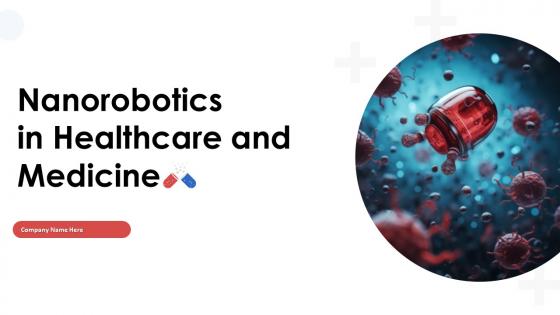
Slide 1: The slide introduces Nanorobotics in Healthcare and Medicine. State your Company Name Here.
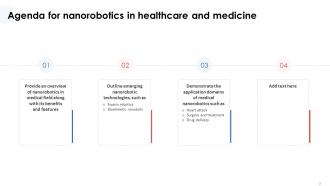
Slide 2: This is an Agenda slide. State your agendas here.
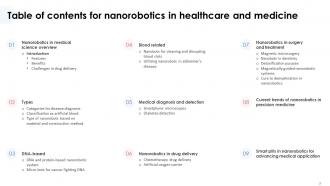
Slide 3: The slide displays Table of contents for the presentation.
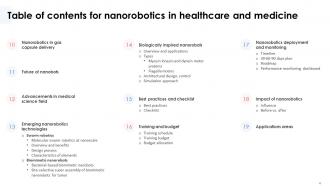
Slide 4: The slide continues Table of contents.
Slide 5: The slide displays Table of contents further.
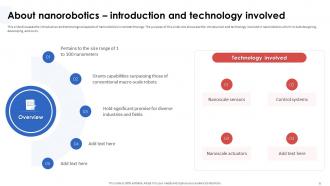
Slide 6: This slide discusses the introduction and technological aspects of nanorobotics in nanotechnology.
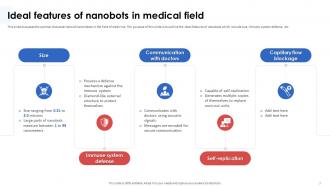
Slide 7: This slide continues the optimal characteristics of nanorobots in the field of medicine.
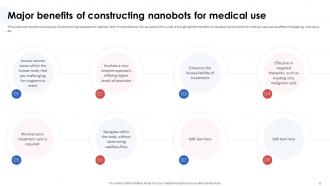
Slide 8: This slide outlines the various pros of constructing nanobots for medical field in nanorobotics.
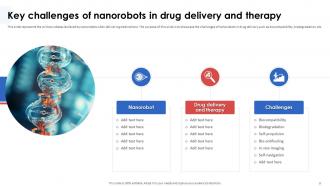
Slide 9: This slide represents the primary obstacles faced by nanorobots when delivering medications.
Slide 10: The slide renders another Title of contents.
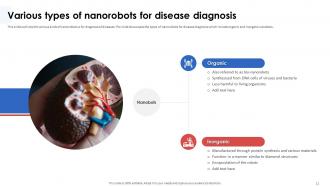
Slide 11: This slide outlines the various kinds of nanorobotics for diagnosis of diseases.
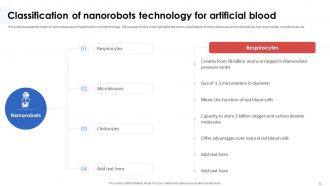
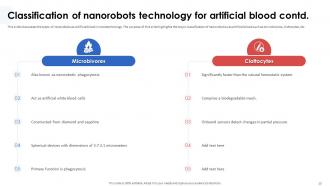
Slide 12: This slide discusses the types of nanorobots as artificial blood in nanotechnology.
Slide 13: This slide showcases the types of nanorobots as artificial blood in nanotechnology.
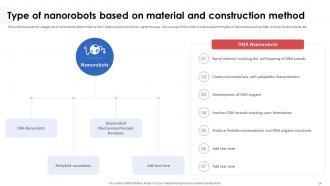
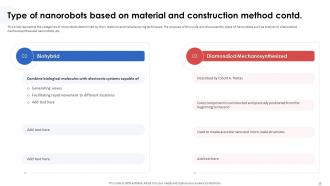
Slide 14: This slide discusses the categories of nanorobots determined by their material and manufacturing techniques.
Slide 15: This slide represents the categories of nanorobots determined by their material and manufacturing techniques.
Slide 16: The slide displays Title of contents further.
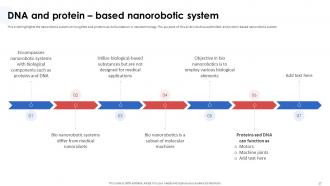
Slide 17: This slide highlights the nanorobotic system utilizing DNA and proteins as its foundation in nanotechnology.
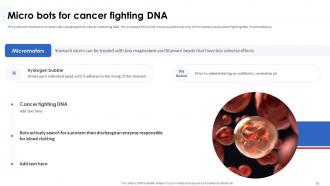
Slide 18: This slide outlines the micro robotic devices designed for cancer combating DNA.
Slide 19: The slide displays Title of contents further.
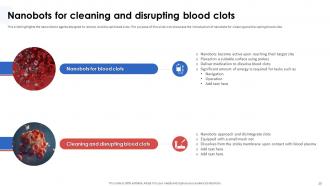
Slide 20: This slide highlights the nanorobotic agents designed to remove and disrupt blood clots.
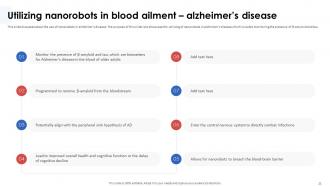
Slide 21: This slide discusses about the use of nanorobots in alzheimer’s disease.
Slide 22: The slide shows Table of contents further.
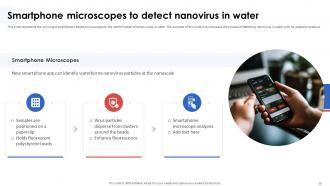
Slide 23: This slide represents the utilizing of smartphone-based microscopes for the identification of nanoviruses in water.
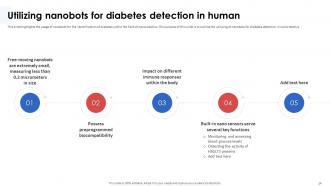
Slide 24: This slide highlights the usage of nanobots for the identification of diabetes within the field of nanorobotics.
Slide 25: The slide presents Title of contents further.
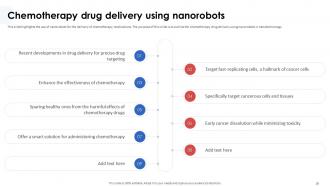
Slide 26: This slide shows the use of nanorobots for the delivery of chemotherapy medications.
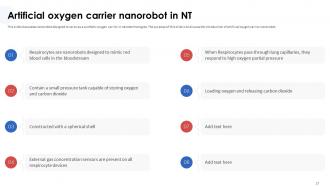
Slide 27: This slide showcases nanorobot designed to serve as a synthetic oxygen carrier in nanotechnologies.
Slide 28: The slide displays Title of contents which is to be discussed further.
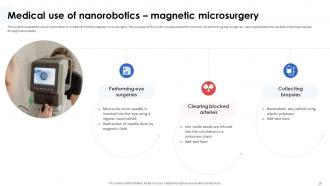
Slide 29: This slide discusses the use of nanorobotics in medical field by magnetic microsurgery.
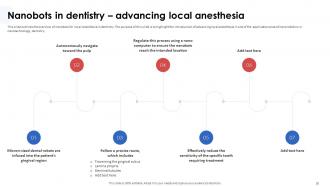
Slide 30: This slide outlines the overview of nanobots for local anesthesia in dentistry.
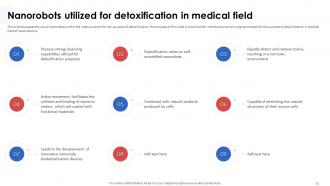
Slide 31: This slide discusses the use of nanorobots within the medical sector for the purpose of detoxification.
Slide 32: This slide showcases the nanorobotic systems that are led magnetically in nanotechnology.
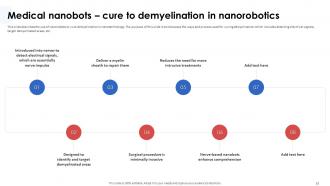
Slide 33: This slide describes the use of nanorobots to cure demyelination in nanotechnology.
Slide 34: The slide displays Title of contents further.
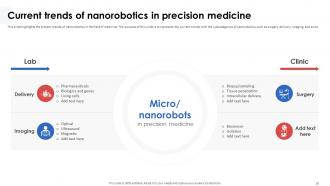
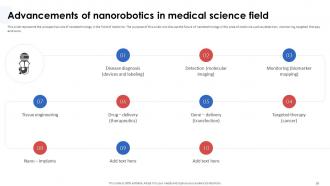
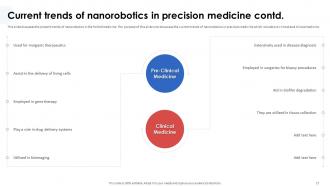
Slide 35: This slide highlights the present trends of nanorobotics in the field of medicine.
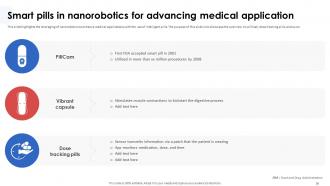
Slide 36: This slide highlights the leveraging of nanorobotics to enhance medical applications with the use of intelligent pills.
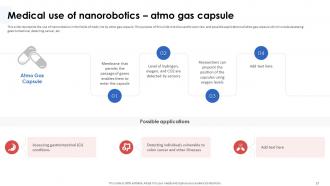
Slide 37: This slide represents the use of nanorobotics in the fields of medicine by atmo gas capsule.
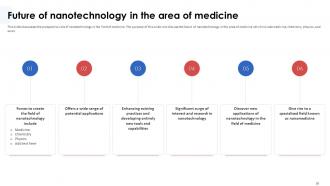
Slide 38: This slide showcases the prospective role of nanotechnology in the field of medicine.
Slide 39: This slide again represents the prospective role of nanotechnology in the field of medicine.
Slide 40: The slide displays Title of contents further.
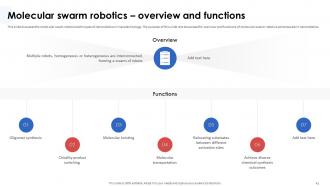
Slide 41: This slide discusses the molecular swam robotics techniques of nanorobotics in nanotechnology.
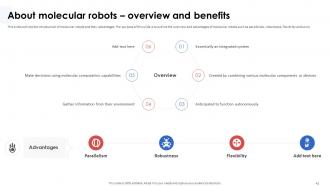
Slide 42: This slide outlines the introduction of molecular robots and their advantages.
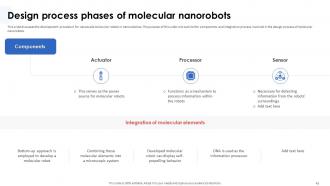
Slide 43: This slide renders the development procedure for nanoscale molecular robots in nanorobotics.
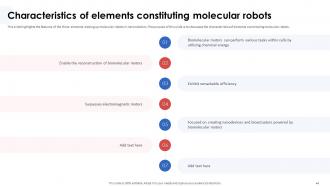
Slide 44: This slide highlights the features of the three elements making up molecular robots in nanorobotics.
Slide 45: The slide displays another Title of contents.
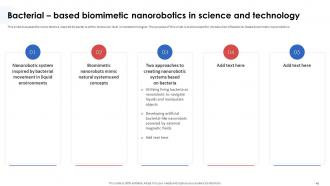
Slide 46: This slide discusses the nanorobotics inspired by bacteria at the molecular level in nanotechnologies.
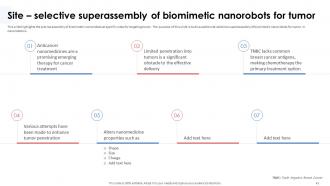
Slide 47: This slide highlights the precise assembly of biomimetic nanorobots at specific sites for targeting tumor.
Slide 48: The slide renders Title of contents which is to be discussed further.
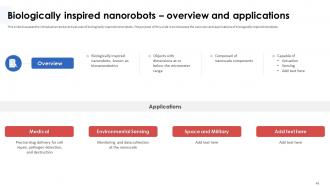
Slide 49: This slide shows the introduction and practical uses of biologically inspired nanorobots.
Slide 50: The slide represents Title of contents further.
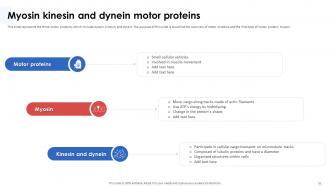
Slide 51: This slide represents the three motor proteins, which include myosin, kinesin, and dynein.
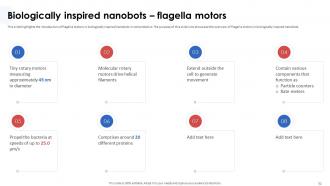
Slide 52: This slide highlights the introduction of flagella motors in biologically inspired nanobots in nanorobotics.
Slide 53: The slide also displays Title of contents.
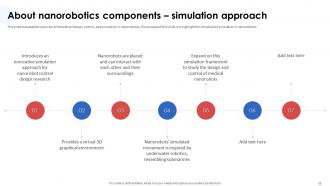
Slide 54: This slide outlines the overview of theoretical design, control, and simulation in nanorobotics.
Slide 55: This slide discusses the overview of theoretical design, control, and simulation in nanorobotics.
Slide 56: The slide represents Title of contents further.
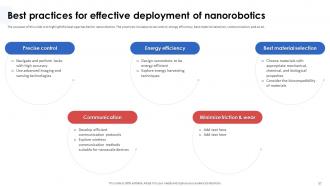
Slide 57: The purpose of this slide is to highlight the best approaches for nanorobotics.
Slide 58: This slide showcases the checklist for implementing nanorobotics in nanotechnology.
Slide 59: The slide displays Title of contents further.
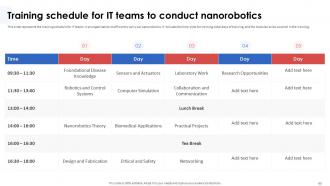
Slide 60: This slide represents the training schedule for IT teams in an organization to efficiently carry out nanorobotics.
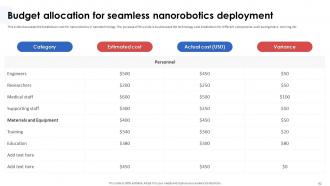
Slide 61: This slide showcases the breakdown cost for nanorobotics.
Slide 62: This slide continues the breakdown cost for nanorobotics in nanotechnology.
Slide 63: The slide depicts Title of contents further.
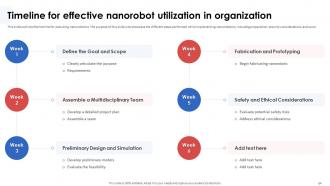
Slide 64: This slide outlines the timeline for executing nanorobotics.
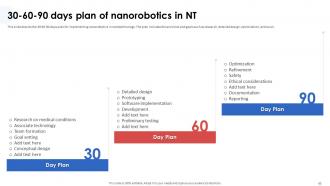
Slide 65: This slide depicts the 30 60 90 days plan for implementing nanorobotics in nanotechnology.
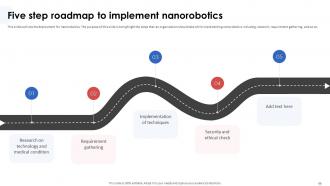
Slide 66: This slide outlines the deployment for nanorobotics.
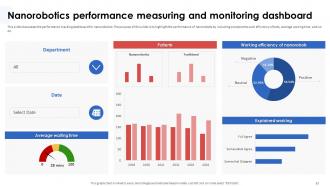
Slide 67: This slide showcases the performance tracking dashboard for nanorobotics.
Slide 68: The slide displays Title of contents further.
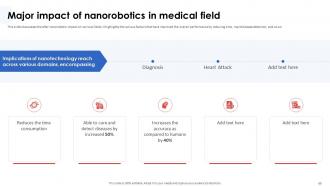
Slide 69: This slide shows the after nanorobotic impact on various fields.
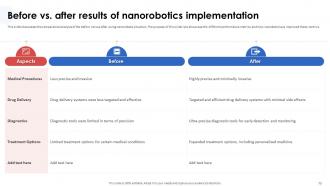
Slide 70: This slide showcases the comparative analysis of the before versus after using nanorobots situation.
Slide 71: The slide depicts Title of contents further.
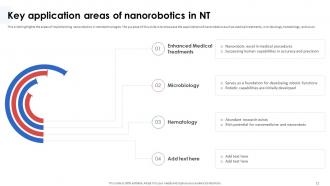
Slide 72: This slide highlights the areas of implementing nanorobotics in nanotechnologies.
Slide 73: This slide shows all the icons included in the presentation.
Slide 74: This slide is titled as Additional Slides for moving forward.
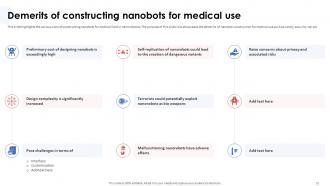
Slide 75: This slide highlights the various cons of constructing nanobots for medical field in nanorobotics.
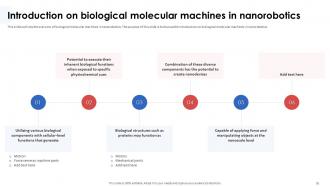
Slide 76: This slide outlines the overview of biological molecular machines in nanorobotics.
Slide 77: This slide discusses the present trends of nanorobotics in the field of medicine.
Slide 78: This slide contains Puzzle with related icons and text.
Slide 79: This slide shows SWOT describing- Strength, Weakness, Opportunity, and Threat.
Slide 80: This is a Timeline slide. Show data related to time intervals here.
Slide 81: This slide shows Post It Notes. Post your important notes here.
Slide 82: This is an Idea Generation slide to state a new idea or highlight information, specifications etc.
Slide 83: This is our mission, vision and goal slide. State your firm goals here.
Slide 84: This slide continues mission slide. State your firm's mission here.
Slide 85: This slide depicts Venn diagram with text boxes.
Slide 86: This slide displays Mind Map with related imagery.
Slide 87: This is a Thank You slide with address, contact numbers and email address.
Nanorobotics In Healthcare And Medicine Powerpoint Presentation Slides with all 95 slides:
Use our Nanorobotics In Healthcare And Medicine Powerpoint Presentation Slides to effectively help you save your valuable time. They are readymade to fit into any presentation structure.


















FAQs for Nanorobotics In Healthcare And Medicine
So basically you're working with miniaturization, biocompatibility, and molecular-scale functionality. These tiny machines need to move around your body somehow - think flagella or magnetic guidance systems. They also need sensors to find their targets and ways to deliver whatever payload they're carrying. Power's honestly the biggest headache since you can't exactly stick a battery in there. Most designs use chemical fuel from your body or external magnetic fields instead. Oh, and everything has to be biodegradable so it doesn't poison you. I'd check out DNA origami techniques and magnetic microswimmers first - they're the closest thing we've got working right now.
So these tiny robots can actually target specific diseased cells instead of just dumping drugs everywhere in your body. Think of it like having a GPS for medication - they navigate straight to tumors or infections. What's cool is you can program them to only release drugs when they hit certain conditions, like specific pH levels. Way less side effects since you're not medicating your entire system, you know? It sounds totally futuristic but labs are already working on this stuff. Honestly, the idea of getting better treatment with smaller doses is pretty amazing. Patients would basically get targeted therapy instead of the usual shotgun approach.
Hey! So you're mostly looking at carbon stuff - nanotubes, graphene, that whole family. Biocompatible polymers are huge too, plus metals like gold and titanium work well. DNA is honestly where things get crazy interesting - you can actually program it and it breaks down naturally. Wild, right? Silicon pops up a lot since we already know how to work with it from making computer chips. Just make sure whatever you pick isn't toxic and stays stable at nano size. Oh, and definitely look into DNA origami papers if you're serious about this - that's where all the cool breakthroughs are happening lately.
So nanorobots are basically like microscopic janitors - they can target specific pollutants in water, break down heavy metals, that sort of thing. Oil spills are huge for this tech since these bots work way better than our current cleanup methods. They're also solid for soil stuff, neutralizing chemicals or pulling out materials to recycle. Honestly, water treatment is probably your best bet to focus on first - that's where the real progress is happening right now. Plus they can get into dangerous spots where you definitely wouldn't want to send people. Pretty wild how something so tiny can tackle such massive environmental problems.
Privacy is the big one - these things would basically spy on your body 24/7. Plus who's actually controlling them? That's honestly terrifying to think about. Safety's another huge issue since we don't know long-term effects at the cellular level. And how do you get real consent for tech most people can't even comprehend? I mean, I barely understand how my phone works half the time. We definitely need solid regulations before this stuff hits the market. Don't wait until it's already out there and people are dealing with consequences.
So basically, nanorobots are insanely tiny - we're talking molecular level stuff you can't even see. Regular robots are just big machines with motors and gears that do factory work or whatever. But nanorobots? They use chemical reactions and biological processes to move around inside your body. Pretty wild, right? They're designed for super precise tasks like delivering drugs directly to cells or fixing things at the atomic level. Oh, and there's some random Chinese character in your question - might want to check that. If you're getting into this field, definitely start with biomimicry and molecular engineering first.
Honestly, it's mostly about communication and power - huge pain points. You can't just stick a GPS on something smaller than a cell, right? Traditional wireless is useless at that scale. So researchers are trying chemical gradients, magnetic fields, even riding blood flow for navigation (kinda wild). Power's equally messy since you need something tiny but long-lasting. Plus coordinating swarms without them crashing into each other or getting lost in your bloodstream? Nightmare. Most teams just focus on passive systems that work with your body instead of against it.
So basically these tiny robots swim through your bloodstream and hunt down cancer cells specifically - it's like having microscopic assassins that only target the bad guys. Way less brutal than regular chemo since you're not poisoning your whole body. They can carry drugs directly to tumors or even recognize cancer markers and attack on their own. Honestly sounds like something from a movie but labs are actually testing this stuff now. Check out Endo Pharmaceuticals if you're curious - they've got some trials going that look pretty promising.
So these nanorobots are basically like tiny heat-seeking missiles but for medicine. They swim straight to diseased tissue instead of flooding your whole body with contrast dye (which seems kinda wasteful tbh). What's crazy is they can spot cancer markers at the individual cell level and basically make tumors glow for the imaging equipment. Perfect for catching things super early. Plus they might be able to diagnose AND treat at the same time, which is wild. I know you're working on diagnostic stuff - this field is exploding right now so definitely worth watching.
So nanotechnology is totally changing robotics - we're talking robots small enough to swim through your bloodstream for drug delivery. Wild stuff. Carbon nanotubes and graphene make everything crazy strong but still lightweight, which is perfect for tiny bots. The sensors are what really blow my mind though - these nanobots can actually sense their environment in ways that seemed impossible just a few years ago. You can have whole swarms working together now. If you're doing any robotics work, definitely check out nanomaterials for your sensors and actuators. Game-changer for sure.
Dude, nanorobots are going to be insane for manufacturing. Picture tiny machines building stuff atom by atom - you'd get materials that are stronger, lighter, whatever properties you want. They could fix problems in real-time too, like catching defects before they mess up the whole batch. Honestly, the coolest part might be smart materials that change based on their environment. We're not quite there yet, but it's happening faster than I thought it would. If you're doing materials R&D, you should probably start figuring out how programmable matter fits into what you're already working on.
So nanorobots mostly talk through chemical signals - they release specific molecules that other nanobots can detect. Pretty basic but effective. Electromagnetic fields work too, especially for longer distances. The swarm thing is honestly the coolest part though - no central brain needed, just simple interactions that somehow create complex group behavior. Some designs mix different communication methods in case one fails. Oh and here's the thing - what works great in your bloodstream might totally suck in an industrial setting, so environment matters big time. Really depends what you're building them for.
Dude, bioinspired nanorobots are seriously cool because nature already did the hard work for us. Bacteria figured out flagella propulsion ages ago, and white blood cells are pros at navigating tissue. Why reinvent the wheel, right? These designs let your robots move way better through the body while using less energy. They won't set off immune alarms either. The self-assembly thing is pretty neat too – plus they break down naturally. Oh, and if you're doing medical stuff, definitely steal ideas from how cells actually work. You'll skip so much annoying trial and error.
So basically these tiny robots would swim around in your bloodstream and target exactly what's wrong with YOU specifically. They'd read your genetic stuff and hit cancer cells while ignoring healthy ones - honestly sounds like something out of a movie but it's real research. Instead of doctors giving everyone the same dose of chemo, the nanobots would adjust everything based on how your body actually responds. Plus they'd monitor your blood 24/7 and send updates to your medical team. It's wild how personalized medicine could get.
Honestly, we're still in the Wild West phase here. There aren't any specific rules for nanorobots yet - regulators are basically figuring it out as they go. Right now they're just using existing medical device or drug approval processes depending on what your nanobot does. The FDA and other agencies are adapting their current frameworks, which is kinda messy but makes sense I guess. Things are changing fast though. If you're working on something like this, definitely keep an eye on FDA's emerging tech guidance. Maybe join some industry groups too? They'll probably know what's coming down the pipeline before anyone else.
-
This design is not only aesthetically pleasing but it has many uses making the cost worthwhile. The graphics look stunning, and you can edit them as per your needs.
-
Awesomely designed templates, Easy to understand.