

NIST Cybersecurity Maturity Framework To Evaluate Risk Management




Try Before you Buy Download Free Sample Product
 Impress Your
Audience
 100%
Editable
 Save Hours
of Time


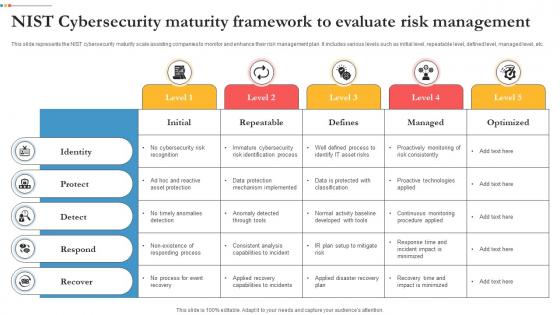
This slide represents the NIST cybersecurity maturity scale assisting companies to monitor and enhance their risk management plan. ITincludes various levels such as initial level, repeatable level, defined level, managed level, etc.
People who downloaded this PowerPoint presentation also viewed the following :
NIST Cybersecurity Maturity Framework To Evaluate Risk Management with all 9 slides:
Use our NIST Cybersecurity Maturity Framework To Evaluate Risk Management to effectively help you save your valuable time. They are readymade to fit into any presentation structure.








FAQs for NIST Cybersecurity Maturity Framework To
So there are five main parts: Identify, Protect, Detect, Respond, and Recover. They kinda flow in order but also loop back into each other constantly. First you figure out what assets and risks you have, then protect them, detect problems when they pop up, respond to limit damage, and recover back to normal. But honestly, it's more like a cycle than steps - what you learn during recovery helps you spot new risks later. I'd say start by seeing where you're weakest in each area since that'll show you the biggest gaps. Oh, and don't expect it to be neat and tidy - you'll be juggling all five at once most of the time.
So basically, grab the NIST Framework and use those five functions (Identify, Protect, Detect, Respond, Recover) as your checklist. First, write down what security stuff you're already doing for each area. Then compare it to what the framework says you should have - trust me, you'll probably find some uncomfortable gaps. I'd make a simple scoring system to rate yourself honestly in each area. The whole point is figuring out where you actually are versus where you need to be. Don't sugarcoat it or you'll just be fooling yourself when planning next steps.
So the NIST Framework is actually perfect for smaller businesses - gives you a solid plan to beef up security without spending a fortune. Start with their free assessment tool to see what shape you're in. Then you can tackle the big stuff: finding weak spots, protecting your most important data, knowing what to do when something goes wrong. Honestly, it beats paying consultants thousands just to tell you the obvious. Build it up gradually based on what you can afford. Oh, and insurance companies sometimes give discounts if you have it implemented, which is pretty sweet.
Honestly, NIST and ISO 27001 work great together. NIST's five functions (Identify, Protect, Detect, Respond, Recover) fit really well with ISO's Plan-Do-Check-Act cycle. Both cover the basics - asset inventory, risk assessments, incident response. Here's the thing though: NIST is way more flexible and outcome-focused. ISO's much stricter with its requirements, which can be a pain but necessary for certification. Most companies I've seen start with NIST as their foundation, then add ISO 27001 on top when they need that official stamp. It's actually a smart approach - you get NIST's practicality plus ISO's credibility.
Start with those five core functions (Identify, Protect, Detect, Respond, Recover) and figure out what matters for your specific industry. Healthcare? You'll be all about HIPAA data protection. Manufacturing focuses more on operational tech security - makes sense, right? Do a risk assessment first to see what's actually critical for your business. Then you can tweak the priority levels and add your own subcategories. The whole thing's super flexible, which is honestly why everyone uses it now. You can bolt on sector-specific stuff like PCI DSS or whatever regulations you're dealing with. Just don't overthink the implementation tiers part.
Look, risk assessment is basically your starting point for everything NIST-related. It drives all your cybersecurity choices. You'll use it in the "Identify" function to figure out what assets you've got and what threats are out there. Then it helps you decide which controls matter most across the other four functions - Protect, Detect, Respond, Recover. Honestly, it's like having a GPS for security decisions. Otherwise you're just randomly buying security tools without knowing what problems actually need fixing. My advice? Start by making a list of your most critical stuff and what could mess with it. That gives you a clear path forward.
So the NIST Framework is actually pretty clever - it doesn't lock you into specific tools or tech. Instead it focuses on those five core functions (Identify, Protect, Detect, Respond, Recover) that work no matter what crazy new threats pop up. When something new hits, you just map it back to those functions and adjust your approach. They keep updating it too - version 2.0 came out recently with better supply chain guidance. Honestly, I think that's way smarter than frameworks that get outdated every few years. Just treat it like a living doc you'll keep tweaking.
So you can track stuff across all five NIST functions - Identify, Protect, Detect, Respond, Recover. Asset inventory completeness and risk assessments for Identify. Patch rates and training completion for Protection. Detection is about response times and false positives (ugh, those are annoying). Don't go crazy trying to measure everything though - you'll burn out your team. Containment speed and system recovery times matter for the last two functions. Honestly? Pick maybe 3-5 metrics that actually match your biggest headaches first. You can always add more later once you've got a rhythm going.
Honestly, mapping your current compliance stuff to NIST is way easier than it sounds. Take whatever you're already doing - SOX, HIPAA, PCI, you know the drill - and just see where it fits into those five buckets: Identify, Protect, Detect, Respond, Recover. Most of these frameworks are like 80% the same anyway, which is kind of annoying but also helpful here. NIST becomes your main organizing system. Your existing programs just plug right in. Oh, and definitely make one of those crosswalk documents showing how everything connects - auditors eat that stuff up and it'll save you headaches later.
Honestly, the biggest pain points are usually money and convincing the C-suite it's worth spending on. Teams get overwhelmed because NIST is massive - like, where do you even begin? Mapping your current mess of security stuff to their neat little functions is brutal, especially if you've been winging it. Oh, and good luck getting anyone outside IT to actually give a damn about cybersecurity. That's probably the hardest part. I'd say pick one piece first - maybe start with "Identify" since you gotta know what you're protecting anyway. Build some wins there before tackling the rest.
Look, you absolutely need everyone on board before rolling out NIST changes. IT folks, executives, operations people - even regular users need to get why they're suddenly dealing with new security stuff. Otherwise you'll hit major pushback when people don't understand the point. Different departments also spot risks you might totally miss - they know their areas way better than you do. Honestly, I've seen implementations crash and burn because leadership skipped this step. Map out who matters early on, then keep communicating with them throughout the whole process. Trust me, it saves headaches later.
NIST has a bunch of great stuff to help you get going. Their implementation guide breaks everything down step by step, and they've got assessment tools plus worksheets for mapping where you're at security-wise. If you're in a specific industry like healthcare or manufacturing, check out their sector guides - honestly way more relevant than generic advice. Oh, and they do webinars and training that'll save you tons of time (wish I'd found those earlier). Start with the Quick Start Guide on their site first. It's not the most exciting read, but you'll need that foundation before jumping into the heavier docs.
Okay so the NIST framework's Respond and Recover parts are basically your game plan when shit hits the fan. You've got categories like Response Planning and Communications that help you not forget crucial stuff in the chaos. Honestly, it's way more thorough than I expected when I first looked at it. Recovery planning helps you get back up and running - plus you can actually learn from what went wrong. Oh, and here's the thing - you can use it now to spot weak points in your current setup instead of discovering them during an actual incident. That's probably the smartest move.
Boeing rolled it out across their whole aerospace thing to handle supply chain mess and compliance stuff. University of Chicago had departments all doing their own security - total chaos - so they used NIST to get everyone on the same page. Aon focused more on speeding up incident response. The smart move? None of them just copied it exactly. They tweaked it for what actually made sense for their business. I'd definitely check out case studies from companies like yours to see what worked for them instead of starting from scratch.
So the NIST Framework basically gives everyone the same vocabulary for talking about cybersecurity stuff. You've got these five simple functions - Identify, Protect, Detect, Respond, Recover. What's cool is it makes security feel less like some IT black box. Marketing suddenly gets that they're part of "Identify" when they handle customer data. HR realizes they're doing "Protect" through employee training. Pretty smart, right? Instead of security being the IT team's headache, everyone owns a piece of it. I'd start by having your team map their daily tasks to those five functions - it's eye-opening.
-
Commendable slides with attractive designs. Extremely pleased with the fact that they are easy to modify. Great work!
-
Use of different colors is good. It's simple and attractive.