


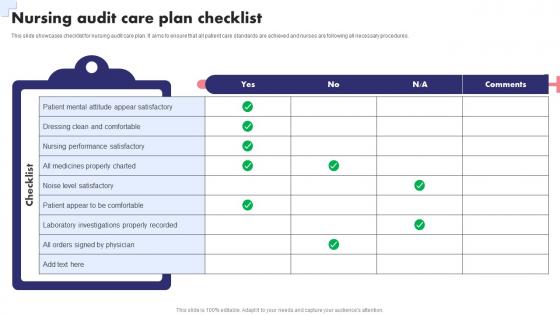
Nursing Audit Care Plan Checklist




Try Before you Buy Download Free Sample Product
 Impress Your
 Audience
 100%
100% Editable
 Save Hours
 of Time


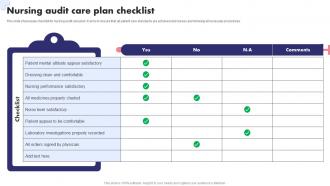
This slide showcases checklist for nursing audit care plan. It aims to ensure that all patient care standards are achieved and nurses are following all necessary procedures.
People who downloaded this PowerPoint presentation also viewed the following :
Nursing Audit Care Plan Checklist with all 9 slides:
Use our Nursing Audit Care Plan Checklist to effectively help you save your valuable time. They are readymade to fit into any presentation structure.








FAQs for Nursing Audit
So basically, they're doing a quality check on your nursing unit's performance. Think of it as making sure you're hitting all the standards and catching any issues early - like documentation problems or med errors. Honestly, most places are pretty good about using the feedback constructively rather than just pointing fingers. Patient outcomes get compared to evidence-based protocols too. The whole point is spotting patterns before they become major headaches. Then you actually get to implement changes that make your daily work safer and smoother for everyone involved.
Honestly, nursing audits are like quality control for healthcare. You're basically reviewing how care gets delivered, checking documentation, looking at outcomes - all that stuff. Patterns start jumping out at you pretty quickly. Maybe staff aren't following certain protocols consistently, or there's some gap nobody noticed before. It's detective work, which sounds way more exciting than it actually is! But here's the thing - you catch problems early instead of waiting for them to blow up. The whole point is spotting high-risk areas so you can fix them. Better practices, fewer mistakes, safer patients. Just don't let the findings sit in a drawer somewhere.
So there's a few different ways to do this. Retrospective audits are your bread and butter - you're just reviewing charts after patients get discharged. Way easier to fit into your schedule. Concurrent ones happen while patients are still there, which is honestly pretty stressful but catches problems fast. Then there's prospective audits that look at care plans before anything happens. You can also do criterion-based (measuring against benchmarks) or outcome-based (did the patient actually get better?). I'd say start with retrospective since it's the most chill approach. My old supervisor always pushed concurrent but that felt like drinking from a firehose.
Start with the big safety stuff - medication errors, falls, infection rates. That's what'll kill you in an audit. Documentation quality matters too, plus staffing ratios and patient satisfaction. Oh, and don't forget response times for call lights and pain management protocols. The metrics can shift depending on what unit you're on though. Honestly, I've seen people try to track like 15 different things and it becomes a nightmare. Stick to 5-7 key ones max. Safety first, then branch out from there. Way more manageable that way.
Nursing audits are basically your safety net for staying compliant with all those regulatory standards - Joint Commission, CMS, you know the drill. They help you spot problems before the actual inspectors roll up (trust me, way less stressful that way). Once you find gaps, you can fix them with training or policy changes. Honestly, I'd start small - pick one risky area and check it monthly. The consistency is what really makes the difference. It's like going to the gym - results come from showing up regularly, not from one perfect workout. You'll see compliance improve pretty quickly once you're tracking things consistently.
Honestly, tech saves so much time with nursing audits. EHRs let you pull patient data instantly instead of digging through charts for hours. Audit software can flag documentation issues automatically and spit out reports right away - no more waiting around. Some places even have AI that catches quality problems early, which is pretty neat I guess. The real win though? You're not buried under paperwork anymore. More time for actual patient care. I'd start with whatever manual tasks are eating up your day - that's where you'll see the biggest difference.
Honestly, nursing audits are perfect for this. You get real data on where people are actually messing up - not just where they think they need help. Look at the documentation, patient outcomes, all that stuff. Patterns jump out fast. Maybe everyone's forgetting med reconciliation or botching wound care protocols. Way better than surveys where people just guess what they're bad at. I mean, half the time we don't even realize our own weak spots, right? Then you can actually build training around the real problems instead of wasting time on random topics that won't help anyone.
Staff pushback is probably your biggest headache - nobody wants more paperwork when they're already swamped. Plus finding time and people to actually do proper audits? Good luck with that budget conversation. Documentation is usually a mess too, which makes analyzing anything pretty painful. Oh, and training auditors takes forever. But here's the thing - if you can show your team upfront that these audits will actually make their jobs easier (not just create busywork), you're golden. Frame it around better patient outcomes and smoother workflows. Makes all the difference.
So nursing audits zoom in on stuff you actually control as a nurse - med administration, patient teaching, care plans, documentation. Clinical audits are way broader and involve the whole team. Honestly, I think nursing audits are better because you're looking at your own standards instead of getting mixed up with what doctors or pharmacy did wrong. The focus stays on nursing processes and outcomes that actually matter to your practice. Oh, and if you're thinking about starting one? Pick just one thing you want to improve first - don't try to audit everything at once.
Okay so nursing audits are definitely worth doing - they catch medication errors and care gaps before things get messy. I know they seem boring as hell, but the data's pretty solid on this. Units that audit regularly have better infection rates and shorter stays. Patient satisfaction goes up too, which is nice since those scores matter so much now. The trick is you can't just collect the info and shove it in a drawer somewhere. You've got to actually change your protocols based on what you find. Otherwise it's just busy work.
Yeah, totally! Nursing audits work great for measuring specific interventions. Just design your criteria around whatever you're testing - pain protocols, fall prevention, that kind of stuff. Here's the thing though: most audits I've seen are pretty useless because they only check if documentation happened, not if patients actually got better. That's backwards thinking if you ask me. You want to track real outcomes alongside your process stuff. Like, did pain scores drop AND did nurses follow the protocol? Mix those two and you'll actually know what's working instead of just checking boxes.
Monthly audits for high-risk areas, quarterly for everything else - that's what actually works. I mean, annual audits are basically useless at this point with how fast things change. Yeah it seems like overkill but you'll catch problems way earlier. Plus throw in some random spot checks when weird patterns pop up or after incidents happen. Honestly the upfront work pays off because you're not scrambling to fix massive issues later. Just map out your schedule now so your team isn't constantly surprised by audit day.
Honestly, three things will save your butt here. Get everyone using the same data collection tools and criteria - nothing tanks credibility like inconsistent methods. Having multiple people review stuff helps catch errors, especially when you're running on fumes at the end of a long day. Your sample size needs to be big enough and actually represent your patient population too. Document everything (I know, boring but necessary) and maybe do some inter-rater checks if you've got a team. Oh, and definitely pilot the whole process small-scale first - trust me, you'll find issues you never thought of.
So basically you gotta match your vibe to whoever you're talking to. Nursing staff need the nitty-gritty stuff that actually affects their day-to-day work - give them concrete action steps they can use. Management? They want the cliff notes version with numbers, trends, and how much it'll cost. Here's what I've learned - always start with the good stuff before hitting them with problems. People shut down otherwise. Charts and graphs are your friend because nobody wants to read through paragraphs of data (honestly, who has time?). And don't forget to book follow-ups to hash out timelines and field their inevitable questions.
Honestly, schedule them regularly instead of waiting for stuff to break - that's when you're already behind. Pick the same tools and criteria every time so you can actually compare results between teams. Otherwise it's just random data that doesn't help anyone. Share what you find right away and give people clear action items with real deadlines. Too many places treat these like paperwork instead of actually learning anything useful - drives me crazy. Start small though. Maybe 2-3 areas monthly until it becomes routine, then expand from there.
-
Extensive range of templates! Highly impressed with the quality of the designs.
-
Fantastic collection of visually appealing PowerPoint templates. They certainly uplift the look of the presentation.