


Omnichannel Customer Journey Flowchart In Retail Business




Try Before you Buy Download Free Sample Product
 Impress Your
 Audience
 100%
100% Editable
 Save Hours
 of Time


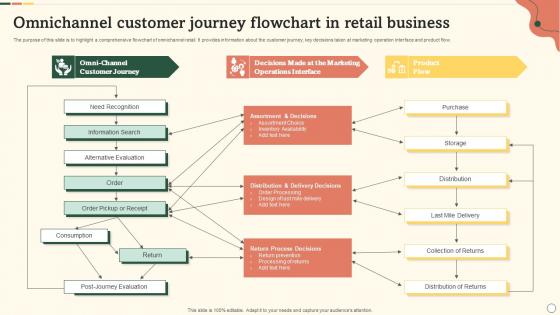
The purpose of this slide is to highlight a comprehensive flowchart of omnichannel retail. It provides information about the customer journey, key decisions taken at marketing operation interface and product flow.
People who downloaded this PowerPoint presentation also viewed the following :
Omnichannel Customer Journey Flowchart In Retail Business with all 6 slides:
Use our Omnichannel Customer Journey Flowchart In Retail Business to effectively help you save your valuable time. They are readymade to fit into any presentation structure.





FAQs for Omnichannel Customer Journey Flowchart
Honestly, it's all about making sure customers don't hit weird roadblocks when they switch between your app, website, and store. First thing - get your inventory synced so they can actually see what's available everywhere. Customer data should follow them around too, like their preferences and order history. Brand consistency matters but the fulfillment stuff is where people really notice. Buy online, pick up in store? Ship from whatever location is closest? That's gold right there. Data integration is genuinely the biggest pain to set up, but you'll hate yourself later if you skip it. I'd start by listing every place customers interact with you, then figure out where things get clunky between them.
Yeah, so people shop totally differently depending on where they are. Store shoppers browse around and grab random stuff - I do this all the time at Target honestly. Online folks research everything and hunt for deals. Mobile users just want quick answers like store hours or if something's in stock. Social media is all about what their friends recommend. Here's the annoying part though - most people bounce between all these channels while deciding what to buy. You'll need to map out those customer journeys to see where they're going. That's where the real patterns show up.
Okay so data analytics basically lets you see how customers actually move between your different channels instead of just guessing. Like someone might browse stuff on their phone, then call your store, then buy online later - without analytics you'd never connect those dots. The patterns are honestly wild once you start looking at them. You can predict what people want and personalize their experience way better. Plus it keeps your pricing and inventory synced up everywhere, which customers definitely notice when it's off. I'd start by mapping out how your customer data flows first, then build from there.
Get yourself a proper brand style guide first - logos, colors, fonts, messaging, the whole thing. Then actually make your teams use it lol. I swear half the brands I see have their email people doing totally different stuff than social media. It's so weird for customers. Train everyone who touches customers so they're giving the same vibe whether it's in-store, online, or phone support. Oh and check your channels monthly to spot inconsistencies before customers do. Nothing kills trust faster than feeling like you're dealing with completely different companies.
Honestly, start with a customer data platform - that's your foundation right there. Without it you're just guessing what people want across different channels. Then grab inventory software that actually syncs in real-time (learned this the hard way), plus a POS system that works everywhere. APIs are annoying but necessary since nothing talks to each other otherwise. Oh, and mobile optimization obviously. Analytics tools help track how customers move around too. The CDP thing is really key though - I'd prioritize that over everything else.
So basically track how customers move between your different channels - conversion rates, lifetime value, that stuff. Revenue and satisfaction scores matter too, but honestly the real gold is seeing the full customer journey instead of just looking at each channel separately. Like how many people research online then buy in-store, or what happens to order values when they use multiple touchpoints. Oh and don't go crazy trying to measure everything - pick maybe 3-5 metrics that actually connect to what you're trying to achieve. Way easier to act on.
Data silos are gonna be your worst enemy - nothing talks to each other so tracking customers becomes impossible. Real-time inventory is a total mess too since people expect to see accurate stock everywhere. Staff training takes forever, especially for weird situations like processing online returns in-store. Oh and the tech integration costs? Brutal. Legacy systems make everything ten times harder than it should be. Honestly though, don't try to fix everything at once. Pick something like unified inventory first and actually get it working before you move on to other stuff.
Honestly, personalization is what makes omnichannel actually work instead of just being a buzzword. You're tracking what customers like and how they shop, then showing them relevant stuff everywhere - your app, emails, physical store, whatever. Nobody's trying to buy winter coats in July, you know? But here's where it gets cool: your store employees can see what someone browsed online, and your website knows their purchase history from when they came in last week. The magic happens when you connect all that data so each interaction feels natural. Like you're picking up where you left off instead of starting over every single time.
Get a system that actually tracks everything in real time - online, in-store, mobile, the whole thing. Otherwise you'll oversell and piss people off (learned this during our Black Friday disaster lol). Safety stock is your friend for popular stuff. Also, let stores ship orders directly instead of routing everything through one warehouse. Makes zero sense not to do this honestly. Start by figuring out where you're currently blind to stock levels. Good inventory software that syncs automatically will save your sanity. Oh and set those buffers higher than you think you need.
Honestly, the trick is making your social media actually sell stuff instead of just posting pretty pictures. Connect your Instagram and Facebook to your inventory so people can buy directly from posts. Social listening helps with customer service too - way better than waiting for emails. The real magic happens when someone sees your product on TikTok and can smoothly buy it on your site without starting over. Plus you get instant feedback that's pretty addictive once you start paying attention. Just sync everything with your main e-commerce platform first, then worry about the fancy stuff.
Honestly, mobile commerce is making retailers step up their omnichannel stuff big time. Your inventory has to sync perfectly when someone browses on their phone, buys on laptop, then picks up in store - or whatever weird combo they do. Mobile users bail SO fast if things don't work smoothly between channels. I swear, we've all gotten ridiculously impatient with slow sites. Can't treat mobile like some side project anymore either. It's basically the glue holding all your other channels together now.
Grab feedback from everywhere - your website, app, stores, social media, all of it. Pretty quickly you'll notice the same complaints popping up over and over. Like customers constantly griping about their cart not syncing between devices or not being able to return online stuff in-store. It's wild how often the obvious fixes get missed when you're buried in day-to-day stuff. Focus on fixing the channel-specific problems fast, but also figure out where your systems aren't playing nice together. Oh, and definitely do monthly check-ins to see which issues keep haunting you.
Dude, AR and VR are seriously changing how people shop. Customers can try on clothes virtually or see how that couch would look in their living room - some of this tech is honestly getting scary realistic. It bridges your online and in-store experiences perfectly. People get the same immersive vibe whether they're browsing on their phone or actually in your shop. I'd start with basic AR for product visualization, maybe let people see items in 3D first. Trust me, customers are gonna expect this stuff sooner than you think.
Honestly, the biggest thing is making sure customers can earn and use points everywhere - your website, app, physical stores, all of it. Nothing's more annoying than when systems don't sync up and someone loses their progress. Get your customer data unified first so their rewards and shopping history actually follows them around. Then personalize based on how they shop across different channels. I'd start by checking where your current setup is broken - like, can someone earn points in-store but only redeem online? That stuff drives people crazy. Fix those gaps and you're golden.
Honestly, the biggest headache is making sure you're protecting customer data everywhere - your website, mobile app, physical stores, social channels, all of it. Each channel usually has its own security setup, which is where hackers slip through the cracks. You'll want consistent encryption and PCI compliance across everything. API security matters too since these systems are constantly sharing data back and forth. I'd start with auditing each touchpoint first. Then standardize your protocols - way easier said than done, but that's the goal.
-
Great product, helpful indeed!
-
Graphics are very appealing to eyes.