


Operating rhythm defines daily weekly and monthly process




Try Before you Buy Download Free Sample Product
 Impress Your
 Audience
 100%
100% Editable
 Save Hours
 of Time


Our Operating Rhythm Defines Daily Weekly And Monthly Process allow your thoughts to exist in enviable comfort. They act like a safe haven.
People who downloaded this PowerPoint presentation also viewed the following :
Content of this Powerpoint Presentation
Description:
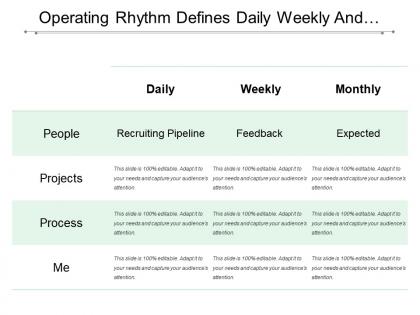
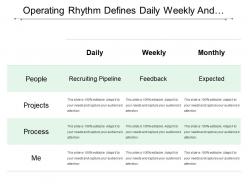
The image is a PowerPoint slide titled "Operating Rhythm Defines Daily Weekly And...", suggesting that the content to be discussed is related to the structuring of operations on a daily, weekly, and monthly basis. The table is divided into three main columns labeled "Daily," "Weekly," and "Monthly," each addressing different aspects of business operations: People, Projects, Process, and Me.
1. Under "Daily" in the "People" row, the term "Recruiting Pipeline" is mentioned, which likely refers to the continual process of identifying and attracting potential job candidates. This would involve daily tasks such as reviewing resumes and conducting initial screening calls.
2. The "Projects" and "Process" rows, under all time frames (Daily, Weekly, Monthly).
3. The "Weekly" column only has a term under "People" - "Feedback," implying that there may be a structured time for giving or receiving feedback on a weekly basis.
4. Under "Monthly" in the "People" row, we see "Expected," suggesting that monthly expectations for staff or team performance are to be set or reviewed.
Use Cases:
This slide template could be applied in a variety of industries for planning and structuring operations:
1. Human Resources:
Use: Structuring the recruitment process and employee feedback mechanisms.
Presenter: HR Manager
Audience: HR Team
2. Project Management:
Use: Planning project timelines and process reviews.
Presenter: Project Manager
Audience: Project Team
3. Manufacturing:
Use: Organizing workforce, production schedules, and quality control checks.
Presenter: Operations Manager
Audience: Manufacturing Staff
4. IT Services:
Use: Managing IT project development cycles and maintenance processes.
Presenter: IT Director
Audience: IT Department Staff
5. Retail:
Use: Scheduling staff rosters, inventory management, and customer service enhancements.
Presenter: Store Manager
Audience: Store Employees
6. Education:
Use: Curriculum planning, teacher evaluations, and process improvements.
Presenter: School Principal
Audience: Teaching Staff
7. Finance:
Use: Financial reporting, compliance checks, and performance forecasting.
Presenter: CFO or Financial Controller
Audience: Finance Department Staff
Operating rhythm defines daily weekly and monthly process with all 5 slides:
Identify areas for further growth with our Operating Rhythm Defines Daily Weekly And Monthly Process. It helps develop infrastructure.

FAQs for Operating rhythm defines daily weekly
Dude, you absolutely need operating rhythm or your team turns into chaos. Regular check-ins and planning sessions mean people actually know when stuff's happening instead of getting blindsided by random meetings all the time. Everyone can plan their work better when they know the schedule. Plus it builds trust - people know they'll get their turn to speak up about problems or wins. The tricky part is nailing the right frequency for your specific team. Some groups need weekly touch-bases, others can go longer. But honestly? Stick to whatever you pick, even when everything's on fire. That's when rhythm matters most.
Dude, it's like giving your team a heartbeat for work. Regular check-ins mean you're not constantly hunting people down for updates. Weekly touchpoints let you catch problems before they blow up, and everyone knows when decisions are due. Honestly, it prevents so much unnecessary chaos - I can't stress this enough. You'll spot roadblocks early and keep everyone aligned on what actually matters. Monthly deeper reviews work well too. Start simple though, then tweak the timing based on what clicks with your specific projects and team vibe.
Honestly, you just need three things sorted out. First - stick to a meeting schedule that actually works. Weekly team check-ins, monthly reviews, quarterly planning. Don't be like my last company that moved everything around constantly (such a mess). Second thing is making sure everyone knows who decides what and when. Nobody should be confused about decision-making authority. Also get some kind of system for sharing updates between teams - could be dashboards or just regular status reports, whatever fits your culture. I'd start by looking at what meetings you already have and see what's missing.
Honestly, remote teams just have to be way more intentional about everything. No more popping by someone's desk for quick questions - instead you're scheduling calls and writing way more stuff down. Office teams get those random coffee conversations that actually solve problems, which is pretty nice. But here's the thing - remote teams often end up being better communicators because they're forced to be clear about everything. The tradeoff is you lose some spontaneity. I'd map out how your team currently stays in touch and see what gaps you've got. Sometimes you don't realize how much those casual office moments were doing until they're gone.
Dude, communication is literally everything here. Most rhythm breakdowns happen because people just stop talking to each other - not because the process sucks. You need those regular check-ins and everyone has to know what's happening when. I'm talking about being super transparent with progress updates, blockers, all that stuff. Over-communicate rather than leaving people guessing. Those recurring meetings? Actually stick to them. I know it sounds boring but consistency is what makes the whole thing work. Oh, and transitions are where things usually go sideways, so double down on communication during those times especially.
Start by writing down all your recurring stuff - meetings, reports, decisions - and see what's actually working versus what's just happening on autopilot. Half your team meetings are probably just glorified status updates anyway. Ask your team what feels broken or slow. Check if the right people are making decisions at the right time. Does info flow smoothly between your managers and everyone else? The goal is figuring out which parts of your rhythm give people energy and which parts just suck the life out of everyone.
Honestly, the worst thing you can do is go overboard with meetings right away. People will hate you for it. I've watched teams get completely buried under metrics that literally don't matter - like tracking stuff just to track it, you know? Start small instead. Pick one meeting that actually serves a purpose, maybe track 2-3 things max. Don't forget to explain WHY you're doing this or everyone thinks it's just busywork. Oh, and give it time to work - at least three months before you start tweaking everything again.
Honestly, tech just handles all the annoying stuff so you don't have to think about it. I set up project management tools for consistent meeting schedules and automated dashboards that show me what I actually need to see. Calendar blocking is huge for protecting focus time - game changer. The mental relief of not tracking everything manually? *Chef's kiss.* Recurring templates for weekly reviews save tons of time, plus status updates can run themselves. Oh, and connecting your different systems through integration tools is worth the setup hassle. Just pick one workflow to automate this week and see how it feels.
Honestly, just pick 2-3 things that actually matter to your team and check monthly. Meeting attendance is obvious - are people showing up? Then look at how fast you're making decisions and whether action items actually get done on time. The real test though? Ask people directly if meetings feel worth their time - they'll be brutally honest about whether it's working or just another time suck. Oh, and track if problems are getting caught early instead of exploding later. Cross-team alignment improving is another good sign, but don't overcomplicate it with too many metrics right off the bat.
Honestly, when things get chaotic you've gotta meet way more often. Weekly check-ins instead of monthly ones. Maybe even daily if it's really bad. Your quarterly planning? Forget it. Break everything into 2-4 week chunks so you can actually pivot when stuff changes - and it will change, trust me. The other thing is communication. I know it sounds obvious but people get weird when they're uncertain, so you'll need to overcommunicate everything. Keep some structure but don't be married to your original plans because they're probably gonna get tossed anyway.
Honestly, the trick is linking your big goals to actual recurring meetings. Your quarterly reviews should track strategic stuff, not just day-to-day ops - I've watched so many teams waste time on boring updates instead. Monthly check-ins help you pivot when numbers look off. Try timing everything with your natural business cycles, like budget season or when products launch. Oh, and definitely assign someone to own each initiative - otherwise it just sits in some forgotten PowerPoint. Give those owners a regular spot to update everyone. Trust me, without that structure your strategy dies a slow death.
Look, you gotta model what you want to see. When you're always in panic mode, your team picks up on that energy and mirrors it back. Be super clear about what's actually urgent vs what can wait until tomorrow - I swear, some managers treat ordering lunch like a five-alarm fire. Block out focus time for yourself and guard your team's deep work hours too. Tell them your rhythm straight up - like "mornings are for strategic stuff, afternoons for putting out fires." And here's the thing that really matters: reward the teams hitting their goals sustainably, not the ones pulling all-nighters every week.
So you've got a bunch of options here. Notion and Confluence are pretty decent for writing down meeting schedules and how decisions get made. RACI matrices help clarify roles if your team likes structure. There's also this "Ways of Working" canvas thing that covers everything. But honestly? Sometimes a basic Google Doc does the trick. The real challenge is getting people to actually use whatever you pick (good luck with that). I'd start by just documenting your current meetings first. Don't overthink it - you can always add more later once people are on board.
Honestly, having a predictable rhythm actually makes people more engaged, not less. Your team knows when meetings happen and when their voice counts. Without that structure, everyone's just waiting around for decisions or wondering if their work even matters - super frustrating. It's kinda like working out regularly, you know? The routine builds momentum instead of holding you back. But here's the thing - it only works if you're actually having real conversations, not just those boring status meetings where everyone zones out. People need to feel connected to what's happening.
Look at Amazon - they're obsessed with those weekly business reviews and it's honestly part of their secret sauce for moving fast. Microsoft totally turned around when Satya started doing quarterly reviews plus weekly leadership check-ins. Toyota's been crushing this forever with their production rhythms. Even smaller players like Buffer and HubSpot get it right with consistent all-hands and sprint planning. The thing that stands out? None of them treat these as "optional" meetings that get bumped for random stuff. If you're gonna try this, just start with one weekly leadership sync - don't go crazy trying to copy everything at once.
-
Best way of representation of the topic.
-
Top Quality presentations that are easily editable.