


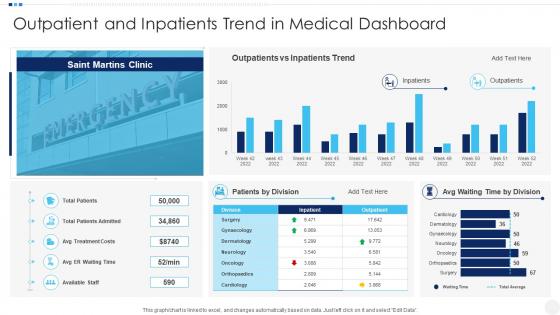
Outpatient And Inpatients Trend In Medical Dashboard




Try Before you Buy Download Free Sample Product
 Impress Your
 Audience
 100%
100% Editable
 Save Hours
 of Time


People who downloaded this PowerPoint presentation also viewed the following :
Outpatient And Inpatients Trend In Medical Dashboard with all 7 slides:






FAQs for Outpatient And Inpatients Trend
Focus on real-time data viz and role-based access first. Critical alerts need to be front and center - nobody wants to hunt for urgent stuff. Let users drill down from overview to patient details without getting lost in a maze of clicks. Most medical dashboards are honestly trash that sit unused. Customization is huge since ER docs need totally different metrics than administrators. Oh, and mobile support isn't optional anymore. Before you build anything, shadow your actual users for a day. You'll quickly see what decisions they're making and which metrics actually matter to them.
Honestly, data visualization is a total lifesaver for healthcare data. You know how you used to spend forever digging through spreadsheets? Now you get real-time charts that instantly show patient trends and where your resources are going. I can spot infection patterns or bottlenecks way faster than before - it's crazy how much time it saves. The trick is focusing on metrics that actually matter for your job, not just random pretty graphs. Though I'll admit, some of the dashboards look pretty cool too! But yeah, it really helps you catch problems before they blow up into bigger issues.
Look, real-time data is what separates useful medical dashboards from fancy wallpaper. Yesterday's ICU numbers during a crisis? Totally worthless. You need instant updates for life-threatening stuff - vitals, emergency alerts, that kind of thing. Non-critical metrics can update every few minutes, but when someone's crashing, seconds matter. It's honestly crazy how many places still rely on outdated info for critical decisions. Real-time feeds let you catch problems early and actually respond to what's happening now instead of reacting to old news.
Gamification is where it's at right now - progress bars, badges, health streaks that actually make people want to open the app. Like Fitbit but for everything health-related. Patients can set personal goals instead of just hitting clinical targets, which makes way more sense honestly. Interactive stuff is replacing those awful static charts - draggable med schedules, clickable body maps. Oh and social features are killing it too. Care team messaging, family sharing, all that. I'd probably start small though - just gamify whatever metric your patients hate tracking most.
So medical dashboards are getting crazy smart now - they're running AI models that predict patient outcomes and readmission risks in real-time. Risk scores show up right next to vitals, plus you get alerts for patients who might crash in the next 6-12 hours. Honestly, the accuracy is pretty impressive these days. The magic happens when machine learning digs through your historical data and spots patterns. Most systems let you tweak alert settings for your specific patient mix, which is nice. My advice? Figure out which predictions would actually make you change treatment decisions first - that's where you'll see real impact.
Dude, you absolutely have to nail the privacy stuff upfront or it'll come back to haunt you. Role-based access is huge - map out who actually needs what patient data first, then build permissions around that. Encrypt everything (in transit and at rest), set up proper audit logging, and get your HIPAA compliance sorted from day one. De-identify data whenever you can swing it. The golden rule? Show people the bare minimum they need to do their job. Trust me, this isn't something you want to retrofit later when you're already live.
Cardiology wants real-time vitals and ECG trends right up front. Radiology's totally different - they're all about imaging queues and turnaround times. Emergency dashboards? Pure organized chaos with bed availability and critical alerts going off constantly. Oncology teams need the long view though - treatment protocols and lab trends spanning months. Here's the thing that actually matters: sit with each team and watch how they actually work. Don't just ask what they want because honestly, people aren't great at explaining their own workflows. Each specialty has completely different priorities and you'll miss the nuances if you don't see it firsthand.
Honestly, mobile dashboards are huge for healthcare. Doctors can pull up patient data from anywhere - checking labs between rooms, reviewing charts during rounds, whatever. Response times get way better when the whole team stays connected. Patients win too since their providers have the full picture in real-time. Just don't cheap out on the mobile version (I've seen some terrible ones). Test it on actual phones and tablets first - you'd be surprised how many places skip that step and end up with clunky interfaces that nobody wants to use.
Honestly, dashboards are game-changers because everyone's finally looking at the same info instead of playing that annoying telephone game with patient updates. No more hunting people down to ask about bed availability or whatever - it's all right there. Think of it as your unit's command center that actually makes sense to doctors, nurses, and admin folks. Those old whiteboards were such a pain! The trick is figuring out what data each role actually needs during their shift. Start by asking your team what they're always scrambling to find. You'll be surprised how different everyone's priorities are.
Honestly, the worst thing you can do is cram everything onto one screen - it's overwhelming. Also ditch the medical jargon unless your users are all doctors. Nothing's more annoying than conflicting data between widgets, so make sure your sources are synced up. Oh, and those red/green color combos? Terrible for colorblind people. Here's something that drives me nuts - dashboards that auto-refresh constantly while you're trying to focus. Super distracting. My advice? Figure out who's actually using this thing first. Then design for their workflow instead of trying to make everyone happy (spoiler: you can't).
Dude, ML can totally transform your medical dashboards from just showing old data to actually predicting what's coming next. Your algorithms will spot patterns and warn you about potential complications or which patients might get readmitted. Different staff see different alerts too - nurses get clinical flags while admins see operational stuff. The system learns as it goes, which is honestly pretty neat. Oh, and don't try to do everything at once. Pick one predictive feature to test first and see how your team handles it.
Patient safety stuff comes first - infection rates, readmissions, mortality data. Can't mess around with those. After that, look at operational things like bed occupancy and ER wait times. Financial metrics are obvious too - cost per patient, revenue cycle speed, all that jazz. Honestly, less is more here. Pick maybe 8-12 metrics tops or you'll drown in data nobody looks at. Real-time updates are clutch. Oh and start with whatever your leadership actually checks daily - no point building something fancy they'll ignore. Keep it simple and focused on what moves the needle.
Dude, integration is everything with these dashboards. Your team will hate you if they have to jump between five different systems just to pull patient info. Trust me on this one. Look for something with solid APIs and connections to your current EHR and lab systems. I've watched perfectly good dashboards get ditched because they needed too much manual typing - nobody's got time for that. Either find one that connects easily or set aside extra cash for custom work. Oh, and maybe test it with a few staff first? They'll tell you real quick if it's gonna work.
Honestly, AI analytics are crazy right now - predictive stuff that catches patient issues before they blow up. The voice interfaces actually work well, which shocked me because I thought they'd be garbage in hospitals. You can literally just ask questions instead of hunting through a million menu tabs. Machine learning customizes your dashboard based on what you actually do, so less clutter. Natural language processing is solid too. Fair warning though - these AI platforms have a learning curve that'll kick your ass if you're not ready for it. Worth starting now while you have time to figure it out.
Run usability sessions with real patients - have them talk through using your dashboard out loud. You'll catch stuff your team would never spot. After portal visits, send quick surveys asking what confused them or what's missing. Focus groups work too, but honestly they get messy with all the privacy rules in healthcare. Monthly feedback collection, then roll out changes quarterly. Patients actually notice when you act on their input instead of just collecting it. The trick is watching what people actually do, not guessing what they want.
-
Excellent Designs.
-
Innovative and Colorful designs.