


La mala comunicación conduce a conflictos en el lugar de trabajo Ppt de capacitación




Try Before you Buy Download Free Sample Product
 Impress Your
 Audience
 100%
100% Editable
 Save Hours
 of Time


Estas diapositivas cubren la mala comunicación como una razón detrás de los conflictos en el lugar de trabajo. También proporciona información sobre lo que conduce a una comunicación deficiente en el lugar de trabajo, que son objetivos poco claros, comentarios limitados e incapacidad para aceptar. Además, analiza el impacto de la mala comunicación en el lugar de trabajo, como un entorno de trabajo impredecible, menos colaboración y baja moral.
People who downloaded this PowerPoint presentation also viewed the following :
Contenido de esta presentación de Powerpoint
Diapositiva 1
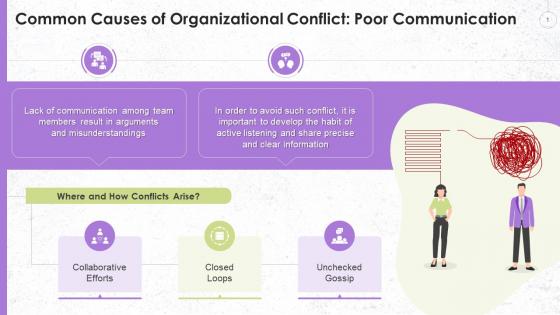
El propósito de esta diapositiva es resaltar cómo la falta de comunicación puede generar conflictos en el lugar de trabajo. También incluye detalles de las áreas donde surge la disputa, como esfuerzos de colaboración, circuitos cerrados y chismes sin control.
Notas del instructor:
Las áreas donde surge el conflicto son:
- Esfuerzos de colaboración : cuando se trabaja en un proyecto de equipo, si un gerente no define ni comunica claramente los roles y los plazos, puede provocar el incumplimiento de los plazos y, posteriormente, señalar con el dedo y jugar con la culpa.
- Circuitos cerrados : la falta de comunicación entre los departamentos genera conflictos. Por ejemplo, los empleados del departamento de ventas dieron un descuento adicional en los productos para lograr su objetivo, sin comunicarlo al departamento de finanzas.
- Chismes sin control : la información falsa que circula por la oficina puede crear tensión entre los empleados y, finalmente, generar conflictos. Algunas formas comunes de chismes sin control son:
- Preocupaciones sobre la seguridad laboral
- Dudas sobre los planes/futuro de la empresa
Diapositiva 2
Esta diapositiva muestra la importancia de la comunicación para minimizar los conflictos en el lugar de trabajo. Explica que una buena comunicación ayuda a evitar conflictos y proporciona las condiciones ideales para mejorar la productividad y el crecimiento.
Notas del instructor:
La buena comunicación ayuda a minimizar los conflictos en el lugar de trabajo de la siguiente manera:
- Evitar confusiones
- Proporcionar propósito
- Fomentar una cultura empresarial transparente
- Crear responsabilidad
- Mejorar la productividad y el crecimiento
Diapositiva 3
Esta diapositiva enumera múltiples causas de mala comunicación en el lugar de trabajo, como liderazgo deficiente, objetivos poco claros, retroalimentación limitada, empleados desmoralizados e incapacidad para aceptar.
Notas del instructor:
Las diferentes causas de la mala comunicación en el lugar de trabajo son:
Liderazgo deficiente:
- En una organización, los empleados buscan la dirección de sus gerentes
- La buena comunicación de la alta dirección ayuda a motivar a los miembros del personal a ser más motivados e innovadores.
- Los buenos líderes siempre comunican sus objetivos, metas y visiones futuras
- La mala comunicación comienza cuando los gerentes no pueden responder preguntas o aclarar puntos.
Objetivos poco claros:
- En una organización, es necesario comprender claramente los objetivos de los empleados.
- Requiere empleados enfocados y conectados que sean conscientes de lo que sus empleados exigen de ellos.
- Si el gerente no proporciona instrucciones, esto podría generar confusión y frustración entre los empleados. Esta es una forma segura de crear un conflicto innecesario.
Comentarios limitados:
- La retroalimentación es importante en cualquier organización para un mejor desempeño del personal
- La mala comunicación, al dar retroalimentación, dificulta el desempeño del personal
Diferencias culturales:
- En una organización, la diversidad cultural es importante ya que ayuda a las empresas a obtener nuevas ideas para una mayor creatividad e innovación.
- Las diversas culturas pueden conducir a una comunicación deficiente, ya que las personas son reacias a cambiar o aprender lo que la persona realmente quiere decir. Por ejemplo, algunas comunicaciones dependen de símbolos, que se malinterpretan fácilmente.
- Los empleados que trabajan en organizaciones provienen de diferentes culturas y orígenes, y su forma de comunicación es diferente.
- Los malentendidos convierten la conversación en un conflicto.
Diapositiva 4
Esta diapositiva enumera las consecuencias de una comunicación deficiente en el lugar de trabajo, como un entorno de trabajo impredecible, una colaboración menos eficaz, conflictos en el lugar de trabajo y baja moral.
Notas del instructor:
Las consecuencias de una mala comunicación son:
Conflicto en el lugar de trabajo:
- La mala comunicación puede causar tensión entre los empleados, lo que hace que el conflicto sea inevitable.
Ambiente de trabajo impredecible:
- La comunicación poco clara provoca problemas como el etiquetado de una empresa como una organización inestable. Esto tiene repercusiones en las ventas y la percepción del cliente.
- Los empleados carecen de una comprensión clara del proyecto, lo que reduce la productividad
Colaboración menos efectiva:
- La colaboración y la comunicación van de la mano
- La colaboración ayuda a promover el autoanálisis y la resolución efectiva de problemas.
Baja moral:
- Se vuelve difícil para los empleados cumplir con las expectativas debido a la mala comunicación cuando la comunicación es deficiente, lo que hace que los empleados se sientan avergonzados e incluso desarrollen una baja autoestima. En última instancia, es el negocio el que paga el precio en términos de menor productividad.
La mala comunicación conduce a un conflicto en el lugar de trabajo Ppt de capacitación con las 20 diapositivas:
Utilice nuestro Ppt de Capacitación sobre Conflictos en la Comunicación deficiente para ayudarlo a ahorrar su valioso tiempo. Están listos para encajar en cualquier estructura de presentación.







FAQs for Poor Communication Leads To Workplace
Honestly? It's usually about talking past each other. Some people want it straight, others need you to be gentle - total mismatch there. Then nobody's clear on deadlines or who's doing what, so everyone just assumes different things. Email makes everything worse too - you think you sound normal but they're reading it like you're pissed off. Oh, and when people have competing priorities, forget about it. Best thing you can do is spell everything out from the start. Also just call them instead of going back and forth over email forever.
Honestly, active listening works because you're actually hearing what they mean instead of just planning your comeback. I do this thing where I repeat back what I heard - "so you're saying..." - and it catches so many miscommunications early. People get way more cooperative when they feel heard too, which is kinda obvious but we forget it. The trick is not formulating your response while they're talking (guilty of this constantly). Try summarizing their point first before you jump in with yours. Makes everything flow better.
Ugh body language is SO important during fights. Like, you can say all the right words but if you're rolling your eyes or crossing your arms, you're basically screaming "screw you" without opening your mouth. Your tone matters too - I've accidentally made "I understand" sound super sarcastic before lol. Eye contact helps though, and keeping your posture open instead of all closed off. Even leaning away sends the wrong message. It's wild how much our bodies talk for us. Definitely something I had to learn the hard way!
Okay so here's what I'd do - make a basic template that has separate spots for actual facts versus how you're feeling about stuff. Use "I" statements instead of pointing fingers at people. Most folks just dive into these conversations without any plan, which is honestly why they blow up half the time. Build in some pause moments where you can actually think before responding. Oh, and leave room to acknowledge what the other person is saying too - that part's huge. Focus on what someone did rather than attacking who they are as a person. Just start with one simple template for team stuff and try it out next time things get heated.
Okay so first thing - slow down and drop your voice lower. It seriously helps dial things back. Actually listen to what they're saying instead of planning your comeback (I'm terrible at this when I'm pissed but it works). You can acknowledge their point without agreeing: "I get why you'd see it that way." Stick to the real issue, not old drama or personal jabs. Ask questions instead of just stating your case - it gets you both thinking solutions rather than who's right. And honestly? If it's still getting heated, just call a 10-minute timeout.
Honestly, culture affects pretty much everything when it comes to communication and conflict. Germans tend to be super direct, while many Asian cultures are more about saving face and being indirect. So if you're someone who tackles problems head-on, a colleague might think you're being aggressive when you're just trying to help. Eye contact, pauses in conversation, how you build your arguments - it all varies. I learned this the hard way at my last job! Instead of assuming everyone communicates like you do, just ask people upfront what works best for them.
Dude, emotional intelligence is a game changer for this stuff. You start picking up on your own triggers - like when you're getting all defensive - plus you can actually read when the other person feels completely unheard. That's when you know to switch up your approach. I've literally caught myself about to say something stupid so many times just by pausing first instead of immediately reacting. You'll ask way better questions too. Finding common ground becomes easier when you're tuned into everyone's emotional state, not just bulldozing through the conversation. Try checking in with both your feelings and theirs next time things get tense.
Stop every 10-15 minutes and ask "what questions do you have so far?" Catches problems before they explode. I learned this after a presentation totally crashed and burned once - still cringe thinking about it! For tricky topics, try anonymous polls with Mentimeter. Sometimes I'll just say "I'm seeing some hesitation here, let's talk about it." Frame pushback positively: "what challenges do you see?" Don't wait until the end to ask for questions - that never works. Schedule specific feedback moments instead. Makes it feel normal, not awkward.
So there are five stages conflicts go through: latent tension, emergence, escalation, stalemate, then resolution. A flowchart would work great for your presentation - maybe use arrows showing it's not always linear since people bounce around between stages. Color coding could help too (red for escalation, green for resolution). Most conflicts get stuck in escalation or stalemate because nobody realizes what stage they're actually in. That's the key point to hammer home. Oh, and definitely throw in some workplace examples - makes it way more relatable than just theory.
So basically structure your whole presentation around conflict resolution steps. Open with "here's the tension we're dealing with" then dig into different viewpoints before jumping to solutions. DESC method is clutch - Describe what's happening, Express the impact, Specify what you want, then talk through consequences. Used it in my Q4 review and nobody lost their shit! Oh and build in spots for questions throughout. Don't just tackle surface stuff - get at the real underlying issues. Wrap up with who's doing what by when.
Honestly, Slack or Teams are solid for chat and sharing files. Asana's pretty good for keeping track of who's doing what - way better than endless email chains. Recording your Zoom calls is actually super helpful for people who miss meetings. Google Docs work great when you need to edit stuff together. Oh, and Loom's clutch for those moments when explaining something over text would take forever. Don't go crazy picking like 10 different tools though. Stick with 2-3 max, otherwise nobody'll use them consistently. Start with whatever your team already knows.
So here's what works - tell a story that mirrors their situation instead of jumping straight into the drama. People get way less defensive when you're talking about "another team" or "this company I heard about." Honestly, I've watched entire hostile meetings flip once someone shares a relatable case study. It's weird how effective it is. Your audience stops feeling attacked and starts thinking solutions. Quick example: instead of saying "our numbers suck," open with how Company X faced similar challenges and what they discovered. Boom - you're collaborating, not pointing fingers. Worth trying next time things get heated.
Ugh yeah, remote work definitely makes conflicts messier. You can't pick up on body language or tone, so things get misunderstood way easier. The worst part? Issues just sit there in email threads getting worse while nobody realizes how heated it's getting. I've seen stupid arguments drag on for days through Slack when they could've been solved in like 2 minutes face-to-face. People also get way more blunt over text than they'd ever be in person - it's weird how that works. My advice? The second you feel any tension brewing, just hop on a quick video call. Don't let it fester.
Look for programs that teach de-escalation and active listening - the role-playing part feels super cringey but it actually helps. You'll want training that shows you your own triggers too, since half the battle is knowing what sets you off. The good ones give you actual conversation scripts instead of just theory. I went through one last year and honestly? Having those templates saved my butt during a heated client call. Don't pick anything too corporate-speak heavy. Find something practical where you can practice handling real workplace drama.
Look, your leadership style basically becomes your team's playbook for handling conflict. When you're collaborative and open about problems, they'll tackle issues directly instead of dancing around them. Authoritative leaders? Their teams usually wait for marching orders or just ignore problems entirely - both options suck, tbh. I've noticed democratic leaders create those environments where people actually feel safe bringing up disagreements early, which is huge. The thing is, whatever conflict resolution approach you model is what you'll get back from your team.
-
Wide collection of templates available. SlideTeam has made it easier to create presentations in just a few minutes.
-
The service is fast, and I could access any presentation after buying the subscription. I don’t think I’ll ever have to worry about a presentation in my life.