

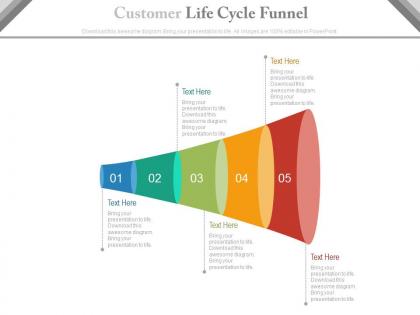
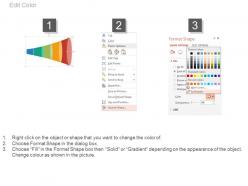
Pptx five staged customer life cycle funnel diagram flat powerpoint design




Try Before you Buy Download Free Sample Product
 Impress Your
 Audience
 100%
100% Editable
 Save Hours
 of Time


Take advantage of our impeccable Ppt mechanism to study the fashion of customer life cycle to strengthen the brand from the root level. Access the infallible tool for the careful and proper scrutiny with its innovative built. Make your striking PowerPoint Presentation a timeliness phenomenon with our pre-designed and easy to recast Ppt designs, creating an ambience for fruitful business discussions and meetings. The vibrant image show is all you need to pierce your unique business ideas for its effective materialization enabling a sticking customer base. The flamboyant slides are crafted to grab the attention and curiosity of the audience at once to trigger the pensive thinking zone. Build an immediate rapport with your viewers by employing the skilled image presentation that accentuates the distinctive features of your customer relationship management. Shred the painstaking measures by adopting a facile approach to mark your business presentations with our convenient templates. Place your order now!. Be big enough for any challenge with our pptx Five Staged Customer Life Cycle Funnel Diagram Flat Powerpoint Design. They enable you to cope.
People who downloaded this PowerPoint presentation also viewed the following :
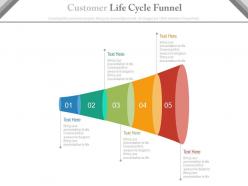
Pptx five staged customer life cycle funnel diagram flat powerpoint design with all 4 slides:
Adhere to good customs with our pptx Five Staged Customer Life Cycle Funnel Diagram Flat Powerpoint Design. You will automatically acquire good habits.
FAQs for Pptx five staged customer life cycle funnel diagram
The customer life cycle funnel includes awareness, interest, consideration, purchase, retention, and advocacy stages, each requiring distinct marketing approaches and messaging strategies. These stages enable businesses to tailor content, allocate resources strategically, and optimize customer touchpoints, with many organizations finding that stage-specific campaigns deliver higher conversion rates and improved customer lifetime value.
Businesses can effectively measure customer life cycle stages through key performance indicators like awareness metrics (website traffic, social media reach), consideration tracking (lead generation, email engagement), conversion rates (sales velocity, deal closure), and retention analytics (customer satisfaction, repeat purchases). These measurement frameworks enable organizations to identify bottlenecks, optimize touchpoints, and enhance customer experiences, with many companies finding that comprehensive tracking ultimately delivers improved conversion rates and sustainable growth.
**INPUT**: What tools and metrics are best suited to analyze customer behavior throughout the funnel stages? **OUTPUT**: Customer funnel analysis tools include Google Analytics, HubSpot, Salesforce Analytics, Mixpanel, and customer journey mapping platforms, while key metrics encompass conversion rates, customer acquisition costs, lifetime value, engagement scores, and retention rates. These technologies streamline behavioral insights by tracking touchpoint interactions, identifying bottlenecks, and predicting churn patterns, with many organizations finding that integrated analytics ultimately deliver deeper customer understanding and competitive advantage.
Different industries adapt the customer life cycle funnel by modifying stages, touchpoints, and metrics to reflect their unique business models and customer behaviors. For example, SaaS companies emphasize onboarding and retention phases with trial periods and usage analytics, while retail focuses on seasonal purchasing patterns and loyalty programs, ultimately enabling more targeted marketing strategies and improved customer experiences across diverse sectors.
Customer segmentation enables businesses to tailor messaging, touchpoints, and experiences at each funnel stage by grouping customers based on demographics, behaviors, purchase history, and preferences. Through targeted segmentation strategies, companies deliver personalized onboarding for new users, customized retention campaigns for loyal customers, and strategic re-engagement initiatives for at-risk segments, ultimately improving conversion rates and maximizing lifetime value.
Content marketing aligns with customer life cycle stages through awareness-building blog posts and social media, consideration-focused case studies and comparisons, decision-enabling testimonials and demos, and retention-driven educational content and exclusive resources. This strategic approach enables businesses to deliver targeted messaging that guides prospects through each funnel stage, ultimately increasing conversion rates and customer lifetime value while building stronger relationships.
Common pitfalls include oversimplifying complex customer journeys, focusing solely on acquisition metrics while neglecting retention data, misaligning funnel stages with actual customer behaviors, and failing to account for non-linear progression through lifecycle phases. These interpretation errors often lead organizations to misallocate resources across touchpoints, ultimately resulting in reduced conversion rates and customer satisfaction, with many businesses finding that regular funnel analysis and cross-departmental collaboration significantly improves lifecycle management accuracy.
Businesses leverage customer feedback through surveys, reviews, social listening, and analytics to identify pain points, preferences, and optimization opportunities across awareness, consideration, purchase, and retention stages. By systematically collecting and analyzing feedback, companies can refine messaging, streamline processes, and personalize experiences at each touchpoint, ultimately delivering improved conversion rates and stronger customer loyalty.
Customer retention represents the foundation of sustainable business growth within the customer life cycle funnel, significantly reducing acquisition costs while maximizing lifetime value through repeat purchases, cross-selling opportunities, and organic referrals. Retained customers in sectors like banking and retail generate 67% more revenue than new acquisitions, with many organizations finding that improving retention by just 5% increases profits by 25-95%.
Personalized marketing strategies enhance customer life cycle funnel effectiveness by delivering targeted content at each stage, increasing engagement rates, and accelerating conversion timelines through data-driven insights. Through advanced segmentation and behavioral tracking, companies across retail, financial services, and healthcare customize messaging that resonates with individual customer needs, ultimately improving retention rates and maximizing lifetime value.
Effective funnel transitions require personalized content delivery, strategic timing optimization, clear value proposition communication, and seamless user experience design across touchpoints. These practices work by addressing specific customer pain points at each stage, providing relevant educational resources, and implementing targeted nurturing campaigns, with many organizations finding that automated workflows and behavioral triggers ultimately deliver higher conversion rates and stronger customer relationships.
CRM systems support customer life cycle tracking by automating data collection, centralizing customer interactions, and providing real-time analytics across acquisition, engagement, and retention phases. These platforms enable businesses to identify conversion bottlenecks, personalize communications, and optimize touchpoints, with many organizations finding that integrated CRM analytics ultimately delivers improved customer experiences and increased lifetime value.
Visualizing customer life cycle funnels reveals critical insights including conversion rates at each stage, bottleneck identification, resource allocation opportunities, customer behavior patterns, and revenue optimization points. These diagrams enable businesses to streamline marketing strategies, enhance customer experiences, and minimize churn, with many organizations finding that visual analysis ultimately delivers improved retention rates and significantly higher lifetime customer value.
Customer life cycle funnel analysis informs product development by revealing pain points, drop-off stages, and engagement patterns across acquisition, activation, retention, and advocacy phases. This data-driven approach enables companies to prioritize feature development, optimize user experiences, and identify innovation opportunities that address specific customer journey bottlenecks, ultimately delivering products that better align with actual user needs and behaviors.
Emerging trends in customer life cycle management include AI-powered personalization, omnichannel integration, predictive analytics, real-time engagement platforms, and automated customer journey orchestration. These technologies streamline customer experiences by delivering personalized touchpoints, anticipating customer needs, and seamlessly connecting interactions across channels, with many organizations finding that strategic automation ultimately enhances retention rates and accelerates revenue growth.
-
Amazing product with appealing content and design.
-
Unique and attractive product design.