


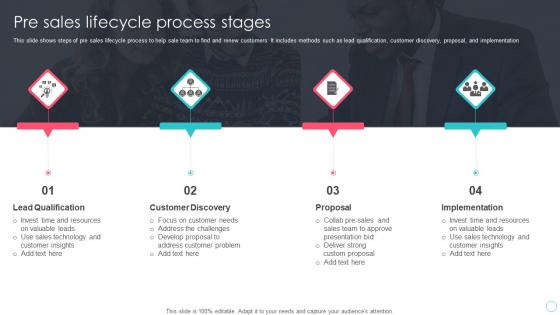
Pre Sales Lifecycle Process Stages




Try Before you Buy Download Free Sample Product
 Impress Your
 Audience
 100%
100% Editable
 Save Hours
 of Time


This slide shows steps of pre sales lifecycle process to help sale team to find and renew customers. It includes methods such as lead qualification, customer discovery, proposal, and implementation
People who downloaded this PowerPoint presentation also viewed the following :
Pre Sales Lifecycle Process Stages with all 6 slides:
Use our Pre Sales Lifecycle Process Stages to effectively help you save your valuable time. They are readymade to fit into any presentation structure.





FAQs for Pre Sales
So there's basically five stages that all connect: lead generation, qualification, discovery, solution design, and proposal/close. First you find prospects, then figure out if they're actually worth pursuing (honestly, most aren't). Discovery comes next - that's where you dig into what they really need. This feeds right into designing your solution. Everything builds on the previous stage, you know? Like, your discovery insights totally shape how you write the proposal. Don't jump around between stages randomly - it's way more effective when info flows forward through the pipeline. Makes the whole process smoother.
Market research and competitor analysis are game-changers for your pre-sales strategy. Look at what messaging actually clicks with your audience and find the pain points your competitors are totally missing. Honestly, it's like getting insider info - you can spot exactly where they're falling short and position yourself as the solution they're not offering. Plus you'll understand pricing expectations way better. Oh and the buyer's journey becomes clearer too. Use all this to create pitches that hit on what prospects genuinely care about. Way more effective than just winging it.
Dude, customer profiling is everything. You gotta know what's bugging them, how they make decisions, what problems they're actually trying to solve. Otherwise you're just another salesperson wasting their time with generic BS. Once you've got that profile down, you can highlight the right features and speak their language. Different stakeholders care about different stuff too. I learned this the hard way - used to give the same pitch to everyone and wondered why deals fell through. Now I position myself as the solution to their specific headache, not just another vendor throwing features at the wall.
Honestly, a good CRM will change your life - tracks all your prospect conversations and handles follow-ups automatically. Video demos work way better than boring emails, trust me on that one. Sales platforms give you instant access to case studies and materials without digging through folders. AI tools can score your leads and tell you what to do next, which saves me like 5+ hours weekly. LinkedIn's great for stalking... I mean researching prospects before you reach out. But seriously, pick one tool first. Don't dump everything on your team at once or they'll hate you.
Stop pitching features - nobody cares about your bells and whistles. Ask discovery questions first, then talk about the problems you actually solve. Like instead of saying "faster processing," say "cuts your processing time by 30%." Way more compelling. Most reps totally blow this part. You've gotta speak their language and connect everything back to their business goals. Throw in some social proof from similar companies if you have it. The whole thing should feel custom-made for them specifically. I mean, that's what separates good reps from mediocre ones - making it about their world, not yours.
Dude, when sales and marketing actually work together, everything clicks. You get leads that aren't garbage, and they come with actual context instead of just a name and email. Marketing creates content that addresses real objections you're hearing - honestly, it's kind of shocking how much better their stuff gets when they know what prospects actually say. No more awkward "here's a contact, figure it out yourself" handoffs. Your discovery calls become way more productive since you're not starting from zero every time. Set up weekly check-ins between teams. Share what's working, what isn't, and nail down what makes a lead actually sales-ready.
Track your conversion rates at every step - lead to qualified opp to closed deal. Demo-to-proposal conversion is where I see most deals crash and burn, so definitely watch that one closely. Time-to-close matters a ton since faster cycles = your pre-sales folks are crushing it. Win rates by deal size and competitor will show you patterns you didn't know existed. Oh, and don't ignore the soft stuff like customer feedback scores. Revenue per pre-sales hour is honestly the metric that matters most, but it's kinda tricky to calculate at first. Start simple with these basics, then get fancy later.
Skip the boring feature dump and tell stories instead. Start with a customer who had the same problems they're dealing with. Like, "Sarah at TechCorp was drowning in manual processes..." hits way harder than "Our platform boosts efficiency 40%." Mini-stories work great throughout - they actually remember that stuff. Problem, solution, results. Keep it tight. Then tie it back to their situation with something like "Sound familiar?" Honestly, I've watched mediocre reps become closers just by switching to this approach. It's kinda wild how much stories change the whole dynamic.
Honestly, the worst part is chasing unqualified leads while good prospects slip away - drives me crazy. Your sales and marketing teams are probably talking past each other too. Most deals die when people just ghost you mid-conversation, which happens way more than it should. Set up some basic lead scoring so you're not wasting time. Get your teams in the same room regularly to actually sync up. Oh, and create a follow-up system with multiple touchpoints - persistence pays off. Look at where you're currently losing people first though. That'll tell you exactly what's broken.
So you're basically creating a filter to weed out time-wasters. Look for budget, decision-making power, actual need, and realistic timing - the classics. Without these, you'll end up chasing people who literally can't buy from you (trust me, it sucks). Short deals close fast. Long ones? They usually don't close at all. Your criteria become like a checklist - is this person actually ready to buy or do they need more warming up? Honestly, sticking to your standards is the hardest part because every lead feels promising at first. But those "maybe" deals that drag on for months will kill your motivation.
Think of a CRM as your team's shared brain for tracking prospects. Every email, call, and meeting gets logged so nobody's wondering if someone already reached out. The automated follow-ups are clutch - honestly saves so much time. What I love most is how anyone can pick up a conversation mid-stream and see the whole history instantly. Plus you can score leads based on how engaged they are, which helps prioritize who to hit up next. I'd start by looking at where your current process is messiest and go from there.
Don't wait for prospects to bring up objections - beat them to it. Ask discovery questions that dig into their concerns and budget stuff early. I literally ask "What would stop you from moving forward with something like this?" and it works way better than you'd think. People actually like the directness. You can also mention concerns you've heard from similar companies and see how they react. Creates a safe space for them to admit their doubts when there's less pressure. Oh and start tracking patterns now - you'll want that objection playbook later.
Definitely dig into those old sales cycles - it's basically free intel sitting right there. Check what messages actually worked with different types of buyers and which objections kept popping up. The deals you lost? Those are honestly the most valuable if you can get feedback. I'd start simple - just make a quick template to jot down what you learned after each deal closes (or doesn't). Then every few months, look for patterns. Teams that do this religiously see their win rates jump pretty dramatically. Worth the time investment for sure.
Honestly, focus on three things: listening way more than you talk, asking better discovery questions, and actually connecting your solution to their business problems. Most people suck at the listening part - myself included sometimes. When you're asking questions, dig into their real pain points and how they make decisions, not just what they think they need. Then don't just rattle off features like everyone else does. Show them exactly how you'll solve their specific mess. Oh, and do your homework before calls - research their industry and challenges beforehand. Try this stuff on your next few calls and see what happens.
Dude, you gotta dig into what's actually driving your customers crazy before you pitch anything. Their pain points are like a cheat code for sales calls. Ask about their biggest headaches first - then you can show how your stuff fixes exactly those problems instead of doing some boring feature dump. Trust me, people buy when they feel understood. Your demos will be way more targeted, and honestly? You'll predict their objections before they even say them. It's wild how much better your discovery questions get when you're focused on their real struggles instead of just trying to sell them something.
-
Nothing beats the well-formatted and professionally designed templates offered. Kudos to SlideTeam for their amazing collection of PPT slides.
-
The best part about SlideTeam is their meticulously prepared presentations (complete-decks and single-slides both), infused with high-quality graphics and easy to edit. All-in-all worthy products.