

Preventive Maintenance Approach To Reduce Plant Downtime Powerpoint Presentation Slides




Try Before you Buy Download Free Sample Product
 Impress Your
 Audience
 100%
100% Editable
 Save Hours
 of Time


Plant maintenance management is the repair activities performed to keep machinery and plant buildings in good operating conditions to avoid losses due to production stoppage. This professionally designed Preventive Maintenance Approach to Reduce Plant Downtime deck assists plant supervisors in devising an action plan to implement a preventive plant maintenance strategy at the manufacturing unit. Our Machine Repair and Servicing module include slides to showcase the existing low operational efficiency of the production plant and the reasons behind it, along with the selection of the best preventive maintenance. The Production Plant Repair PowerPoint deck, has an inspection checklist to identify building and machine issues at the production plant. It also has a budget plan, work schedule plan, and communication plan to ensure the smooth conduct of repair activities. Further, the Machine Repair and Servicing PPT module also covers its positive impact on plant operational efficiency in terms of early detection of malfunctions, reduced downtime, and increased equipment lifespan. Lastly, our template also includes dashboards to monitor shift efficiency, machine efficiency, and equipment malfunctions at the manufacturing plant. Get access now.
People who downloaded this PowerPoint presentation also viewed the following :
Content of this Powerpoint Presentation
Slide 1: This slide displays the title Preventive Maintenance Approach to Reduce Plant Downtime.
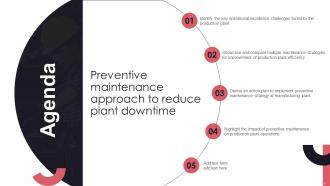
Slide 2: This slide displays the title Agenda.
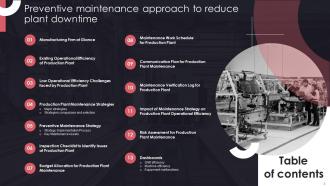
Slide 3: This slide exhibit table of content.
Slide 4: This slide exhibit table of content- Manufacturing Firm at Glance.
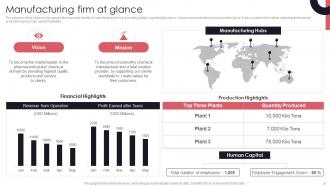
Slide 5: The purpose of this slide is to showcase the corporate identity of manufacturing firm by providing details regarding the vision, mission and production hubs.
Slide 6: This slide exhibit table of content- Existing Operational Efficiency of Production Plant.
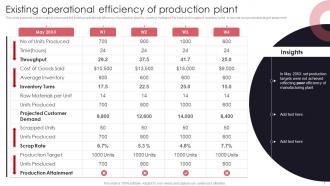
Slide 7: This slide presents a dashboard to showcase the existing operational efficiency of production plant.
Slide 8: This slide exhibit table of content- Low Operational Efficiency Challenges faced by Production Plant.
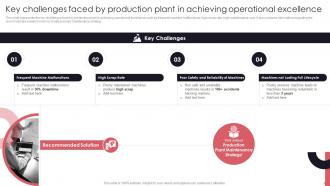
Slide 9: This slide represents the key challenges faced by production plant in achieving operational excellence.
Slide 10: This slide exhibit table of content- Production Plant Maintenance Strategies.
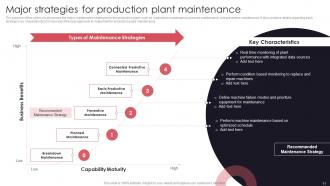
Slide 11: The purpose of this slide is to showcase the major maintenance strategies for the production plant.
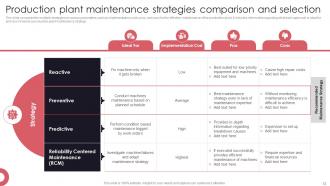
Slide 12: This slide compares the multiple strategies on various parameters.
Slide 13: This slide exhibit table of content- Preventive Maintenance Strategy.
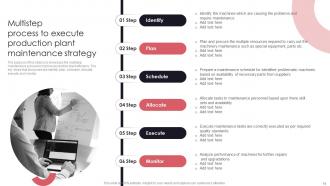
Slide 14: The purpose of this slide is to showcase the multistep maintenance process to improve production plant efficiency.
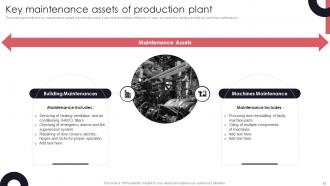
Slide 15: This slide represents the key maintenance assets of production plant.
Slide 16: This slide exhibit table of content- Inspection Checklist to Identify Issues at Production Plant.
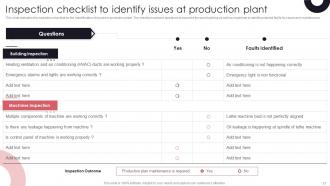
Slide 17: This slide indicates the inspection checklist for the identification of issues in production plant.
Slide 18: This slide exhibit table of content- Budget Allocation for Production.
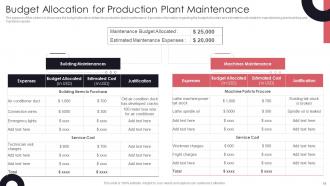
Slide 19: The purpose of this slide is to showcase the budget allocation details for production plant maintenance.
Slide 20: This slide exhibit table of content- Maintenance Work Schedule for Production Plant.
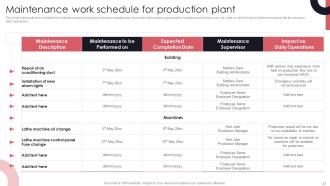
Slide 21: This slide represents the schedule for production plant building and machines maintenance.
Slide 22: This slide exhibit table of content- Communication Plan for Production Plant Maintenance.
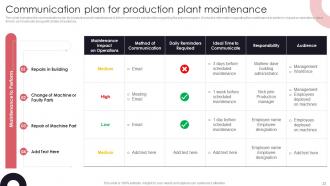
Slide 23: This slide indicates the communication plan for production plant maintenance to inform concerned stakeholders regarding the planned repairs.
Slide 24: This slide exhibit table of content- Maintenance Verification Log for Production Plant.
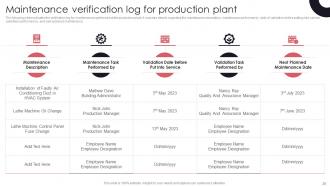
Slide 25: The following slide indicates the verification log for maintenances performed at the production plant.
Slide 26: This slide exhibit table of content- Impact of Maintenance Strategy on Production Plant Operational Efficiency.
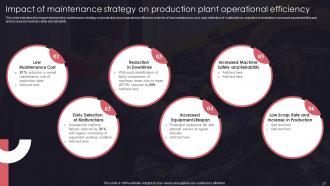
Slide 27: This slide indicates the impact of preventive maintenance strategy on production plant operational efficiency.
Slide 28: This slide exhibit table of content- Risk Assessment for Production Plant Maintenance.
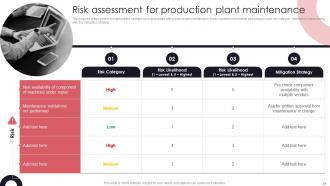
Slide 29: The purpose of this slide is to highlight the multiple risks associated with product plant maintenance.
Slide 30: This slide exhibit table of content- Dashboards.
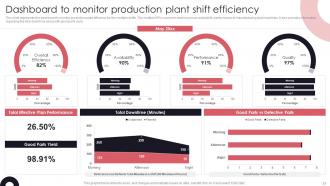
Slide 31: This slide represents the dashboard to monitor production plant efficiency for the multiple shifts.
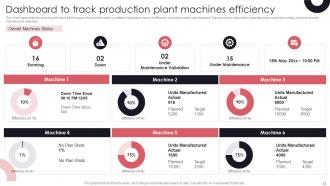
Slide 32: This slide represents the dashboard to track performance of production plant’s multiple machines in terms of efficiency and actual units manufactured.
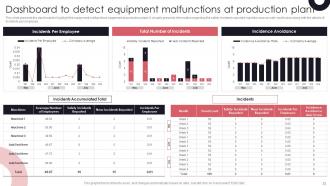
Slide 33: This slide presents the dashboard to highlight the equipment malfunctions happened at production plant.
Slide 34: This is the icons slide.
Slide 35: This slide presents title for additional slides.
Slide 36: This slide shows details of team members like name, designation, etc.
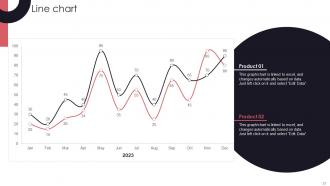
Slide 37: This slide exhibits yearly profits stacked line charts for different products.
Slide 38: This slide display About us.
Slide 39: This slide display SWOT analysis.
Slide 40: This slide shows puzzle for displaying elements of company.
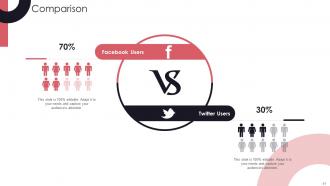
Slide 41: This slide shows Comparison.
Slide 42: This slide shows Our goal.
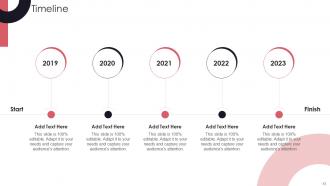
Slide 43: This slide exhibits yearly timeline of company.
Slide 44: This is thank you slide & contains contact details of company like office address, phone no., etc.
Preventive Maintenance Approach To Reduce Plant Downtime Powerpoint Presentation Slides with all 49 slides:
Use our Preventive Maintenance Approach To Reduce Plant Downtime Powerpoint Presentation Slides to effectively help you save your valuable time. They are readymade to fit into any presentation structure.









FAQs for Preventive Maintenance Approach To Reduce Plant Downtime
Honestly, start with your most critical stuff first - don't try to tackle everything at once. Get some kind of tracking system going (even a spreadsheet works initially) and create solid checklists for each piece of equipment. Regular inspections are huge, and you need people who actually know what they're looking at, not just going through the motions. Stock spare parts based on what breaks most often. Set maintenance schedules using manufacturer specs but adjust for how hard you're running things. Oh, and this is crucial - get management on board early because they hold the purse strings. Without their buy-in, you're basically dead in the water.
Track your equipment uptime and MTBF first - those are the big ones. Maintenance costs per asset matter too, obviously. The planned vs unplanned maintenance ratio is honestly where most companies mess up. OEE scores will show you the real picture of how things are running. Safety incidents and technician productivity are worth watching, even though they're harder to measure. Oh, and whether you're actually hitting those scheduled maintenance windows without screwing up production. Pick maybe 3-4 of these that make sense for your setup. You'll need at least six months of data to spot any real patterns - anything less is just noise.
Honestly, IoT sensors are where it's at for maintenance these days. They track vibration, temperature, all that stuff in real-time so you're not just crossing your fingers hoping nothing breaks. AI takes it up another notch - the predictive stuff is scary accurate now. Oh, and definitely get some CMMS software to handle scheduling automatically because nobody wants to track that manually. I'd say pick one or two important machines first, see how it goes. My buddy tried to do everything at once and it was a nightmare. Start small, then expand when you've got it dialed in.
Dude, preventive maintenance is huge in aerospace, healthcare, manufacturing, and energy. Aerospace is obvious - planes fall out of the sky if stuff breaks. Same deal with hospital equipment like ventilators or MRI machines when someone's life depends on them working. Manufacturing? Those lines cost thousands per hour when they're down. I've watched plant managers completely lose it over unexpected shutdowns. Energy plants are scary because you've got safety risks plus massive money at stake. My advice? Figure out what equipment would totally screw you if it failed, then build your PM schedule around those first.
Check your equipment manuals first - they'll give you the baseline. Most places do monthly checks on critical stuff, quarterly on regular equipment. Annual inspections work fine for low-priority items. But honestly? The paperwork gets old fast. What really matters is your operating conditions and when things actually break down. I'd rather schedule maintenance right before failures typically happen instead of following some random calendar dates. It's way more about balancing costs against downtime risk than sticking to rigid schedules.
Honestly, the hardest part is convincing management to spend money when nothing's broken yet. They just see dollar signs, not prevention. Resource constraints hit everyone too - never enough budget or people. Scheduling's a nightmare because production never wants downtime, even planned stuff. Your maintenance team might push back since they're used to just fixing things when they break. Oh, and if your equipment records are garbage (which they probably are), good luck figuring out maintenance intervals. My advice? Pick your most critical machines first. Build some wins there, then use those success stories to expand the program.
Dude, training your team is literally what makes or breaks a preventive maintenance program. I've seen so many companies skip this step and then wonder why their schedules don't work. Your employees need to know how to actually inspect stuff, follow the checklists properly, and catch warning signs early. Otherwise you're just throwing money at problems that could've been prevented. When people feel confident about what they're doing, they'll actually take care of the equipment instead of just going through the motions. Find your biggest training gaps first and tackle those - don't try to fix everything at once.
Timing's the big thing here. Preventive maintenance runs on a schedule no matter what - like changing oil every 3 months even if it looks perfect. Predictive is totally different though. You're using sensors and data to actually predict failures, like "hey, this bearing's gonna die in two weeks based on what we're seeing." Way cooler tech but honestly? Super expensive upfront. Most places should nail down their basic preventive stuff first, then maybe add predictive for the equipment that'll really hurt if it breaks.
For tracking preventive maintenance, CMMS software is definitely the way to go. Fiix, UpKeep, and Maintenance Connection are solid choices - they're all pretty similar tbh, just different layouts. You'll get automated work orders, asset tracking, and those helpful reminders. Honestly though, if you're running a smaller operation, don't sleep on a good Excel setup with some conditional formatting. That can work surprisingly well. The real trick? Pick whatever system your team will actually stick with. I've seen fancy software collect dust while simple spreadsheets keep things humming. Start basic, then add features once everyone's on board.
Honestly, leadership needs to stop treating maintenance like it's just burning money and actually invest in it. Give your team proper training and tools - can't expect miracles when they're constantly putting out fires. Track the breakdowns you *prevented* instead of just counting the disasters. I swear, most places only care about maintenance when everything's falling apart. Set up clear schedules and celebrate those wins when preventive work saves the day. Oh, and share those success stories around - people need to see maintenance as heroes, not just the guys who show up when stuff breaks.
Dude, preventive maintenance will save you a ton - like 20-30% on your total maintenance costs. Your equipment won't break down nearly as much, and you'll dodge those awful emergency repairs that always hit when you're swamped. Well-maintained stuff also runs way more efficiently, so your energy bills drop too. Honestly, the labor savings are probably the biggest win since you're doing planned work instead of running around putting out fires. Oh, and track your current breakdown costs for a few months first - you'll need that baseline to see how much you're actually saving.
Start with the stuff that'll really screw you over if it dies - production equipment, safety-critical systems, anything expensive to replace. Your maintenance records are clutch here. I'd focus on whatever keeps breaking or eating your budget first. Don't get too hung up on age though - sometimes newer equipment is way more finicky than the old workhorses. Make a quick scoring system: downtime costs, safety risks, how often it fails. Honestly, just rank everything and tackle the worst offenders with preventive schedules. The rest can wait.
Honestly, just track the basics but don't skip anything - date, who worked on it, what they did, problems they found. Our compressor died last year and we had literally nothing on record, which sucked. Also write down parts you swapped out, any readings, next service date. Whatever system your crew will actually use is the right one - doesn't matter how fancy the software is if nobody fills it out. Oh and definitely snap photos of weird stuff or parts that look sketchy. The whole point is making it fast enough that techs won't blow it off every time.
Look, preventive maintenance is just catching stuff before it breaks badly. You inspect and replace parts on schedule so little problems don't turn into huge disasters that kill your equipment for weeks. Nobody wants to do it - kinda like going to the dentist - but it beats dealing with major failures later. Your equipment will run way better and last longer instead of just running it into the ground. Oh, and definitely track where you're having failures now. That'll show you where to focus your PM efforts first for the biggest impact.
Look, compliance isn't optional - OSHA, EPA, whatever applies to your stuff will literally shut you down if you mess up. You've got to build your whole PM schedule around their mandatory inspection timelines. The paperwork is honestly annoying, but beats getting fined or having someone get hurt on your watch. Each piece of equipment probably falls under different regs too, which makes it fun. Start by figuring out what standards actually apply to your gear, then work backwards from there. Short answer? The government basically writes your maintenance calendar for you.
-
I was really impressed with the presentation I created with their templates. I’ll be using their services moving forward.
-
I took a chance with SlideTeam. I never looked back. Great products and great service.