

Mechanical Maintenance Proposal Powerpoint Presentation Slides




Try Before you Buy Download Free Sample Product
 Impress Your
 Audience
 100%
100% Editable
 Save Hours
 of Time


Engineering Maintenance Service Proposal caters to all the Companys needs. Check out Our insightfully crafted Mechanical Maintenance Proposal. It provides comprehensive maintenance for all your engineering needs. Our team of certified engineers and technicians is highly skilled and experienced in engineering disciplines. We are committed to providing the highest quality of service, focusing on safety and reliability. Our services include preventive maintenance, emergency repairs, and system upgrades. We also offer training and consulting services to help you maximize the efficiency and effectiveness of your engineering systems. We aim to help you accomplish and maintain the highest performance and reliability standards. Looking forward to serving you and your engineering needs. Get access now.
People who downloaded this PowerPoint presentation also viewed the following :
Content of this Powerpoint Presentation
Slide 1: This slide introduces Mechanical Maintenance Proposal. State your company name and begin.
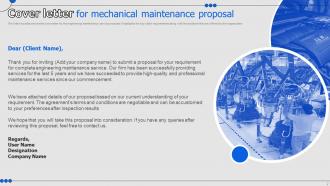
Slide 2: This slide shows Cover letter for mechanical maintenance proposal.
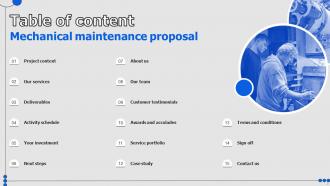
Slide 3: This slide elucidates the Table of Contents.
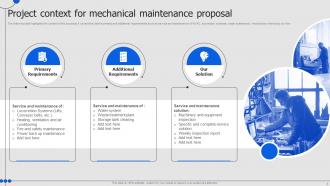
Slide 4: The following slide highlights the context of the proposal, it covers the client’s primary and additional requirements such as service and maintenance of HVAC, locomotion systems, water systems etc.
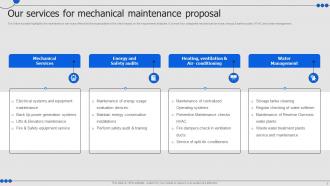
Slide 5: This slide presents the maintenance services offered by the organization to the clients.
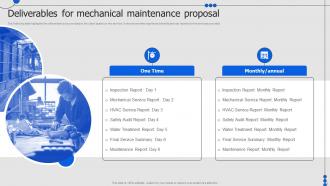
Slide 6: This slide portrays the deliverable to be provided to the client based on the service.
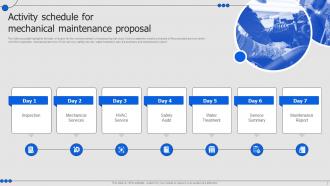
Slide 7: This slide displays the Activity schedule for engineering maintenance service proposal.
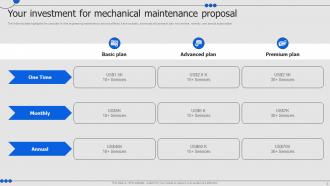
Slide 8: The following slide shows the cost plan for the engineering maintenance service offered.
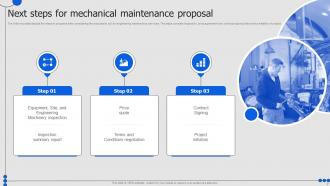
Slide 9: This slide states the steps to progress after considering the proposal to opt for engineering maintenance services.
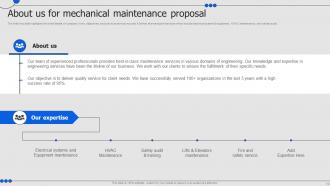
Slide 10: This is the About us showcasing the Company related information.
Slide 11: This is Our team slide. State the information related to your team members here.
Slide 12: This sldie continues the Team related information.
Slide 13: This slide indicates the Customer testimonials for engineering maintenance service proposal.
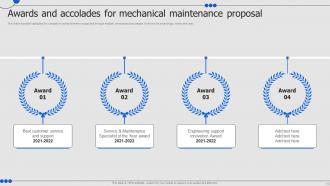
Slide 14: The following slide displays the company’s achievements recognized through multiple awards and accolades.
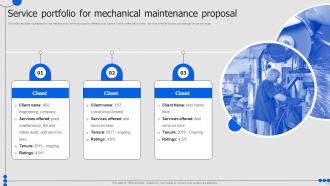
Slide 15: The following slide portrays the top maintenance service projects offered to the clients.
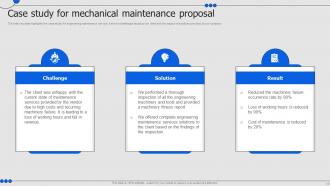
Slide 16: The following slide highlights the case study for engineering maintenance service.
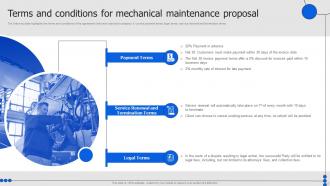
Slide 17: This slide presents the terms and conditions of the agreement between client and company.
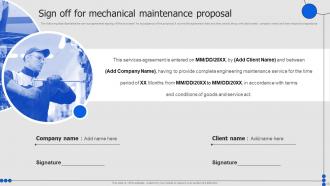
Slide 18: The following slide illustrates the service agreement signing off the document for acceptance of the proposal.
Slide 19: This slide exhibits the Contact details of the organization.
Slide 20: This is the Icons slide containing all the Icons used in the plan.
Slide 21: The purpose of this slide is to elucidate Additional information.
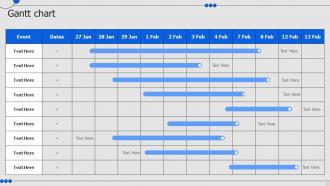
Slide 22: This is the Gantt chart with related imagery.
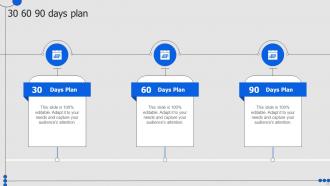
Slide 23: This is the 30 60 90 days plan slide for efficient planning.
Slide 24: This slide incorporates the Company's mission, vision, and values.
Slide 25: This slide reveals the Roadmap of the organization.
Slide 26: This slide showcases the Company's Timeline.
Mechanical Maintenance Proposal Powerpoint Presentation Slides with all 31 slides:
Use our Mechanical Maintenance Proposal Powerpoint Presentation Slides to effectively help you save your valuable time. They are readymade to fit into any presentation structure.










FAQs for Mechanical Maintenance Proposal
So there are basically four key things you need: preventive maintenance (regular inspections and swapping parts), predictive stuff using monitoring tools, fixing things when they actually break, and - this one sucks but you gotta do it - documenting everything. That documentation really helps you spot patterns later though. You'll need good spare parts inventory, techs who actually know your equipment, and solid work order processes. Honestly, I'd start by figuring out which equipment is most critical and how it typically fails. That way you're not wasting time on stuff that doesn't matter as much.
Daily checks for anything critical or safety-related, weekly for your standard stuff. But honestly? It really comes down to how hard you're running things. I always do quick visual sweeps on high-use equipment - fluid levels, listen for funky sounds, that sort of thing. Less critical machines can wait a week or even longer if they're not getting hammered. Check your manufacturer's manual first, then adjust based on what actually breaks on you. I learned this the hard way - start with their schedule but don't be afraid to tweak it once you know how your specific setup behaves.
Dude, lockout/tagout first - no exceptions on that one. Proper PPE too: safety glasses, gloves, steel-toed boots depending on the job. I've watched way too many people skip basics and pay for it. Good lighting helps more than you'd think. Test everything's actually dead before you touch it, even after locking out. Don't work solo on complicated stuff if possible. Oh, and keep your first aid kit close by - make sure someone knows where you're at. Sounds paranoid but honestly better safe than sorry.
Honestly, predictive maintenance is a game changer - it can boost your equipment lifespan by 20-40%. You're basically monitoring stuff like vibration, temperature, oil quality instead of just waiting for things to break or doing maintenance on some random schedule. It's like getting blood work done regularly instead of waiting until you're actually sick, you know? Catches problems way before they turn into expensive disasters. The trick is setting up good sensors and - this is key - actually doing something with the data you collect. Too many places just gather info and let it sit there doing nothing.
So you're gonna see bearing failures mostly - usually from crappy lubrication or dirt getting in there. Belt issues too, especially when tension's off or stuff isn't aligned right. Pump cavitation's another big one when suction pressure drops. Honestly? Like 80% of this crap comes down to skipping maintenance or screwing up the install. I swear it's never just random bad luck. Heat, moisture, running equipment too hard - that's your real culprits right there. Oh, and vibration from misalignment will kill anything eventually. I'd start by looking at your PM schedule and double-checking alignment on whatever's giving you trouble.
So vibration analysis is basically your early warning system for equipment problems. Each issue creates its own unique pattern - bearing wear sounds different from misalignment or imbalance. Pretty cool actually. You'll want to get baseline readings when everything's running smoothly, then watch for changes over time. That way you can plan maintenance instead of getting hit with random breakdowns (which always happen at the worst times, right?). I'd start with your most critical stuff first. It's like your machines are trying to tell you what's wrong - you just need to learn their language.
Dude, proper lubrication literally saves your equipment from destroying itself. I've watched machines just eat themselves alive when people skip this stuff - not pretty. It cuts down friction between moving parts and helps dump excess heat. Plus it keeps dirt and crap from getting where it shouldn't be. Honestly, half the noise issues I see could've been prevented with better lube schedules. You'll want to match the right type to each piece of equipment though. Start by checking what you're doing now and actually write it down somewhere - trust me on that part.
Honestly, going digital will save you so much headache. CMMS software is clutch for tracking work orders and scheduling maintenance - way better than those messy spreadsheets we all hate. Your techs can use mobile apps to grab manuals and update job status without constantly heading back to the office. IoT sensors are pretty cool too, they'll give you real-time data on how equipment's doing. I'd say start with something basic first though. Don't go crazy with all the bells and whistles right away - let your team get used to it, then add fancier predictive stuff later.
Look, preventive maintenance is a total game changer - it stops those awful emergency breakdowns that somehow always hit when you're swamped. Planned repairs cost way less than scrambling for parts on weekends (learned that the hard way). Your equipment actually runs better and lasts longer too. The best part? You control when things go down instead of having production randomly shut off. I'd honestly rather deal with scheduled maintenance during slow periods than panic repairs. Start with your most critical stuff and follow what the manufacturer suggests for timing.
So ISO standards are basically your maintenance roadmap - they cover everything from scheduling preventive work to analyzing reliability data. The big ones are ISO 55000 for asset management and ISO 14224 for data collection. Not gonna lie, they're boring as hell to read through, but they're super valuable for keeping your processes consistent. Plus they help you meet regulatory stuff and compare against what everyone else is doing. I'd start by figuring out what ISO standards your company already uses, then just see where your current maintenance setup matches up.
You're gonna want formal training first - like a 2-year associate degree in mechanical maintenance or industrial tech. Then get into an apprenticeship program because honestly, classroom stuff is pretty useless without actually working on real equipment. Most places also want certifications in hydraulics, pneumatics, welding, and basic electrical since everything's integrated now. OSHA safety training is required everywhere too, which is kind of a pain but whatever. I'd start with your local community college's program. After that, look into manufacturer-specific certs for whatever equipment your company actually uses - that's where the real money is.
Honestly, maintenance logs are like having a crystal ball for your equipment. You'll start seeing patterns - like that one pump that always craps out around 500 hours. Track everything and you can actually predict when stuff's gonna break instead of getting blindsided. Documentation helps with scheduling, ordering parts ahead of time, and keeping auditors happy. Trust me, your future self will thank you when you're not trying to figure out what the last guy did (or didn't do). Even basic tracking beats winging it completely.
Honestly, logistics are gonna be your biggest nightmare out there. You're stuck with whatever tools you packed, so when something breaks (and it will), you're screwed until the next shipment arrives. Internet's usually trash too, so forget about video calling tech support. Working alone or with maybe one other person makes everything take twice as long. I learned this the hard way - now I pack way more spare parts and backup tools than I think I need. Feels like overkill when you're packing, but trust me, you'll thank yourself later when you're not sitting around for weeks waiting on a $5 component.
So CMMS basically handles all that boring paperwork you're doing by hand right now. Work orders get scheduled automatically, you can track your equipment in real-time, inventory management - the whole deal. The best part? It saves everything so you can spot patterns and actually predict failures before they happen. Way better than getting called at 2 AM because something died unexpectedly. You'll spend less time shuffling papers and more time on actual repairs. Honestly, the predictive stuff alone makes it worth it. I'd start with your most important equipment first, then expand from there.
So basically you can't just dump oil and coolants down the drain - that stuff's toxic as hell. Regular trash won't work for contaminated parts either. Energy efficiency is actually a bigger deal than most people think since maintained equipment uses way less power. Noise pollution's another thing, especially if you're in a neighborhood. My dad learned that the hard way with angry neighbors lol. Set up proper disposal for hazardous waste, try eco-friendly lubricants when you can. Stay on top of maintenance schedules too - prevents way bigger headaches later.
-
SlideTeam’s readymade presentations have landed my unique images with my bosses in the past and it continues to reward me.
-
SlideTeam offers so many variations of designs and topics. It’s unbelievable! Easy to create such stunning presentations now.