

Problem statement beauty and personal care product




Try Before you Buy Download Free Sample Product
 Impress Your
 Audience
 100%
100% Editable
 Save Hours
 of Time


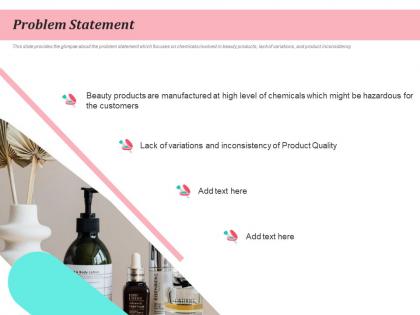
This slide provides the glimpse about the problem statement which focuses on chemicals involved in beauty products, lack of variations, and product inconsistency
People who downloaded this PowerPoint presentation also viewed the following :
Problem statement beauty and personal care product with all 2 slides:
Use our Problem Statement Beauty And Personal Care Product to effectively help you save your valuable time. They are readymade to fit into any presentation structure.

FAQs for Problem statement beauty and
Look, the basics still matter - good quality, solid brand rep, decent pricing. But social media is honestly running the show now, which is kind of wild when you think about it. People are obsessed with clean ingredients and what other customers actually say in reviews. They want brands that match their vibe too. Don't sleep on packaging design - it's weirdly important. Plus they need to actually find your stuff easily when shopping. For your strategy, just be super transparent about what's in it. Get real testimonials, not the fake-sounding ones. Make sure your brand story actually connects with whoever you're trying to reach.
Honestly, start with real customer research - surveys, focus groups, whatever gets you actual data instead of guessing. Social media listening is huge for this stuff, like seeing what people complain about with their current skincare routine. Demographics matter but psychographics are where it's at - their values, lifestyle, how they actually use products. I'd probably create personas from that data, then test small campaigns with different segments. Oh and don't try to target everyone at once, that's a mess. Pick one clear segment first, see what works, then expand from there.
Dude, sustainability isn't just trendy anymore - it's literally make or break. Millennials and Gen Z will drop your brand in a heartbeat if you're not doing the eco thing right. Like, they actually care about refillable packaging and cruelty-free testing. Fenty Beauty and The Ordinary are crushing it partly because they're super transparent about ingredients and environmental stuff. Oh, and biodegradable formulas are huge now too. Basically, if you're launching anything, build this stuff in from the start. Don't try to slap it on later as some afterthought marketing thing.
Ugh, social media literally controls everything in beauty now. Companies are constantly scrambling to make vitamin C serums or whatever TikTok decides is trendy that week. The marketing teams have it worse though - they're always pivoting campaigns to chase whatever's blowing up. It moves so fast it's actually insane. My tip? Follow the big beauty influencers and set up Google Alerts so you can catch trends early. Way better than always being behind everyone else. Trust me, getting ahead of the curve makes such a difference.
Honestly, it's rough out there for new beauty brands. L'Oreal and Sephora basically own everything, so you're fighting for whatever's left. Social media ads cost a fortune now - like, when did Instagram get so expensive? Building trust is hard when people don't know your name yet. Supply chains are tricky too. The product differentiation thing is probably the trickiest part though. Everyone's already drowning in options. My advice? Don't try to compete with everything. Pick one specific group of people and focus just on them. Way better than spreading yourself thin across everyone.
Honestly, customer feedback is where it's at - surveys, reviews, social media, all of it. Look for patterns in complaints about texture or shade matching, then test fixes with small groups first. Social listening catches trends super early too. Like, I've literally seen brands completely change winning products just because of Instagram comments (wild, right?). Oh and here's the thing - you gotta close the loop. Tell customers when you've actually made changes based on what they said. That's how you build real loyalty instead of just collecting feedback that goes nowhere.
So the big thing right now is all the microbiome stuff - brands are throwing prebiotics and postbiotics into everything to help your skin's natural bacteria. Waterless products are huge too, like those solid shampoo bars and powder cleansers. Bakuchiol is literally in every single serum launch as the "natural retinol" - I swear I can't escape it. Peptides are getting way more specific now instead of just generic anti-aging nonsense. Oh, and skip anything that's just riding trends without actual studies behind it. Some brands are just slapping buzzwords on bottles hoping you won't notice.
Honestly, packaging design can make or break you. You get like 3 seconds max to grab someone's attention when they're browsing - that's it. Good packaging is basically your 24/7 salesperson doing all the work. When I'm at Sephora, what makes me actually stop and pick something up? Usually it's the sleek stuff that looks Instagram-ready and screams quality. Your design has to instantly communicate who it's for, the price range, and what it does. Worth investing in upfront because a crowded shelf is brutal competition.
Honestly, you can't just go broad anymore - find your specific niche and own it. Tell real stories, not that polished marketing BS everyone sees through now. Build actual communities around what you stand for. TikTok totally flipped the script on discovery (I swear I find new brands daily on there). Work with smaller influencers who genuinely use your products instead of paying mega-celebrities who clearly don't. Personalization is everything - custom shades, tailored routines based on skin type. But here's the thing: solve something the big brands won't touch. Find those ignored problems and become the answer for that specific group of people.
Okay so honestly? People can smell BS from a mile away now. You've gotta show real proof - like actual before/after pics, ingredient breakdowns, genuine reviews from customers. Don't just say your retinol is "amazing" - explain WHY it works differently than whatever they're buying at Target. I swear the brands doing well right now feel like they're having an actual conversation with you instead of pitching. Social proof is everything. Pick one solid claim per product that you can actually back up and go from there. Way better than overselling a bunch of stuff people won't believe anyway.
Honestly, beauty brands can't get away with the bare minimum anymore. Different cultures have totally different beauty standards, skin tones, hair types - the whole deal. Someone in humid Thailand needs different skincare than someone in freezing Canada, you know? Climate and genetics play such a huge role. Brands that actually get this are expanding their shade ranges for real, not just slapping on two extra colors and calling it diversity. They're making region-specific stuff too. Miss this and you're basically throwing away money while pissing off customers who could've been loyal forever.
Okay so AR is totally changing beauty shopping - you can literally try on makeup through your phone camera without making a mess. Sephora and L'Oréal are killing it with this stuff. I spent like an hour yesterday testing different lipstick shades on my face, which sounds ridiculous but it's actually super helpful. You don't have to guess anymore if that red will look good on you. Companies are seeing way fewer returns because people know what they're getting. Plus customers are buying more since they feel confident about their choices. Honestly, if beauty brands aren't doing this yet, they're behind.
So the big stuff to watch for is labor practices - like palm oil and mica mining where workers get screwed over with terrible conditions. Environmental damage too from over-harvesting plants and all the chemical runoff. Some suppliers still test on animals or use conflict minerals, which is messed up. Honestly, the whole supply chain thing is a nightmare because there's like 3-4 layers between the brand and where ingredients actually come from. Makes it super hard to track what's really happening. I'd ask brands about their auditing processes and what certifications they have - that's your best starting point.
Okay so first thing - ditch that whole light/medium/dark system, it's basically useless. You'll want to test on like 40+ different skin tones minimum, and actually get diverse people involved from the start, not just slap them on at the end. Undertones are huge too - warm, cool, neutral - plus how stuff works on oily vs dry skin. The whole "nude" lip thing is so played out honestly. Partner with influencers and MUAs who actually know diverse beauty inside and out. Oh and don't do that thing where brands launch one "inclusive" line like they deserve a medal. Just make everything inclusive from the jump.
AI skin analysis is everywhere these days - apps scan your face and make custom formulations just for you. Proven and Curology are crushing it with algorithms that consider your environment, hormones, all that stuff. Smart devices are getting crazy too. Those at-home LED masks now adjust intensity based on what they're reading from your skin in real-time, which honestly blows my mind a little. We're moving away from generic routines toward super personalized regimens that actually change as your skin does. If you're shopping around, look for brands mixing machine learning with actual dermatology expertise - not just fancy gadgets.
-
Very well designed and informative templates.
-
Designs have enough space to add content.