


Project Crisis Management Framework With Team Responsibilities




Try Before you Buy Download Free Sample Product
 Impress Your
 Audience
 100%
100% Editable
 Save Hours
 of Time


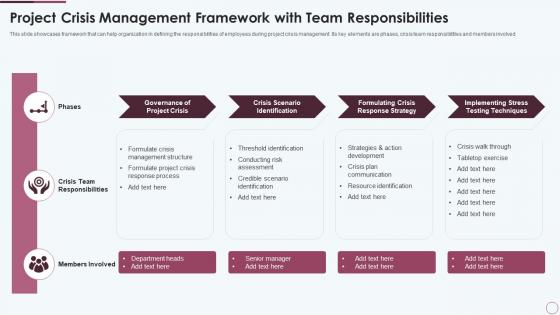
This slide showcases framework that can help organization in defining the responsibilities of employees during project crisis management. Its key elements are phases, crisis team responsibilities and members involved.
People who downloaded this PowerPoint presentation also viewed the following :
Project Crisis Management Framework With Team Responsibilities with all 6 slides:
Use our Project Crisis Management Framework With Team Responsibilities to effectively help you save your valuable time. They are readymade to fit into any presentation structure.





FAQs for Project Crisis Management Framework
Key components of an effective crisis management plan include risk assessment protocols, communication strategies, response team structures, stakeholder notification systems, and recovery procedures. These elements work together by establishing clear decision-making hierarchies, enabling rapid information flow, and streamlining coordinated responses, with many organizations finding that comprehensive planning significantly reduces response time and minimizes operational disruption during critical incidents.
Organizations can identify potential crises through comprehensive risk assessment frameworks, continuous monitoring systems, stakeholder feedback mechanisms, early warning indicators, and predictive analytics tools. These proactive approaches enable companies to detect emerging threats across operational, financial, and reputational areas, with many finding that systematic crisis identification ultimately delivers faster response times and significantly reduced business disruption.
Communication serves as the foundation of effective crisis management, enabling transparent information sharing, stakeholder coordination, clear decision-making processes, and public trust maintenance. Through strategic messaging and real-time updates, organizations streamline response efforts, minimize misinformation spread, and maintain operational continuity, with many companies finding that proactive communication ultimately transforms potential reputation damage into competitive advantage.
Leadership significantly influences crisis outcomes through clear communication, decisive decision-making, resource mobilization, and stakeholder coordination during critical moments. Effective leaders demonstrate transparency and accountability, enabling organizations to maintain trust, minimize operational disruptions, and recover faster, with many companies finding that strong leadership during crises ultimately strengthens their competitive position and organizational resilience.
Essential crisis management tools include real-time monitoring platforms, automated alert systems, social media management software, communication dashboards, and data analytics solutions. These technologies streamline response coordination by enabling instant stakeholder notifications, tracking public sentiment, and centralizing decision-making processes, with many organizations finding that integrated platforms significantly reduce response times and enhance operational resilience.
Common pitfalls include delayed response, inconsistent messaging, poor stakeholder communication, inadequate resource allocation, and lack of leadership visibility. Organizations often struggle with information silos, reactive rather than proactive approaches, and insufficient crisis team coordination, while many companies find that unclear decision-making processes and neglecting employee concerns ultimately damage reputation and stakeholder trust.
Companies recover reputation post-crisis through transparent communication, swift corrective actions, stakeholder engagement, consistent messaging, and demonstrating genuine accountability. Organizations like Johnson & Johnson and Toyota have successfully rebuilt trust by implementing comprehensive response strategies, investing in improved processes, and maintaining ongoing dialogue with customers, ultimately strengthening stakeholder relationships and competitive positioning.
Effective crisis stakeholder engagement strategies include transparent communication protocols, regular update schedules, dedicated liaison channels, proactive outreach programs, and tailored messaging frameworks. These approaches streamline information flow by establishing trust, minimizing uncertainty, and maintaining operational continuity, with many organizations finding that consistent stakeholder communication during crises ultimately delivers stronger relationships and competitive advantage.
Crisis simulations prepare teams by creating realistic, high-pressure environments that test decision-making, communication protocols, and resource allocation under controlled conditions. Through scenario-based training, organizations can identify weaknesses in their response plans, improve coordination between departments, and build confidence in crisis procedures, with many companies finding that regular simulations significantly reduce response times and enhance overall crisis management effectiveness.
Social media significantly impacts crisis management by enabling real-time communication, rapid information dissemination, stakeholder engagement, and brand reputation monitoring, while also amplifying misinformation spread. These platforms help organizations respond immediately during emergencies, coordinate with emergency services, and maintain transparent public communication, with many companies finding that strategic social media management ultimately delivers faster crisis resolution and enhanced stakeholder trust.
Crisis response effectiveness metrics include response time, stakeholder communication reach, media sentiment analysis, operational recovery speed, and financial impact assessment. These measurements enable organizations to evaluate their crisis management capabilities by tracking how quickly services resume, measuring customer retention rates, and assessing reputation recovery, with many companies finding that comprehensive metrics ultimately deliver improved preparedness and stronger stakeholder confidence.
Cultural differences significantly affect crisis management strategies through varying communication styles, decision-making processes, authority structures, and stakeholder expectations across regions. While Western approaches often emphasize transparency and rapid public communication, many Asian cultures prioritize consensus-building and face-saving measures, with global organizations finding that culturally-adapted strategies ultimately deliver more effective crisis resolution and stakeholder trust.
Crisis response ethical considerations include transparency in communications, equitable resource allocation, protecting vulnerable populations, maintaining data privacy, and ensuring decision-making accountability. Organizations must balance stakeholder interests while preserving public trust, with many finding that ethical frameworks guide faster recovery, minimize reputational damage, and ultimately strengthen long-term stakeholder relationships.
Businesses can utilize crisis feedback by conducting comprehensive post-crisis analyses, documenting lessons learned, updating response protocols, and strengthening communication frameworks. Through systematic evaluation of their crisis response, organizations across sectors like healthcare, finance, and retail enhance their preparedness strategies, streamline decision-making processes, and build more resilient operational structures for future challenges.
Employee training serves as the foundation of effective crisis management by equipping teams with response protocols, communication procedures, decision-making frameworks, and role clarity during emergencies. Through regular simulations and scenario-based exercises, organizations enable faster response times, reduced confusion, and coordinated actions across departments, with many companies finding that well-trained employees ultimately minimize operational disruptions and protect business continuity.
-
Unique and attractive product design.
-
Unique research projects to present in meeting.