


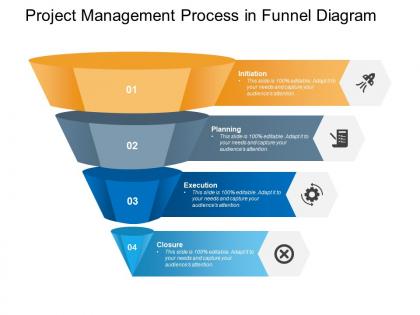
Project management process in funnel diagram





Try Before you Buy Download Free Sample Product
 Impress Your
 Audience
 100%
100% Editable
 Save Hours
 of Time


The project management process in a funnel diagram is a great way to visualize the various steps involved in managing a project. The first step is to identify the goal of the project. This will help to determine what needs to be done and how to go about doing it. Next, a project plan is created. This plan will outline the steps needed to complete the project and help to keep everything on track. By understanding the different steps in the project management process and how they flow into one another, you can create a more effective plan for your next project. The SlideTeam presentation on project management will help you to visualize each step of the process and understand how it impacts your overall goal. Plus, our templates are easy to use and customizable, so you can get started right away. Download our project management PowerPoint presentations now.
People who downloaded this PowerPoint presentation also viewed the following :
Project management process in funnel diagram with all 5 slides:
Advocate control of carbon emissions with our Project Management Process In Funnel Diagram. Educate folks on the dangers of climate change.

FAQs for Project management process
So the PM funnel breaks down into five stages, and honestly it's pretty straightforward once you get it. Discovery is where you figure out what you're even trying to do. Then planning - scope, timeline, all that fun stuff. Execution is the meat of it (you'll spend most of your time here). Monitoring keeps you from going off the rails. Closure wraps everything up with deliverables and lessons learned - though let's be real, half the time people skip this part. It basically filters you from "hey what if we..." down to actual results. Figure out which stage you're in first, then you'll know what to focus on.
Dude, visual aids are a game changer for project management funnels. People actually *get it* when they can see the whole pipeline instead of just hearing about phases. Flowcharts or kanban boards work great - even basic funnel diagrams help. Your team spots bottlenecks instantly and understands capacity without you having to explain everything twice. I swear, it's night and day compared to endless spreadsheets that make everyone's eyes glaze over. Status meetings become so much faster when there's a visual everyone can point to and discuss.
Look, stakeholder analysis is your cheat sheet for dealing with people through the whole project cycle. Figure out who's got power, who needs to be on board, and who might cause drama later. I've literally watched projects crash because people ignored this part - it's wild how much grief you can avoid. Map everyone by how much influence they have vs how interested they are in your project. Do this early when you're just getting started. Some folks need constant updates, others just want the highlights. Trust me, spending time on this upfront saves you from so many awkward conversations down the road.
So at the beginning, you're dealing with these massive unknowns - like what if the whole market tanks or we can't get the resources we need? Your strategies are pretty broad then. Keep options open, build in some buffers. But once you get into actual execution, suddenly it's super tactical stuff. Schedule delays, tech problems breaking, team drama. Goes from "what happens if the economy implodes" to "crap, Mike's sick and he's the only one who knows the system." I always mess this up and don't document the small stuff early enough. Start tracking both levels from day one.
So project metrics are basically your filters for each stage. At the start, you're checking feasibility stuff - do we have the resources, will this actually make money? Then midway through, you're watching timeline and budget burn to see what needs more help or a kick in the pants. Most teams collect all this data but then... just ignore it, which drives me crazy. Later on, quality scores and whether stakeholders are happy decide what gets rushed to the finish line. The trick is picking the right metrics for whatever decision you're actually trying to make at each point.
Honestly, just tackle whatever's blocking stuff from moving forward first - those bottlenecks will mess up everything else. After that, focus on tasks feeding your biggest projects. I used to way overthink this whole thing lol. The key is keeping work flowing smoothly from start to finish. Score things based on how urgent they are plus how much they'll help overall flow. Oh, and definitely check your priorities weekly since things change so fast. Sometimes I'll even do a quick mental check mid-week if projects are shifting around a lot.
Honestly, just start with a Kanban board - Trello or Asana work great because you can actually see stuff moving through stages. Way more satisfying than you'd think. Funnel charts in Google Sheets are solid too, especially when you need to show the numbers to higher-ups. Yeah, some people go crazy with Tableau but that's total overkill unless you're tracking like 50+ projects. The real trick is finding something your team won't abandon after two weeks. I've seen so many fancy setups just die because nobody wanted to update them. Keep it simple first, then add bells and whistles later if you actually need them.
So the Project Management Funnel is basically about filtering what's actually worth your time, rather than just following those typical linear phases everyone uses. You're not drowning in every single request that comes through - honestly, such a relief compared to treating everything like the world's ending. Most traditional methods like Waterfall or Agile tell you *how* to do work, but this funnel thing helps you figure out *what* work you should even bother with first. Maybe try running your current projects through three simple stages: ideas, evaluation, then execution. See what actually deserves to make it through? Way better than that whole "everything's urgent" chaos we usually deal with.
Honestly, most project failures happen in totally predictable ways. Right at the start, teams skip getting everyone on the same page or rush requirements - then wonder why everything's a mess later. Planning phase? Scope creep will absolutely kill you, plus people always think timelines are way more doable than they actually are. Once you're executing, communication falls apart and nobody's really tracking what's happening. Micromanaging makes everyone miserable too. Teams often ignore red flags during monitoring or don't even know what metrics matter. And closure? Ha - everyone's already running to the next crisis. Set up checkpoint reviews though, they'll save your sanity.
Here's what I'd do - think of each funnel stage like a mini sprint. Discovery becomes your backlog planning session. Development? That's where you actually run sprints. Launch turns into your retro (though honestly, these phases blur together way more than anyone admits). Skip the rigid gates and do iterative check-ins instead. Stakeholders can pivot when they see what's not working. Daily standups within each stage keep everyone moving - trust me, communication gaps kill projects faster than scope creep. Your funnel gets way more flexible this way, and you won't have to scrap everything when requirements inevitably change.
So when you're wrapping things up, definitely track your completion rates and whether you hit budget/timeline targets. Client satisfaction scores matter too - honestly, what's the point if they hate the end result? Adoption rates are clutch because I've seen "successful" projects that literally nobody ended up using. Keep an eye on team velocity so you're not burning everyone out (learned that one the hard way). Set up some automated dashboards for this stuff. Trust me, you don't want to be scrambling for reports when your stakeholders start breathing down your neck asking for updates.
Honestly, just match your process to the project size. Small stuff? Skip the heavy discovery phase and keep docs light. Complex projects need all that stakeholder mapping and deep feasibility work - don't shortcut it. I've watched so many teams mess this up by using the same bloated process for everything. Such a waste of time. Gate criteria should match your risk level too. High-stakes work gets stricter approvals, routine projects can cruise through with basic checkpoints. Maybe try sorting your projects into like 2-3 buckets first? Then you can customize each stage based on what actually makes sense for that complexity level.
Make sure everyone knows what "done" means for each phase - like approved requirements or finished testing. Get sign-offs before moving on, trust me on this one. Yeah, retrospectives are kinda annoying but honestly just spend 10 minutes writing down what sucked and what didn't. Your team needs to know how their roles change in the next stage. Oh, and don't forget to tell people outside your core group too. Send a quick "hey we're switching from planning to building on Monday" message. Saves you from answering a million confused questions later.
Oh man, communication totally changes depending on where you are in the project! At the start, everyone's throwing ideas around and having those big-picture conversations about what you're actually trying to do. Planning gets way more formal - suddenly you're in structured meetings documenting every decision (kinda boring but necessary). Execution is mostly quick check-ins and putting out fires. This phase can get messy fast if your team isn't tight. The wrap-up focuses on what went wrong and right, plus handing things off. Really though, you've gotta match how you communicate to what that specific stage needs.
Oh hey! Microsoft did this when they launched Teams - started with their own employees first, then picked some big clients before going wide. Smart move honestly. 3M's probably the best example though. They take like thousands of R&D ideas and whittle them down to maybe 50 actual products each year. Brutal but it works! Toyota does something similar with their lean stuff too, just filtering projects through tougher and tougher checkpoints. There's this Harvard Business Review piece on 3M's whole process that's actually pretty interesting - shows exactly how they decide what makes the cut.
No Reviews