

Project quality assurance and control plan powerpoint presentation slides




Try Before you Buy Download Free Sample Product
 Impress Your
 Audience
 100%
100% Editable
 Save Hours
 of Time


Determine how quality will be managed by handling processes and procedures using Project Quality Assurance And Control Plan PowerPoint Presentation Slides. The project quality plan PowerPoint slideshow is a useful tool to present a quality management plan for product assurance and control. Using this PPT slideshow, the firm can implement a quality management strategy by assigning quality standards, and a management plan Gantt chart. Ensure quality through control assurance initiatives and checklist by using this content-ready PPT complate deck. Discuss how product quality is controlled through various control initiatives, checklists, quality assurance, logs, and assurance issues reporting plan. The project quality management PPT template covers quality testing with a project inspection checklist, non-destructive testing techniques, and tools. Provide details about handling risks associated with quality, review with the risk register, and communication regarding the project. Depict overall quality improvement impact analysis and the tracking dashboard with the help of a professionally designed PPT slide deck.
People who downloaded this PowerPoint presentation also viewed the following :
Content of this Powerpoint Presentation
Slide 1: This slide introduces Project Quality Assurance and Control Plan. State your Company name and begin.
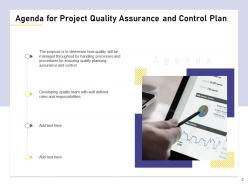
Slide 2: This slide shows Agenda.
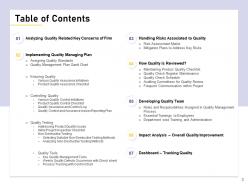
Slide 3: This slide displays Table of Contents.
Slide 4: This slide shows Table of Contents.
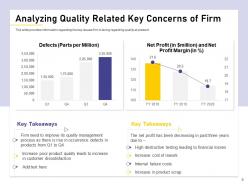
Slide 5: This slide provides information regarding the key issues firm is facing regarding quality at present.
Slide 6: This slide shows Table of Contents.
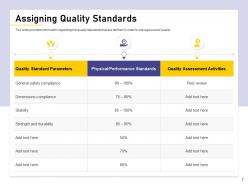
Slide 7: This slide provides information regarding the quality standards that are defined in order to manage overall quality.
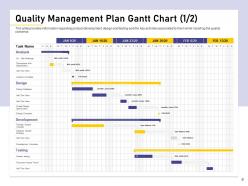
Slide 8: This slide provides information regarding product development, design and testing and the key activities associated to them while handling the quality concerns.
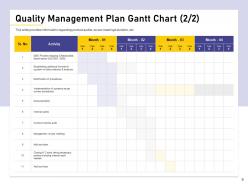
Slide 9: This slide provides information regarding product audits, review meetings duration, etc.
Slide 10: This slide shows Table of Contents.
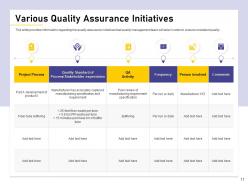
Slide 11: This slide provides information regarding the quality assurance initiatives that quality management team will take in order to ensure consistent quality.
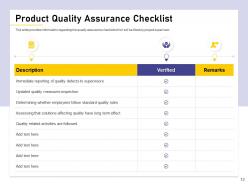
Slide 12: This slide provides information regarding the quality assurance checklist which will be filled by project supervisor.
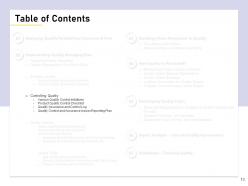
Slide 13: This slide showcases Table of Contents.
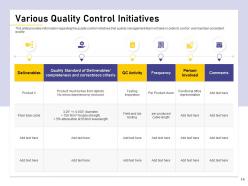
Slide 14: This slide provides information regarding the quality control initiatives that quality management team will take in order to control and maintain consistent quality.
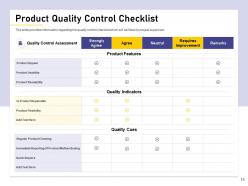
Slide 15: This slide provides information regarding the quality control checklist which will be filled by project supervisor.
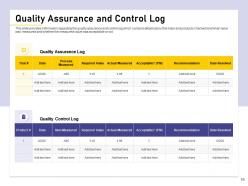
Slide 16: This slide provides information regarding the quality assurance and control log which contains details about the trials and products checked and what value was measured and whether the measured value was acceptable or not.
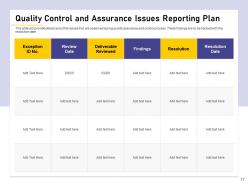
Slide 17: This slide will provide details about the issues that are observed during quality assurance and control process. These findings are to be tracked with the resolution date.
Slide 18: This slide displays Table of Contents.
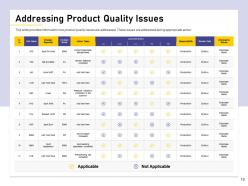
Slide 19: This slide provides information how product quality issues are addressed. These issues are addressed taking appropriate action.
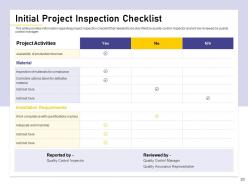
Slide 20: This slide provides information regarding project inspection checklist that needed to be duly filled by quality control inspector and will be reviewed by quality control manager.
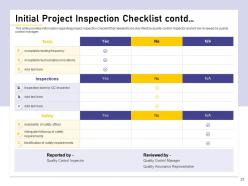
Slide 21: This slide provides information regarding project inspection checklist that needed to be duly filled by quality control inspector and will be reviewed by quality control manager.
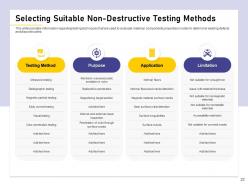
Slide 22: This slide provides information regarding testing techniques that are used to evaluate material, components properties in order to determine welding defects and discontinuities.
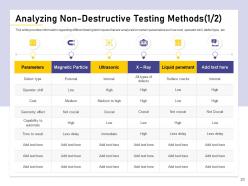
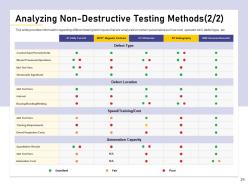
Slide 23: This slide provides information regarding different testing techniques that are analyzed on certain parameters such as cost, operator skill, defect type, etc.
Slide 24: This slide provides information regarding different testing techniques that are analyzed on certain parameters such as cost, operator skill, defect type, etc.
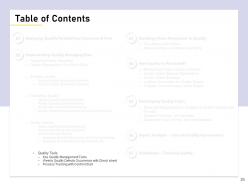
Slide 25: This slide displays Table of Contents
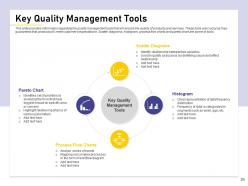
Slide 26: This slide provides information regarding the quality management tools that will ensure the quality of products and services. These tools are crucial as they guarantees that products will meet customer's expectations. Scatter diagrams, histogram, process flow charts and pareto chart are some of tools.
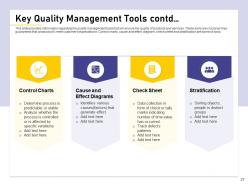
Slide 27: This slide provides information regarding the quality management tools that will ensure the quality of products and services. These tools are crucial as they guarantees that products will meet customer's expectations. Control charts, cause and effect diagram, check sheet and stratification are some of tools.
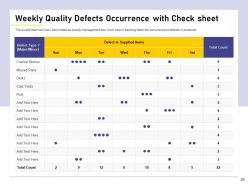
Slide 28: This slide showcases Weekly Quality Defects Occurrence with Check sheet
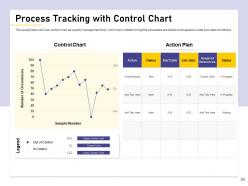
Slide 29: This slide presents Process Tracking with Control Chart.
Slide 30: This slide showcases Table of Contents.
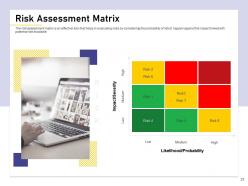
Slide 31: This slide showcases Risk Assessment Matrix.
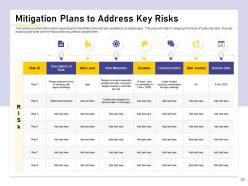
Slide 32: This slide provides information regarding the identified risks that are needed to be addressed. The plan will help in keeping the track of potential risks that are existing and what are the resources required to handle them.
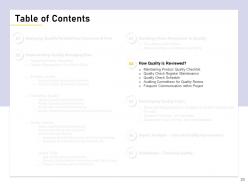
Slide 33: This slide displays Table of Contents
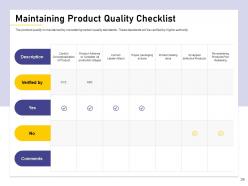
Slide 34: This slide provides information Maintaining Product Quality Checklist
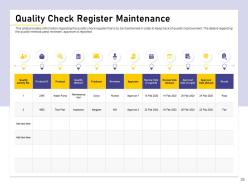
Slide 35: This slide provides information regarding the quality check register that is to be maintained in order to keep track of quality improvement. The details regarding the quality method used, reviewer, approver is reported.
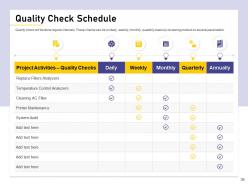
Slide 36: This slide showcases Quality Check Schedule
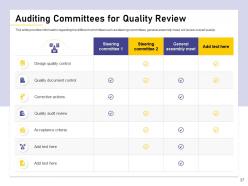
Slide 37: This slide provides information regarding the different committees such as steering committees, general assembly meet, will review overall quality.
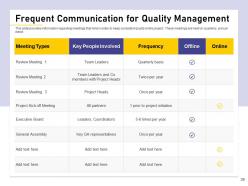
Slide 38: This slide provides information regarding meetings that held in order to keep consistent quality entire project. These meetings are held on quarterly, annual basis.
Slide 39: This slide displays Table of Contents.
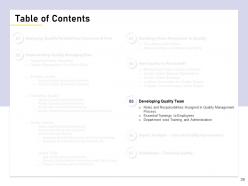
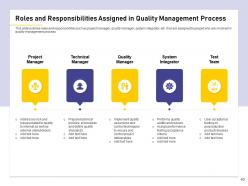
Slide 40: This slide outlines roles and responsibilities such as project manager, quality manager, system integrator, etc. that are assigned to people who are involved in quality management process.
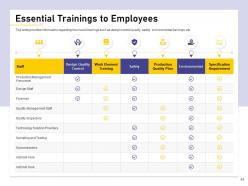
Slide 41: This slide provides information regarding the crucial trainings such as design control quality, safety, environmental trainings, etc.
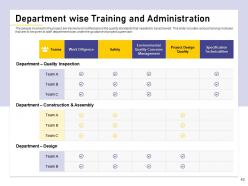
Slide 42: This slide showcases Department wise Training and Administration
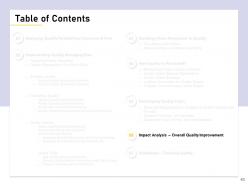
Slide 43: This slide displays Table of Contents
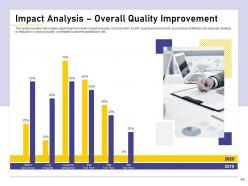
Slide 44: This slide provides information regarding the overall impact of quality improvement. As with quality enhancement, occurrence of defects has reduced, leading to reduction in cost of quality, increased customer satisfaction, etc.
Slide 45: This slide displays Table of Contents
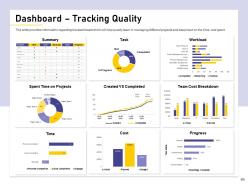
Slide 46: This slide provides information regarding the dashboard which will help quality team in managing different projects and keep track on the time, cost spent.
Slide 47: This is Icons Slide for Project Quality Assurance and Control Plan.
Slide 48: This slide is titled as Additional Slides for moving forward.
Slide 49: This is About Us slide to showcase Company specifications.
Slide 50: This slide displays Mission, Vision and Goals.
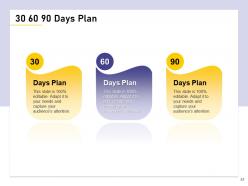
Slide 51: This is 30 60 90 Days Plan slide.
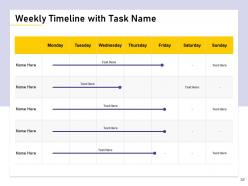
Slide 52: This slide displays Weekly Timeline with Task Name
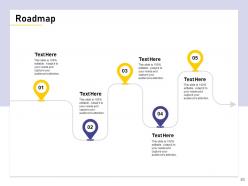
Slide 53: This slide depicts Roadmap
Slide 54: This is Thank You slide with Contact details.
Project quality assurance and control plan powerpoint presentation slides with all 54 slides:
Use our Project Quality Assurance And Control Plan Powerpoint Presentation Slides to effectively help you save your valuable time. They are readymade to fit into any presentation structure.


FAQs for Project quality assurance and control plan
Start with your project risks - figure those out first, then everything else builds around them. You'll need quality objectives, clear standards, and who's doing what. Testing procedures are obvious. Review checkpoints too. Honestly, documentation is boring but saves your butt when auditors show up later. Don't skip the corrective action stuff for when things break. Your team needs training plans, and you'll want solid reporting structures. Communication protocols matter more than people think. Oh, and metrics to actually measure if you're succeeding - otherwise you're just guessing.
Basically, QA happens before stuff gets built - you're setting up processes and standards to stop problems from even starting. QC is after the fact, where you're testing and checking everything to catch issues before shipping. Think of QA as prevention, QC as detection. Honestly, I've seen teams skip the QA part and just rely on testing later, but that's way more work in the long run. Short sentences work better for QC. QA needs more planning upfront. Both matter though - document them separately so your team knows whether they're trying to prevent problems or find them.
Look, stakeholder feedback is huge for QA because they literally decide what counts as "quality." Without their input upfront, you're basically shooting in the dark about acceptance criteria and what actually matters to them. They'll bring up stuff you never would've thought of - I've been burned by this before. When budgets get squeezed (and they always do), their priorities help you figure out what to focus on first. Oh, and definitely get them involved during the planning phase. Don't wait until you've already built everything and then ask for their thoughts.
So basically you want to think like a pessimist when planning your QA - what's gonna break? Map out the scary stuff first: integrations failing, performance crashing, data getting corrupted. Then build your test cases around those nightmares. I always tell my team to focus testing time on the riskiest areas rather than wasting it on boring happy-path scenarios. Set up automated alerts for the metrics that actually matter. Oh and create checkpoints throughout the process so you catch issues early. It's way better than scrambling when everything's on fire later.
Focus on defect density first - that's bugs per deliverable. Customer satisfaction scores matter too, obviously. Track your schedule and budget variance from quality stuff. First-pass yield is clutch though - shows how much work gets through quality checks without needing fixes. Honestly, rework is such a pain and it kills your timeline every time. Cost of quality tells you the real damage when things go sideways. Pick maybe 3-4 metrics based on your biggest quality risks. Weekly tracking works best so you can pivot when stuff starts going wrong instead of finding out too late.
Monthly audits work best for active projects - or hit the major milestones if you're crunched for time. Check if your team's actually doing what they're supposed to do, review deliverables against your standards, and see if they fixed stuff from last time. Honestly, most people hate audits but they catch problems early. Interview team members, test your processes, review the actual work products. Oh and document everything with clear action items and deadlines - I've seen too many audits where nothing gets followed up on and it's just wasted effort.
Honestly, you've got tons of solid options depending on what you need. Monday.com or Asana work great for tracking quality checkpoints and workflow stuff. Minitab's probably overkill unless you're doing heavy statistical work - Excel handles most data analysis just fine. Mobile apps like iAuditor are actually pretty clutch for field inspections and real-time reporting. I've seen teams waste months trying to pick the "perfect" system when they could've started with Google Workspace or SharePoint for document control. My advice? Start with tools your team already knows and add from there.
Training your team makes a huge difference in QA - basically everyone gets on the same page about what good quality actually looks like for your specific project. People catch problems way earlier when they know the standards and testing procedures upfront. It's honestly painful watching untrained teams create more rework than progress (been there). Your team members start becoming quality advocates themselves once they're trained properly. Don't do generic quality theory though - that's useless. Focus on your actual project's criteria and testing protocols. Short, practical sessions work best.
Ugh, scope creep is the worst - everyone suddenly wants "just one more thing" checked. Resource constraints hit hard too when your team's getting pulled everywhere. Don't even get me started on stakeholders who can't agree on quality standards upfront. Timeline pressure makes people want to skip QC steps (spoiler: bad idea). Documentation becomes a total mess with multiple people involved, honestly it's chaos sometimes. Lock down scope early and build in buffer time because stuff always takes longer. Set clear expectations about what quality actually means to everyone. Trust me on the buffer thing - learned that one the hard way.
Build feedback loops right into your QA process - monthly retrospectives work great. Track metrics that actually tell you something useful, not just vanity numbers. Automated reports help you catch trends before they become disasters. Here's the thing though - people need to feel safe reporting problems without getting thrown under the bus. That's how you get real insights. Don't just have your team follow checklists like robots. Get them actively hunting for gaps and pitching improvements. Start with simple monthly meetings where you review what's working and what isn't. Oh, and actually track whether your changes are improving quality outcomes.
So basically, quality objectives give you something concrete to aim for instead of just winging it and hoping for the best. Like you'll set specific targets upfront - "zero critical bugs" or "95% user satisfaction" - so there's no confusion about what you're trying to achieve. Honestly, most teams skip this step and then wonder why everything's a mess later. It helps you figure out where to spend your time and money too. Plus you can catch problems early before they turn into those nightmare scenarios that keep you up at night. Without clear objectives, you're just guessing whether something's actually ready to ship.
Dude, compliance requirements will basically dictate your whole QA/QC setup from day one. You've gotta identify what applies to you first - FDA regs if you're in pharma, ISO stuff for manufacturing, whatever. Those rules determine your testing schedules, documentation needs, and who gets to approve what. Honestly, I've seen too many companies try to bolt compliance onto existing processes later and it's a nightmare. Way easier to design everything around those requirements upfront. The paperwork alone will kill you otherwise. Map out what you need to follow first, then build your quality processes to match.
So you've got a few routes you can take here. Quality logs and checklists are honestly your best bet - they track everything from inspections to fixes in one place. Audit reports work well for the formal stuff, inspection records let you capture the nitty-gritty details with photos. Dashboards are pretty clutch since you can spot patterns quickly. Oh, and definitely do root cause analysis docs when stuff breaks (trust me on this one). The real trick though? Pick whatever your team will actually use consistently. Beautiful documentation means nothing if it just sits there collecting dust.
Honestly, just match your QA to whatever methodology you're using. Waterfall? Go ahead and plan everything upfront with detailed docs and formal reviews between phases. But Agile's completely different - you want testing baked into every sprint with fast feedback loops. Keep the documentation light so it doesn't bog things down. The worst thing you can do is try to jam a rigid QA process into an Agile setup (learned that one the hard way). Look at your current QA stuff and see how it lines up with your delivery cycle, then tweak from there.
Don't jump straight to fixing when you see something go wrong - collect the facts first. Try the "5 Whys" thing where you keep asking why after each answer. Sounds dumb but it actually works really well to get past the obvious stuff. Talk to whoever was dealing with the problem directly since they usually know what's up. Write down what you find (trust me on this one). Once you figure out the real cause, focus on preventing it instead of just slapping a band-aid on it. Otherwise you'll be dealing with the same crap again in two weeks.
-
Easy to edit slides with easy to understand instructions.
-
Great designs, really helpful.
-
Thanks for all your great templates they have saved me lots of time and accelerate my presentations. Great product, keep them up!
-
Great product with highly impressive and engaging designs.
-
Graphics are very appealing to eyes.