


Proposta de slides de apresentação de serviços de saúde




Try Before you Buy Download Free Sample Product
 Impress Your
 Audience
 100%
100% Editable
 Save Hours
 of Time


Indústria de cuidados de saúde sempre foi o maior apoio a cada indivíduo. Os profissionais médicos trabalham muito para servir o país com suas instalações avançadas. Existem inúmeros departamentos de saúde bem estabelecidos e alcançando grandes alturas. Por outro lado, ainda existem alguns setores de saúde que precisam buscar mais reconhecimento. Na maioria das vezes, os novos empreendimentos de saúde não têm serviços médicos adequados e não conseguem se estabelecer na principal indústria de saúde. Neste caso, o departamento específico menciona seus problemas que são resolvidos por um provedor de serviços. Com a ajuda de propostas prontas para conteúdo, os fornecedores podem facilmente entrar em contato com os clientes e oferecer seus serviços. Apresentando nossos slides de apresentação em PowerPoint de Proposta para Serviços de Saúde de fácil acesso, especialmente projetados para atender às suas necessidades. Utilizando este modelo de proposta de serviços médicos em PPT, você pode informar aos clientes sobre seus serviços impecáveis e de qualidade. Aproveite nosso slide de proposta de ferramentas de saúde em PowerPoint para projetar a página inicial de sua proposta que explica o histórico de sua empresa. A proposta inclui o sumário que dá o esboço de cada tópico completamente. Peça ajuda deste tema de proposta de saúde em PPT para destacar sua licença relevante e certificado de qualificação que constrói a confiança do cliente. Empregue nosso modelo de PowerPoint projetado profissionalmente para ilustrar os serviços relacionados ao projeto para a área de saúde que sua empresa fornece. Com a ajuda deste layout de proposta em PPT, você pode exibir o logotipo de sua empresa que mostra a essência de sua marca. Com isso, você pode falar sobre as certificações e recompensas que sua empresa recebeu ao longo dos anos. Existem recursos adicionais e cores vibrantes presentes no slide que dão à sua proposta um visual mais estético. Torne seu acordo mais claro baixando nossa apresentação em PowerPoint de proposta de serviços de saúde projetada profissionalmente.
People who downloaded this PowerPoint presentation also viewed the following :
Conteúdo desta apresentação em PowerPoint
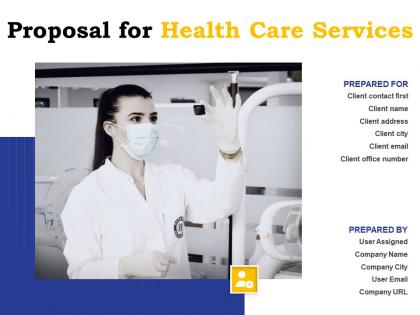
Slide 1: Este slide apresenta a Proposta para Serviços de Saúde. Detalhe os dados do Cliente e os dados do Usuário.
Slide 2: Este slide exibe a Carta de Apresentação.
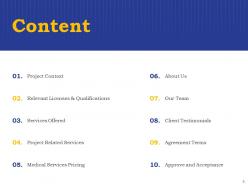
Slide 3: Este slide exibe o Conteúdo da apresentação.
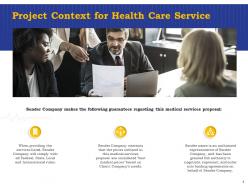
Slide 4: Este slide mostra o Contexto do Projeto para o Serviço de Saúde.
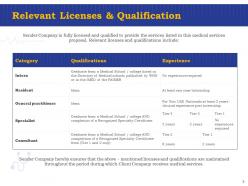
Slide 5: Este slide mostra as Licenças e Qualificações Relevantes.
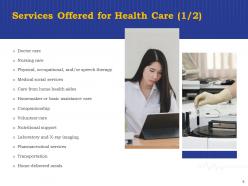
Slide 6: Este slide mostra os Serviços Oferecidos para Saúde.
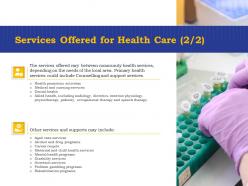
Slide 7: Este slide mostra os Serviços Oferecidos para Saúde.
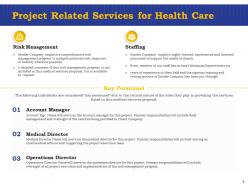
Slide 8: Este slide apresenta os Serviços Relacionados ao Projeto para Saúde, mostrando os papéis da Gestão de Riscos, Contratação, Gerente de Contas, Diretor Médico, Diretor de Operações, Pessoal-Chave.
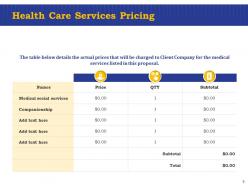
Slide 9: Este slide mostra os Preços dos Serviços de Saúde. A tabela abaixo detalha os preços reais que serão cobrados da Empresa Cliente pelos serviços médicos listados nesta proposta.
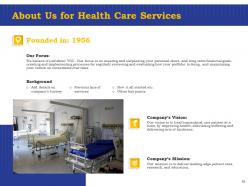
Slide 10: Este é o slide Sobre Nós para mostrar as especificações da Empresa.
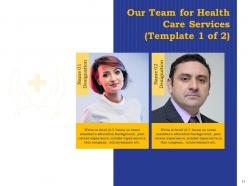
Slide 11: Este é o slide Nossa Equipe com Nomes e Designações.
Slide 12: Este é também o slide Nossa Equipe. Escreva brevemente (4-5 linhas) sobre a formação acadêmica, experiência profissional anterior, experiência semelhante nesta empresa, realizações etc. de cada membro da equipe.
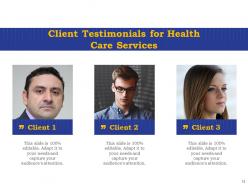
Slide 13: Este slide exibe Depoimentos de Clientes para Serviços de Saúde.
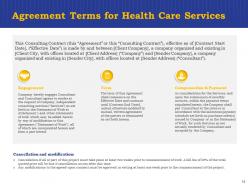
Slide 14: Este slide exibe os Termos do Acordo para Serviços de Saúde.
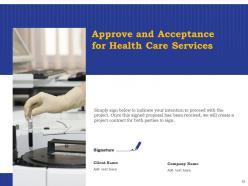
Slide 15: Este slide mostra a Aprovação e Aceitação para Serviços de Saúde com o nome da Empresa, nome do Cliente e Assinatura. Basta assinar abaixo para indicar sua intenção de prosseguir com o projeto. Assim que esta proposta assinada for recebida, criaremos um contrato de projeto para ambas as partes assinarem.
Slide 16: Este slide mostra os Detalhes de Contato.
Slide 17: Este é o Slide de Ícones para Serviços de Saúde.
Slide 18: Este slide é intitulado Slides Adicionais para Avançar.
Slide 19: Este é o slide Nossa Missão com Objetivo, Visão e Missão.
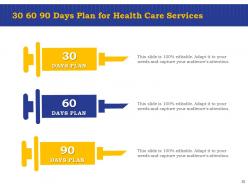
Slide 20: Este é o slide Plano de 30 60 90 Dias.
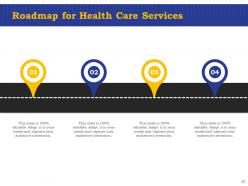
Slide 21: Este slide exibe o Roteiro.
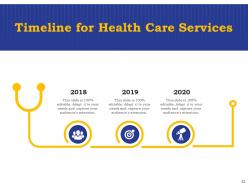
Slide 22: Este slide mostra a Linha do Tempo para Serviços de Saúde.
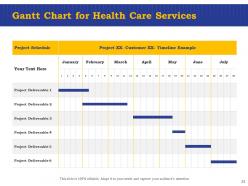
Slide 23: Este slide apresenta o Gráfico de Gantt para Serviços de Saúde.
Slide 1: Proposta de Serviços de Saúde Slide 2: Introdução - Visão geral dos serviços de saúde oferecidos - Objetivos e metas da proposta Slide 3: Serviços Médicos - Consultas médicas - Exames de diagnóstico - Tratamentos e procedimentos Slide 4: Serviços de Enfermagem - Cuidados de enfermagem - Educação em saúde - Acompanhamento de pacientes Slide 5: Serviços de Fisioterapia - Avaliação e tratamento fisioterapêutico - Reabilitação física - Terapia ocupacional Slide 6: Serviços de Saúde Mental - Consultas psicológicas - Terapia individual e em grupo - Programas de bem-estar mental Slide 7: Serviços de Odontologia - Consultas odontológicas - Tratamentos dentários - Higiene oral Slide 8: Serviços de Farmácia - Dispensação de medicamentos - Orientação farmacêutica - Acompanhamento do uso de medicamentos Slide 9: Serviços de Nutrição - Avaliação nutricional - Planos alimentares personalizados - Educação nutricional Slide 10: Serviços de Imagem - Exames de imagem (radiologia, ultrassom, tomografia) - Interpretação e laudos médicos - Acompanhamento de resultados Slide 11: Serviços de Laboratório - Coleta de amostras - Análises laboratoriais - Relatórios de resultados Slide 12: Serviços de Emergência - Atendimento de urgência e emergência - Estabilização de pacientes - Transporte para unidades de saúde Slide 13: Serviços de Internação - Acomodações hospitalares - Cuidados médicos e de enfermagem - Serviços de apoio hospitalar Slide 14: Equipe Multidisciplinar - Médicos especialistas - Enfermeiros - Fisioterapeutas - Psicólogos - Odontólogos - Farmacêuticos - Nutricionistas - Técnicos de imagem e laboratório Slide 15: Infraestrutura e Tecnologia - Instalações modernas e equipadas - Sistemas de informação e registros eletrônicos - Telemedicina e atendimento remoto Slide 16: Acesso e Conveniência - Horários de atendimento flexíveis - Unidades em locais estratégicos - Agendamento online e aplicativo móvel Slide 17: Qualidade e Segurança - Protocolos e procedimentos padronizados - Monitoramento de indicadores de qualidade - Acreditação e certificações Slide 18: Experiência do Paciente - Atendimento personalizado e humanizado - Comunicação efetiva com os pacientes - Satisfação e feedback dos pacientes Slide 19: Parcerias e Convênios - Convênios com planos de saúde - Acordos com empresas e organizações - Colaboração com instituições de saúde Slide 20: Investimentos e Sustentabilidade - Investimentos em infraestrutura e tecnologia - Gestão financeira eficiente - Sustentabilidade a longo prazo Slide 21: Impacto Social - Promoção da saúde e bem-estar da comunidade - Programas de responsabilidade social - Acessibilidade e inclusão Slide 22: Plano de Implementação - Etapas e cronograma de implementação - Recursos necessários - Monitoramento e avaliação Slide 23: Conclusão - Resumo dos principais pontos da proposta - Benefícios para os pacientes e a comunidade - Próximos passos
Apresentação de slides para proposta de serviços de saúde


FAQs for Proposal for health care services
Okay so the big ones are rural access and mental health - wait times for therapy are absolutely brutal right now. Low-income folks can't get preventive care either, which is messed up. Oh and we're super short on specialists in underserved areas. Telehealth could help but the infrastructure is still spotty in a lot of places. I'd focus your proposal on these four things since they'll make the biggest difference for health disparities. Maybe start with the rural stuff? That one's pretty straightforward to tackle first.
Honestly, start with your biggest headaches first - don't try to fix everything at once. Telemedicine is huge now, plus automated scheduling saves so much time. Electronic health records that actually sync properly are a game changer (when they work right, anyway). AI can help with diagnostics and figuring out who needs care first. Mobile apps are great for monitoring patients remotely and medication reminders. The whole COVID thing really pushed telehealth forward - showed us we didn't need to do everything in person. Digital tools help coordinate staff and manage inventory too. Just pick what's driving you crazy and tackle that.
Look, there are basically three things you need to track. Patient satisfaction is huge - how long they're waiting, how the staff treats them, overall experience. Clinical stuff matters too obviously - readmission rates, whether treatments actually work, complications you could've prevented. Then there's the money side which honestly gets messy fast - cost per patient, how your revenue's flowing, efficiency ratios and all that. The data will probably make your head spin at first. But if you can nail down baselines for these three areas before you launch, you'll be in good shape. Start simple and build from there.
So build feedback collection into different parts of your proposal - patient surveys, focus groups, maybe a simple online portal. People actually love being heard about their healthcare (weird but true). Ask specific stuff like wait times and communication preferences instead of vague "rate us 1-10" questions. The real trick is closing the loop - analyze what they tell you and show patients how you used their feedback to make changes. Otherwise it's just performative BS. Start with one or two methods and add more later. Don't overthink it initially.
Yeah, so first year you're looking at about $2.3M - staffing, equipment, facility stuff. Pretty brutal upfront. But your break-even hits around month 18, which honestly isn't terrible for something this big. Monthly costs after that run about $180K. The ROI comes mainly from higher patient volume and not having to outsource anymore. Oh, and definitely check section 4 if you haven't - breaks down where all that money's actually going so you can figure out what to spend on first.
So it basically just builds on the HIPAA stuff you're already doing - nothing crazy new there. We stuck with current CMS guidelines too, which honestly made the whole regulatory section pretty dry to write but whatever. Patient privacy, billing protocols, all that fun stuff maps to what you know already. The cool part though? How we tied everything into existing Medicare/Medicaid reimbursement. Way less painful than starting from scratch. You should probably jump to section 3.2 first since it breaks down which current policies we're using. Makes the whole implementation thing way clearer.
So community health workers are like the main link between patients and doctors. They do preventive stuff, screenings, teach people about health - all right in their neighborhoods. What's cool is they actually live in these communities, so they get the culture and barriers people face. They help manage chronic conditions too and refer folks to specialists when things get serious. Oh, and they're basically healthcare advocates which is pretty needed honestly. Makes care way more accessible for people who usually get overlooked by the system.
So they're putting clinics right in low-income neighborhoods and boosting telehealth coverage. Community health workers help bridge gaps, plus there's sliding-scale payments and transportation vouchers - which honestly makes sense since half these people can't even get to appointments. Providers get cultural training and materials come in different languages. Priority enrollment for underserved folks too. The thing is, you really need solid metrics tracking whether people are actually getting better access, not just having more services sitting there unused. Otherwise it's just throwing money around.
Local hospitals and community health centers should be your first targets - that's where the referrals happen. Insurance companies matter too for getting coverage sorted out. Community groups like senior centers are gold because they actually know your patients. Academic partnerships can add some credibility plus free labor from students, which is honestly pretty nice. I'd focus on maybe 2-3 solid relationships first instead of spreading yourself thin everywhere. Once you've got those working well, then branch out. Oh, and specialty clinics are worth pursuing too if they align with what you're doing.
Cast a wide net with this - social media and local newspaper ads work great for general awareness. Then go deeper with health fairs and senior center presentations. Partner up with local organizations too. Word-of-mouth is honestly underrated in healthcare, people trust recommendations from friends more than ads. If you've got a diverse community, definitely make materials in different languages. Your patient newsletter and website homepage are easy wins since people already check those. Oh, and track which methods bring in the most calls - that way you can focus your budget on what's actually working instead of guessing.
Just focus on showing how early stuff like screenings and check-ups saves tons of money later. Like, preventing diabetes complications is way cheaper than dealing with kidney failure down the line - that's a no-brainer. Yeah, you're spending more upfront but honestly the numbers work out great over 3-5 years. Highlight how you'll cut down ER visits and hospital stays for chronic diseases. ROI projections are huge here. Stakeholders love seeing actual dollar savings, so make those projections really clear and specific.
Oh man, you're gonna hit three big walls: money problems, can't find good staff, and all the legal red tape. Funding's tricky - try getting money from different places and roll things out slowly instead of all at once. Start hunting for people way earlier than you think you need to. Maybe team up with schools that train folks? And seriously, get lawyers involved from the start because fixing compliance issues later is such a nightmare. I learned that one the hard way. Make yourself a little chart of what could go wrong and how you'll handle it.
So basically this proposal has this flexible setup where you can switch up services based on new health trends and patient data. Pretty smart actually. They do quarterly reviews to see what's working and what's a bust. The tech can scale up or down too, which is clutch. Most healthcare plans pretend nothing ever changes - this one actually gets it. It's all modular, so adding new specialties or telehealth stuff won't require rebuilding everything from scratch. Definitely start with the data analytics part first though, that'll show you where to pivot next.
So we're rolling out end-to-end encryption for patient data, which honestly looks way more secure than what most places are using right now. Multi-factor authentication for system access too. Patient records go on HIPAA-compliant servers with regular audits, and we're doing need-to-know access only - so staff can just see what's relevant to them. Oh, and there's mandatory privacy training for everyone. The big thing you'll need to watch for is getting explicit patient consent before sharing data between departments. Documentation is key there, don't skip it.
So basically you get these feedback loops between staff and management - everyone's constantly sharing what works and what doesn't. There are innovation labs too where teams can test new stuff without waiting forever for approvals (which is huge because healthcare moves so slowly). Plus you get dedicated time for improvement projects and access to dashboards showing real patient outcomes in real-time. Oh, and here's the thing - you actually have to act on the feedback you collect. Otherwise it just turns into another pointless bureaucratic thing nobody cares about.
-
Easily Understandable slides.
-
It saves your time and decrease your efforts in half.