


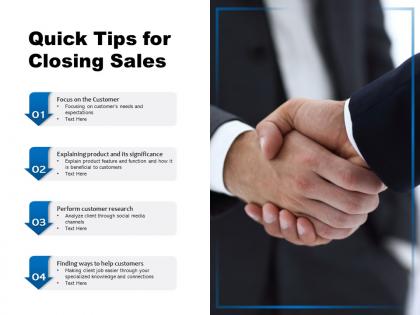
Quick tips for closing sales




Try Before you Buy Download Free Sample Product
 Impress Your
 Audience
 100%
100% Editable
 Save Hours
 of Time


Follow a contrarian approach with our Quick Tips For Closing Sales. They help challenge archaic beliefs.
People who downloaded this PowerPoint presentation also viewed the following :
Quick tips for closing sales with all 2 slides:
Dismiss cynicism with our Quick Tips For Closing Sales. Your forthright approach will build belief.
FAQs for Quick tips
Effective closing techniques include the assumptive close, alternative choice close, urgency close, summary close, and trial close, each tailored to specific buyer personalities and scenarios. These approaches work by building natural momentum, addressing final objections, and creating decision-forcing moments, with many sales professionals finding that matching closing style to customer type significantly improves conversion rates and shortens sales cycles.
Emotional intelligence enables sales professionals to close more deals by reading customer emotions, adapting communication styles, and building genuine rapport through active listening and empathy. By recognizing buying signals, addressing unspoken concerns, and timing proposals strategically, salespeople create trust-based relationships that naturally lead to purchase decisions, ultimately delivering higher conversion rates and stronger customer loyalty.
Active listening enables sales professionals to identify genuine customer concerns, uncover hidden objections, and understand underlying needs that directly impact purchasing decisions. Through attentive listening, salespeople can address specific hesitations, tailor closing approaches to individual client priorities, and build trust that facilitates smoother deal completion, with many finding that customers respond more favorably when they feel genuinely heard and understood.
Visualization techniques enhance sales closing by helping salespeople mentally rehearse successful outcomes, anticipate objections, and build confidence before critical conversations. Through guided imagery and scenario planning, sales professionals can practice handling complex negotiations, visualize positive client responses, and prepare for various closing situations, ultimately delivering more persuasive presentations and stronger deal conversions.
Persuasive closing language includes assumptive phrases like "when we implement this," scarcity indicators such as "limited availability," and benefit-focused statements emphasizing outcomes rather than features. Successful salespeople combine social proof language with urgency creators and confirmation techniques, ultimately guiding prospects toward decisions while addressing final objections, with many finding that assumptive language significantly increases conversion rates.
Strategies include addressing price concerns through value demonstration, handling timing objections with urgency creation, countering competitor comparisons with unique differentiators, and resolving trust issues through testimonials and guarantees. These approaches work by acknowledging concerns directly, providing compelling evidence, and creating emotional connection, with many sales professionals finding that active listening combined with prepared responses ultimately converts hesitant prospects into committed customers.
Timing significantly influences sales closing success by aligning your approach with customer readiness, decision-making cycles, and budget availability. Strategic timing involves recognizing buying signals, understanding seasonal business patterns, and respecting prospect timelines, with many sales professionals finding that premature closes damage relationships while delayed approaches risk losing opportunities to competitors who act decisively.
Visual aids, particularly professional presentation templates, significantly enhance sales closure rates by improving information retention, building credibility, and creating emotional connections with prospects. These tools streamline complex product demonstrations, enable consistent messaging across sales teams, and help prospects visualize solutions more clearly, ultimately reducing decision-making time and increasing conversion rates in competitive markets.
Sellers can create urgency through transparent communication about genuine deadlines, limited availability, or time-sensitive benefits, while emphasizing value rather than pressure. By focusing on helping customers understand consequences of delayed decisions, sharing relevant market insights, and positioning urgency as collaborative guidance rather than sales tactics, sellers ultimately build trust while motivating action.
Effective follow-up strategies include personalized email sequences, value-added content sharing, strategic phone calls, social media engagement, and timely proposal delivery. These approaches work by maintaining consistent touchpoints, addressing specific client concerns, and demonstrating ongoing value, with many sales professionals finding that combining multiple channels increases conversion rates significantly.
Cultural differences significantly influence closing strategies by affecting communication styles, decision-making processes, relationship-building expectations, and negotiation timelines across global markets. While Western cultures often favor direct, data-driven closes, many Asian and Middle Eastern markets prioritize relationship development and consensus-building, with sales teams finding that adapting their approach to local cultural norms ultimately delivers higher conversion rates and stronger client partnerships.
Sales professionals should track conversion rates, average deal size, sales cycle length, close ratio by technique, and objection-to-close ratios to measure closing effectiveness. These metrics enable teams to identify which approaches work best across different customer segments, ultimately optimizing their strategies, increasing revenue per representative, and enhancing overall sales performance.
Storytelling enhances closing by presenting relatable customer success scenarios, addressing specific objections through narrative examples, and creating emotional connections that complement logical arguments. Sales professionals in industries like software, insurance, and consulting use brief case studies of similar clients achieving desired outcomes, ultimately building trust and demonstrating proven value propositions.
Client rapport serves as the foundation for successful sales closure by building trust, reducing buyer resistance, and creating emotional connection that facilitates decision-making. Strong rapport enables salespeople to understand client needs more deeply, address concerns more effectively, and present solutions more persuasively, with many sales professionals finding that genuine relationships ultimately drive higher conversion rates and long-term customer loyalty.
B2B closing strategies emphasize relationship building, consensus-driven decisions, and long-term value propositions, while B2C approaches focus on emotional triggers, urgency, and immediate benefits. B2B sales typically require multiple touchpoints with decision committees and detailed ROI justifications, whereas B2C leverages personalized experiences and streamlined purchase processes, with successful organizations finding that adapting communication style and timeline expectations ultimately delivers higher conversion rates.
No Reviews