

Raci Matrix For Vendor Risk Assessment




Try Before you Buy Download Free Sample Product
 Impress Your
 Audience
 100%
100% Editable
 Save Hours
 of Time


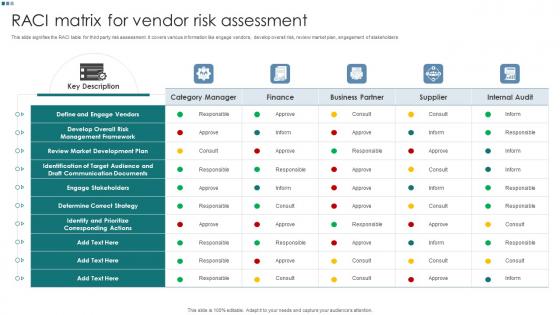
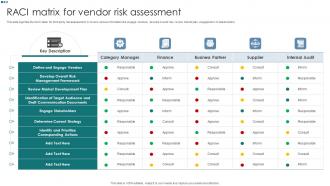
This slide signifies the RACI table for third party risk assessment. It covers various information like engage vendors, develop overall risk, review market plan, engagement of stakeholders.
People who downloaded this PowerPoint presentation also viewed the following :
Raci Matrix For Vendor Risk Assessment with all 6 slides:
Use our Raci Matrix For Vendor Risk Assessment to effectively help you save your valuable time. They are readymade to fit into any presentation structure.





FAQs for Raci Matrix For
Ok so basically you need four things. Start with clear risk buckets - financial stuff, operations, cybersecurity, compliance, reputation. Then make a consistent scoring system because otherwise you're just making it up as you go (which never works well). Due diligence should match the risk level - like, your paper clip vendor doesn't need the same treatment as your cloud provider, you know? Oh and continuous monitoring is huge since things change all the time. I'd honestly just start by putting your current vendors into risk tiers first - you'll probably be surprised at what you find.
Build a scoring system that looks at data access, financial impact, and compliance stuff. Sort vendors into risk buckets - critical, high, medium, low based on what they touch and how much you'd be screwed if they failed. Most companies waste time doing deep dives on everyone, which honestly just burns people out. Save the heavy assessments for vendors who could actually tank your business. Lighter reviews work fine for low-risk ones. Oh, and set up regular check-ins - especially when contracts are up for renewal or things change.
Just figure out what regulations actually hit your industry first. Financial stuff means dealing with SOX and PCI DSS - banking has those FFIEC guidelines too. Healthcare's obviously all about HIPAA. GDPR will absolutely wreck you if you've got EU customers and ignore it. Cloud providers need SOC 2, government contracts require FedRAMP. There's probably other niche stuff I'm forgetting depending on what you do. Honestly, I'd just make a simple checklist of whatever applies to you and drill your vendors on each one. Make them show actual proof they're compliant, not just say they are.
Quantitative gives you actual numbers - financial ratios, security scores, compliance percentages. Stuff you can measure and compare directly. Qualitative is more subjective judgment calls, like expert opinions and interviews about company culture or how solid their management seems. Most companies I've seen mix both approaches, which makes sense honestly. Numbers don't capture everything. I'd probably start with the quantitative data first to weed out obvious nos, then dig into the qualitative stuff for your final picks. Way easier than trying to interview like 20 vendors right off the bat.
So for automating vendor risk stuff, BitSight and SecurityScorecard are pretty decent - they'll monitor your vendors 24/7 and spit out risk scores. ServiceNow and MetricStream handle the boring workflow parts like questionnaires and approvals. Some teams build their own thing with APIs, but honestly that's a pain unless you have the dev resources. The biggest thing though? Whatever you pick has to actually talk to your current systems. I've seen too many companies end up with yet another tool that sits by itself and nobody uses it.
At minimum, do them yearly. But that's honestly pretty bare bones for most situations. High-risk vendors or anyone touching sensitive data? I'd say quarterly or every six months. It really comes down to your industry's rules and how much risk you're comfortable with. Also - and this is where people mess up - you need to do assessments whenever something major changes. New services, data breaches, company gets sold, whatever. Oh, and set those calendar reminders now because scrambling at deadline time sucks.
So I'd focus on a mix of hard numbers and the softer stuff. Track how many vendors actually finish their assessments on time, plus average time to fix critical issues. Also break down your vendors by risk level - that's super helpful. Here's the thing though: measure how many incidents actually trace back to vendor problems. That tells you if your program is working or just busy work. Don't ignore whether people are happy with the process either. Business teams will just work around you if it sucks. Start with maybe 3-4 key metrics, then add more once you get the hang of it.
Honestly, you've gotta bake compliance checks right into your contracts from day one. Security questionnaires during selection are a must. Require certs like SOC 2 or ISO 27001 - yeah, the paperwork sucks but it'll save your ass later. Set up regular audits and if you can swing it budget-wise, automated monitoring tools are clutch. Critical vendors? Do on-site visits. Also make sure they're required to tell you immediately when things go wrong - can't stress this enough. Oh, and put compliance on every vendor review agenda, not just something you check once and forget about.
Due diligence is your fact-checking phase - where you verify everything the vendor actually told you is legit. You'll need to dig into their financials, security certs, compliance records, all that fun stuff. Honestly? It's boring as hell but you can't skip it. Without doing this homework, you're just trusting whatever they say about handling your company's data. That's a terrible idea. I always start with their latest audit reports first, then work backwards. Takes forever but beats getting burned later when something goes wrong.
Know your audience - execs want the big picture with risk scores and business impact, but your tech folks need all the nitty-gritty details. Red/yellow/green dashboards work great because nobody has to think too hard. Honestly, I've watched amazing security assessments just die because they read like textbooks instead of action plans. Don't forget timelines and who owns what fixes. That part's crucial. Connect everything back to stuff leadership actually loses sleep over - revenue, compliance, whatever keeps them up at night. Makes your findings way harder to shove in a drawer.
You've got some good moves here. Put everything in writing first - SLAs, penalties, the works. Don't just check on vendors once and call it good; you need regular visits and reviews. High-risk ones should carry extra insurance or follow specific security standards. Also spread things around - putting everything with one vendor is asking for trouble, honestly. Oh, and match your effort to the actual risk level. No point going overboard on controls for some low-stakes relationship that barely matters to your business.
Your vendor's broke? Yeah, that's gonna wreck your whole risk picture. Service disruptions, broken contracts, maybe they fold entirely - suddenly you're hunting for replacements while everything's on fire. Been there, it sucks. Broke vendors also skimp on the important stuff. Security gets sloppy, quality drops, compliance becomes an afterthought when they're bleeding cash. Check their financials early - statements, credit scores, cash flow, the works. Honestly, declining revenue or debt piles should send you running. Don't wait around hoping it gets better.
Honestly, the biggest mistake I see is people treating these assessments like a one-time thing. You rush through the initial questionnaire just to check the box, but then what? Companies change their security practices all the time. Another thing - those generic templates are pretty useless if they don't match what your vendor actually does for you. Like, why are you asking about data encryption if they're just handling your office supplies? Focus on the risks that actually matter for your business. And definitely don't forget to circle back periodically. I'd say yearly at minimum, but really depends on how critical they are.
Honestly, geopolitical stuff can totally screw up your vendor deals. Trade wars and sanctions pop up out of nowhere - I've watched companies panic when their main supplier suddenly became off-limits. Political chaos in a vendor's country means supply chain headaches and way higher costs. You'll want to check out the political situation where your vendors are based. Smart move is having backup suppliers in more stable places. Also throw some clauses in your contracts covering this kind of disruption - learned that one the hard way. Keep tabs on the news too since this stuff changes fast.
Talk to your vendors regularly - like actually schedule check-ins so you're both on the same page about risks. Set up shared tracking systems where you can both see what's happening in real-time. Getting them to participate is honestly such a pain sometimes, but joint workshops really help you catch stuff you'd miss alone. Share threat intel with them too. Quarterly reviews work well if you document who's doing what by when. Oh and make it collaborative, not like you're auditing them - nobody wants that vibe. The partnership approach gets way better results.
-
Loved the templates on SlideTeam, I believe I have found the go to place for my presentation needs!
-
Loved the collection. Editing the presentation was seamless with their templates.