

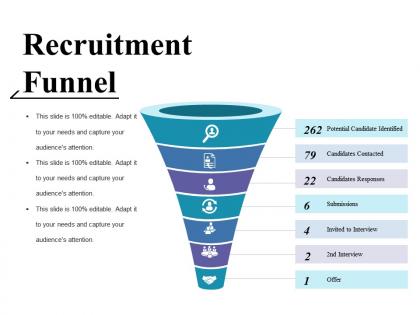
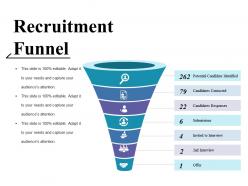
Recruitment funnel ppt gallery




Try Before you Buy Download Free Sample Product
 Impress Your
 Audience
 100%
100% Editable
 Save Hours
 of Time


Our Recruitment Funnel Ppt Gallery allow you to go with the flow. Continue to go forward at your convenience.
People who downloaded this PowerPoint presentation also viewed the following :
Recruitment funnel ppt gallery with all 5 slides:
Get great group dynamics with our Recruitment Funnel Ppt Gallery. They generate collaborative effort.
FAQs for Recruitment
So basically you start with sourcing candidates, then do initial screening and contact. After that comes interviewing - usually a few rounds which honestly can drag on forever at some companies. Then reference checks and finally the offer/onboarding stuff. It's like a funnel where you're narrowing down from tons of people to just one. Some places add extra steps like skills tests or those culture fit interviews. Really depends on the company. You'll want to track how many people make it through each stage though - helps you figure out where things get stuck in the process.
Honestly, employee referrals are still your best bet - your team knows talented people you'd never find otherwise. Build up your employer brand before you're desperate. LinkedIn posts about actual company culture help, but skip the corporate BS in job descriptions. Nobody wants to read that garbage. Hit up industry events where good candidates actually go. Oh, and please update your careers page if it looks ancient. The whole thing is about being visible consistently in the right spots. Start those relationships early instead of scrambling when you need someone tomorrow.
Think of employer branding like your company's dating profile - it attracts the right people before they even apply. Good branding means quality candidates actually want to work for you. Bad branding? You'll either scare away talent or end up with people who don't fit. The trick is being authentic about your culture, not just posting pretty Instagram photos of your office (we've all seen those fake "candid" team shots). When your brand matches reality, candidates basically pre-filter themselves. You get applicants who actually mesh with what you're about instead of random people just looking for any job.
Honestly, the data shows you exactly where people are bailing in your hiring process instead of just guessing what's wrong. Maybe they're seeing your job post but not applying, or they start the application then give up halfway through - super common with those marathon forms btw. You can also spot if there's a particular interview round where everyone gets rejected. Track your application completion rates first, then time-to-hire. Those will give you some quick fixes right away. Plus you'll figure out which job boards or recruiting sources actually bring in good candidates worth the money.
You'll need different metrics for each stage to catch where things go wrong. Start tracking application volume and which sources actually work - some job boards are total garbage. Phone screen-to-interview rates matter too, plus how long you take to schedule (nobody wants to wait weeks). Interview-to-offer ratios tell you if you're being too picky. Offer acceptance rates? That's where you'll see if your compensation sucks. Oh, and candidate experience scores - people talk when interviews are awful. Set up something simple to track this stuff. Spreadsheets are fine, just don't overthink it. The goal is spotting patterns fast so you can fix what's broken.
From what I've seen, the worst bottlenecks hit in three places: not enough good people applying, hiring managers taking forever to give feedback, and interviews that drag on way too long. Maybe your application is too complicated? Job descriptions can be pretty intimidating too - I swear some companies write them like they're looking for unicorns. Communication between teams is usually terrible, which doesn't help. Track where people drop out of your process first. That'll show you the real problem. Set deadlines for feedback and make your interview timeline consistent. Oh, and simplify that application flow if you can.
So ATS systems handle your whole hiring process - job posting, resume screening, candidate tracking, the works. They'll post to multiple job boards at once and filter resumes by keywords automatically. The analytics are honestly pretty sweet - shows you exactly where people bail and timing for each step. Yeah, setup can be a pain initially (some interfaces are straight garbage), but once it's running you'll never go back to manual sorting. Hours saved, zero lost candidates. Oh, and definitely map out your current process first before picking one.
Honestly, personalized rejection emails with feedback are clutch - even when you're drowning in work. Keep the good ones in your pipeline though! Toss them in your CRM with notes about their strengths and what might work later. The quarterly update thing actually works pretty well, or invite them to company stuff. Makes people feel less crappy about the whole rejection thing, you know? Short sentences help sometimes. Set up those automated sequences if you can swing it - saves your sanity while keeping relationships warm for when something better opens up.
Look, start with job postings - where you're advertising and how you're writing them matters more than people think. Hit up HBCUs, diverse professional groups, community orgs for sourcing. Structured interviews are your friend here, plus get different people on your interview panels. Seriously cuts down on bias. Track who's dropping off at each stage so you can see the patterns. Don't just bolt this onto your existing process - it needs to be baked in from the start. Maybe pick one piece to focus on this week? The sourcing part's probably easiest to tackle first.
Honestly, it's all about not treating people like crap during the process. Quick responses are huge - nobody wants to wait weeks for basic updates. Ditch those awful template emails too, candidates can tell immediately. I'd audit where people are dropping off first, then fix those pain points. Make sure your application works on mobile since that's where everyone applies from anyway. Regular updates help even when nothing's happening. Oh, and give them actual glimpses of what working there is like through team chats or quick videos. People want to know they're not walking into a nightmare job, you know?
Passive candidates are basically people who aren't job hunting but might be open to the right thing. They're at the top of your funnel, which is kinda backwards when you think about it. You can't treat them like regular applicants though - they're not desperate or anything. Build relationships first. Share cool content, network, just stay on their radar without being pushy. It's honestly more like... I dunno, making friends? You want them thinking of you when they finally decide to make a move. Keep them interested so you're their go-to person.
Think of interviews as your main way to filter people - you get to see who can actually do the job vs who just looks good on paper. Start with phone screens to cut obvious no's, then do technical/behavioral rounds that dig deeper. Each round should eliminate like 50-70% of candidates (sounds harsh but it works). The key thing is making sure each interviewer knows exactly what they're evaluating. Otherwise you end up with these weird random conversations that don't tell you anything useful. Oh and trust me - this is where you'll catch people who seem perfect on their resume but totally can't deliver.
Start with tracking one simple thing - like how long it takes to actually hire someone. Then build from there. Get feedback from candidates after each interview round (yeah, it's annoying extra work but you'll catch stuff you're missing). Also check where people are dropping out of your process. Monthly team reviews help too - sometimes patterns are obvious when you step back and look. Your hiring managers probably have opinions about candidate quality, so ask them! The real trick though? Don't just collect all this feedback and let it sit there. Actually change things based on what you learn.
Dude, yes - a messy recruitment process will absolutely destroy your employer brand. People talk, especially when they've had a crappy experience. Ghost someone after three interviews? That story's ending up on Glassdoor for sure. I've watched companies shoot themselves in the foot for years because they built this reputation for wasting people's time or having zero communication. The thing is, even people you reject can become cheerleaders if you just treat them like humans. Keep your process clear, actually respond to candidates, and give real feedback when it's over. Your future hiring success totally depends on not screwing this up.
Honestly, you've gotta completely rethink your screening process. Test for stuff that actually matters remotely - like how clearly they communicate or if they can stay motivated without someone breathing down their neck. During interviews, throw in some real scenarios - screen sharing exercises or see how they handle async messages. Be super upfront about your remote setup too, because candidates are judging whether they want to work with YOU remotely. Skip the awkward culture fit chitchat and focus on how they deal with unclear situations. Oh, and make your interview process mirror what they'll actually experience - don't create some elaborate dance that has nothing to do with the real job.
-
Enough space for editing and adding your own content.
-
Top Quality presentations that are easily editable.