


Restaurant operations management operational checklist




Try Before you Buy Download Free Sample Product
 Impress Your
 Audience
 100%
100% Editable
 Save Hours
 of Time


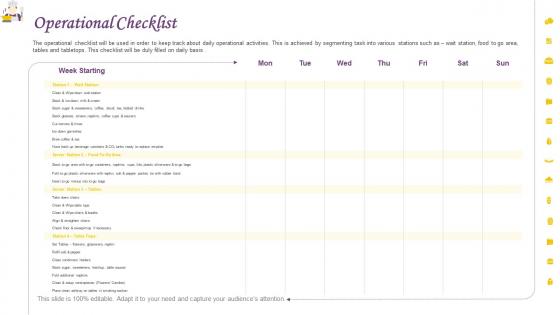
The operational checklist will be used in order to keep track about daily operational activities. This is achieved by segmenting task into various stations such as wait station, food to go area, tables and tabletops. This checklist will be duly filled on daily basis .
People who downloaded this PowerPoint presentation also viewed the following :
Restaurant operations management operational checklist with all 6 slides:
Use our Restaurant Operations Management Operational Checklist to effectively help you save your valuable time. They are readymade to fit into any presentation structure.





FAQs for Restaurant operations
A daily restaurant operations checklist includes inventory management, food safety protocols, equipment maintenance, staff scheduling, customer service standards, and financial reconciliation. These components streamline operations by ensuring consistent food quality, maintaining health compliance, and optimizing resource allocation, with many restaurant chains finding that systematic daily checklists reduce costs, enhance customer experiences, and ultimately deliver improved operational efficiency.
Technology streamlines restaurant operations by automating inventory management, enabling digital ordering systems, optimizing staff scheduling, and providing real-time analytics for decision-making. Through integrated POS systems and kitchen display technologies, restaurants enhance order accuracy, reduce wait times, and improve customer experiences, while ultimately delivering operational efficiency and competitive advantage in an increasingly digital hospitality landscape.
Restaurant safety and hygiene practices include temperature monitoring, hand sanitization protocols, surface disinfection procedures, food storage guidelines, and equipment maintenance schedules. These measures streamline compliance by reducing contamination risks, ensuring food safety standards, and maintaining customer confidence, with many establishments finding that systematic hygiene protocols ultimately deliver operational efficiency and enhanced reputation management.
Staffing levels significantly impact restaurant operations by affecting service speed, food quality, customer satisfaction, and operational costs. Inadequate staffing leads to longer wait times, increased errors, and employee burnout, while overstaffing reduces profitability, with many successful restaurants finding that strategic scheduling and cross-training maximize efficiency while maintaining excellent service standards.
Restaurant inventory management best practices include implementing first-in-first-out rotation, conducting regular cycle counts, establishing par levels for each item, using digital tracking systems, and maintaining detailed vendor relationships. These approaches streamline operations by reducing food waste, minimizing stockouts, and optimizing cash flow, with many restaurants finding that systematic inventory control ultimately delivers 15-20% cost savings while enhancing menu consistency.
A well-structured checklist enhances customer service by ensuring consistent greeting protocols, timely order taking, accurate food delivery, and proper table maintenance throughout each dining experience. These standardized procedures enable staff to maintain service quality during busy periods, reduce wait times, and address customer needs proactively, ultimately delivering higher satisfaction rates and encouraging repeat business.
Employee training ensures consistent service quality, food safety compliance, efficient workflow management, and brand standard adherence across all restaurant operations. Well-trained staff deliver faster service, reduce waste, minimize errors, and enhance customer experiences, with many restaurants finding that comprehensive training programs significantly improve operational efficiency and ultimately drive higher customer satisfaction and profitability.
Restaurant operations checklists adapt to changing health regulations through modular design, regular updates, digital platforms, staff training protocols, and compliance tracking systems. These flexible frameworks enable restaurants to quickly incorporate new sanitization requirements, capacity restrictions, and safety protocols, while maintaining operational efficiency and ensuring consistent adherence across all locations, ultimately protecting customers and avoiding costly violations.
Essential tools include point-of-sale systems, inventory management software, employee scheduling platforms, customer relationship management systems, and kitchen display systems. These technologies streamline operations by automating order processing, tracking stock levels, and optimizing staff allocation, with many restaurants finding that integrated solutions deliver faster service, reduced waste, and enhanced customer experiences.
Restaurants can measure checklist effectiveness through completion rates, time tracking, customer satisfaction scores, food safety audit results, and revenue per table metrics. By analyzing these data points weekly, establishments streamline service delivery, reduce waste, and enhance dining experiences, with many finding that systematic measurement ultimately delivers improved operational efficiency and competitive advantage.
Common pitfalls include creating overly complex checklists, failing to customize tasks for specific roles, neglecting regular updates, and overlooking staff input during development. Many restaurants find that generic templates without operational specificity, unclear task descriptions, and insufficient training on checklist usage ultimately reduce efficiency rather than streamline operations, making staff compliance difficult.
Restaurant layout significantly affects operational efficiency by optimizing workflow patterns, minimizing staff movement between stations, and ensuring smooth customer flow from entrance to seating areas. Strategic design enables faster table turnover, reduces service delays, and enhances kitchen-to-dining coordination, with many establishments finding that well-planned layouts ultimately deliver improved customer satisfaction and increased revenue potential.
Essential checklist items include daily equipment inspections, cleaning schedules for fryers and grills, refrigeration temperature monitoring, HVAC filter replacements, and plumbing system checks. These maintenance protocols streamline operations by preventing costly breakdowns, ensuring food safety compliance, and maintaining consistent service quality, with many restaurant chains finding that proactive facility management ultimately delivers reduced operational costs and enhanced customer experiences.
Restaurants should review their operations checklist monthly for routine updates, quarterly for comprehensive assessments, and immediately following any incidents, regulatory changes, or menu modifications. This systematic approach enables consistent service quality, regulatory compliance, and operational efficiency, with many establishments finding that regular reviews identify cost-saving opportunities and enhance customer experiences while maintaining competitive standards.
Effective peak service strategies include optimized staff scheduling, pre-prepared ingredients, streamlined kitchen workflows, reservation management systems, and cross-trained personnel. These approaches enhance operational efficiency by reducing wait times, maximizing table turnover, and maintaining food quality consistency, with many restaurants finding that strategic preparation and flexible staffing ultimately deliver improved customer experiences and increased revenue during busy periods.
-
Excellent Designs.
-
Very unique and reliable designs.