


Targets and incentives achieve sales ppt powerpoint presentation file grid




Try Before you Buy Download Free Sample Product
 Impress Your
 Audience
 100%
100% Editable
 Save Hours
 of Time


Gift them fearlessness with our Targets And Incentives Achieve Sales Ppt Powerpoint Presentation File Grid. They will acquire the fortitude to endeavour.
People who downloaded this PowerPoint presentation also viewed the following :
Content of this Powerpoint Presentation
Description:
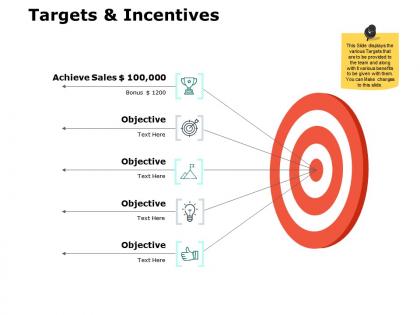
This image is a PowerPoint slide titled "Targets & Incentives," designed for presenting business objectives and their associated incentives to an audience. The main title prominently displays the overarching theme of the slide's content. Below that, there's a specific target mentioned, "Achieve Sales $ 100,000," accompanied by the incentive for reaching it, which is Bonus $ 1200.
Underneath, multiple objectives are listed with placeholders for text, each indicated by a different icon: a bullseye for precision or goal-oriented tasks, a beaker possibly symbolizing experimentation or development, a lightbulb for ideas or innovation, and a thumbs-up for approval or success. These are designed to be edited with specific objectives matching each of those themes.
On the right side of the slide, there's a bullseye target graphic, which visually reinforces the concept of goals and objectives.
The yellow note box in the corner provides instructions for presenters, emphasizing that the slide is customizable. This adaptability allows the presenter to tailor the content to suit various targets and corresponding incentives within their organization.
Use Cases:
Now, let's look at seven industries where this kind of slide may be applicable:
1. Sales:
Use: To motivate the sales team with specific targets and monetary incentives.
Presenter: Sales manager or team leader.
Audience: Sales representatives and team members.
2. Education:
Use: To outline goals for educators or students, with rewards for achievement.
Presenter: Department head or school principal.
Audience: Teachers or students.
3. Healthcare:
Use: To define patient care objectives or health outcome targets with rewards for staff.
Presenter: Hospital administrator or department manager.
Audience: Medical staff or healthcare providers.
4. Information Technology:
Use: To set project milestones and bonuses for on-time delivery of software or systems.
Presenter: IT project manager or CTO.
Audience: IT developers and project teams.
5. Manufacturing:
Use: To present production goals and efficiency bonuses for workers.
Presenter: Plant manager or operations director.
Audience: Production line workers and supervisors.
6. Marketing:
Use: To specify campaign objectives and incentives for creative ideas or effective execution.
Presenter: Marketing director or brand manager.
Audience: Marketing team and creative staff.
7. Real Estate:
Use: To establish sales benchmarks and commission structures for agents.
Presenter: Real estate brokerage owner or sales director.
Audience: Real estate agents and brokers.
Targets and incentives achieve sales ppt powerpoint presentation file grid with all 5 slides:
Give them assurance with our Targets And Incentives Achieve Sales Ppt Powerpoint Presentation File Grid. They will definitely believe they can do it.

FAQs for Targets and incentives achieve sales ppt powerpoint
Honestly, just look at what your team actually hit last quarter - not the inflated numbers management wanted. That's your starting point. From there, think about market changes or new competitors that might shake things up. Each person's different too - their experience, territory, all that stuff matters. I usually aim for targets that push people maybe 10-15% past their comfort zone. Any higher and they'll just mentally check out. Oh, and definitely get your team involved in setting these numbers. They're way more likely to care if they had a say in it rather than having goals dropped on them from above.
Honestly, aim for like 80% of your team hitting targets - not just your star players. Some people get fired up by individual competition, others work better as a team, so do both. Yeah money's great, but I've seen people get genuinely excited about a good parking spot or an extra day off. Wild, right? Just make sure whatever you pick actually drives the right behaviors instead of people gaming the system. Ask your team what they actually want - you might be surprised. Then switch things up every few months based on what's actually working.
Honestly, you can't set good targets without digging into your sales data first. Look at your team's historical performance, conversion rates, seasonal patterns - all that stuff. Too many managers just slap 20% on top of last year's numbers and wonder why everyone misses quota (drives me crazy). Your data will show you which quarters are actually strong, how long sales cycles really take, where your reps consistently struggle or crush it. I'd pull at least 12-18 months of solid data to catch real trends, not just random good months. Then factor in whatever's changing in your market this year.
So here's the thing - figure out what actually drives your business success first. Revenue growth? Customer retention? Whatever it is, build your sales targets around THAT instead of just throwing random numbers at people (which honestly most companies do and it's ridiculous). Your incentive structure needs to match too. Like if customer lifetime value matters most, don't just pay reps for closing deals - reward them for growing accounts long-term. Check in regularly since priorities change. Otherwise you'll have salespeople chasing metrics that don't even help the business anymore.
For quick sales sprints, cash bonuses are your best bet. People love instant gratification - spot bonuses, gift cards, whatever they can grab right away. Public recognition hits different too, especially if you call them out in front of everyone. I swear I've watched salespeople fight over a good parking spot like it was a promotion! Make sure your goals are super specific with tight deadlines. They need to know exactly what gets them paid and when. Short deadlines create urgency. Oh, and visibility matters - if other people can't see someone winning, half the motivation's gone.
Honestly, just throw some game stuff into your sales process and watch people get weirdly competitive. Leaderboards work great - nobody wants to be at the bottom. Add badges for hitting different milestones, maybe point systems too. I've seen grown adults obsess over digital trophies, which is hilarious but effective. Monthly challenges are solid, or you could do leagues where people move up and down based on performance. Progress bars filling up toward goals hit that dopamine rush perfectly. The trick is making everything visible so people can flex their wins. Start with a basic leaderboard though - don't overcomplicate it right away.
Track the obvious stuff first - revenue growth, deal closure rates, quota hits. Those tell you if people are actually selling more. Then look at the day-to-day behaviors: activity levels, pipeline health, how deals move through stages. Here's what most companies miss though - check if your team is actually happy. Retention rates matter because amazing incentives mean nothing if everyone quits after six months. I've seen that happen way too often. Set up a monthly dashboard so you can catch problems early. Way easier to tweak things before they blow up.
So team targets are about hitting collective stuff - total revenue, new customers, whatever. Individual ones? That's your personal quota and daily activities. Here's the thing though - team targets actually stop people from being weird and competitive with each other. Like, nobody's gonna hoard their best leads when everyone's working toward the same goal. You still need individual targets for accountability and fair pay, obviously. But I've seen it happen where people won't share good prospecting tricks because they're technically competing. Pretty dumb if you ask me. You want both types so people perform individually but aren't sabotaging the team vibe.
Set up that mid-quarter review process now, before things get messy. Most places handle this with documented amendment procedures - manager approval, clear reasoning, the whole deal. But honestly? Communication is what really matters here. I've watched too many sales reps get screwed over by random target changes with zero explanation. Don't just slash quotas without fixing the comp plan too. That's asking for trouble. Monthly checkpoints are your friend - way better than scrambling when the market tanks. Oh, and document everything! Get those sign-offs so you're covered later.
Oh man, aggressive targets are the worst - I've literally watched people quit mid-quarter because of insane goals. Don't do that to your team. Also avoid those individual-only bonuses that turn everyone into backstabbing sharks. Nobody wants that drama. Your metrics need to match what's actually good for business long-term, not just quick cash grabs. Short-term spikes look nice but they're usually fake growth anyway. Honestly? Just ask your current reps what motivates them before you design anything. They'll tell you exactly what works and what doesn't.
Honestly, being transparent about sales targets is a game changer. Your team actually knows what they're aiming for instead of guessing. Builds way more trust too - nobody wants to feel like management's hiding the ball or playing favorites with quotas. I've watched teams get super competitive when everyone can see the same goal posts. People get less stressed about targets randomly changing on them. Way more confident too. Just make sure the numbers are realistic before you share them though - nothing kills morale faster than impossible targets that everyone can see are BS.
Dude, ongoing training is literally your secret weapon for crushing those sales goals. Your skills stay razor-sharp, and you'll adapt way faster to new products or when the market shifts on you. What crushed it last quarter? Probably won't work now - that's just how it goes. Training keeps you ahead of customer objections too. You become way more confident during pitches, and honestly, closing deals gets easier when you know your stuff inside and out. It also helps you spot your weak areas before they tank your numbers. My advice? Actually show up to those team training sessions. Don't skip them. Your future commission checks will definitely thank you.
Honestly, the tech side makes incentive programs so much better. Your CRM can show reps where they stand in real-time instead of making them wait until month-end (which is honestly torture). Set up automated alerts for milestones, throw in some leaderboards to make it competitive - people eat that stuff up. The transparency factor is massive. Sales enablement tools will even personalize coaching based on what each person's struggling with. I'd start by connecting whatever you're using now to track incentives with your existing sales tools. Then just build out from there as you go.
Oh man, this is tricky stuff. Different cultures have totally different views on competition and recognition - some love public leaderboards, others hate being singled out. I've literally watched programs crash and burn because nobody thought about this. Survey your team first about what actually motivates them. Money? Time off? Career growth? Also, don't forget practical stuff like when their fiscal years are and what holidays matter locally. Some people get way more excited about development opportunities than cash bonuses anyway. Start small and test it out before going big.
Honestly, you want goals that make people stretch without being total fantasy. I learned this the hard way - nothing kills morale faster than impossible targets that make your team want to quit. Get your reps involved when you're setting numbers. Use your historical data as the starting point, then break those big annual targets into monthly chunks so people can actually see they're making progress. Here's the thing though - if someone hits 85% of a really tough goal, celebrate that instead of making them feel like crap for missing 100%. That mindset shift makes all the difference.
No Reviews