


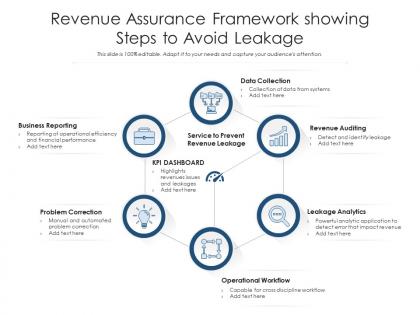
Revenue assurance framework showing steps to avoid leakage




Try Before you Buy Download Free Sample Product
 Impress Your
 Audience
 100%
100% Editable
 Save Hours
 of Time


Our Revenue Assurance Framework Showing Steps To Avoid Leakage are topically designed to provide an attractive backdrop to any subject. Use them to look like a presentation pro.
People who downloaded this PowerPoint presentation also viewed the following :
Revenue assurance framework showing steps to avoid leakage with all 2 slides:
Use our Revenue Assurance Framework Showing Steps To Avoid Leakage to effectively help you save your valuable time. They are readymade to fit into any presentation structure.

FAQs for Revenue assurance framework showing steps
Look, you need four key things for revenue assurance that actually works. Data quality controls are your foundation - garbage in, garbage out situation. Real-time monitoring catches problems before they snowball. Clear governance so everyone knows their role when stuff hits the fan. And honestly? The collaboration piece between billing, provisioning, customer service - that's where most companies screw up. Those handoffs are leak central. Automated tools are non-negotiable now because manual tracking is basically impossible with today's data volumes. Start by mapping your whole revenue flow first. Find your biggest risk spots and tackle those.
Honestly, automation is a game-changer for revenue assurance. It handles all that boring data reconciliation stuff that would take your team forever to do by hand. Set up rules to catch billing issues and usage spikes as they happen instead of finding them weeks later. Your people can actually dig into why problems occur rather than just hunting for them constantly. The dashboards are pretty solid too – execs trust automated reports way more than manual ones. Oh, and definitely start with whatever process gives you the biggest headaches. That's where you'll see results fast.
Think of data analytics like being a detective hunting for missing money. Run automated checks on your billing systems and customer usage - you'll catch stuff like people using services without getting charged or weird pricing errors. Real-time monitoring beats waiting for those monthly reports (honestly, who has time for that?). Look for patterns too - maybe certain product bundles always mess up or specific processes keep breaking. I'd start with your top three money-makers and run some basic variance reports. You'll probably find leaks right away, maybe even in the first few days.
So you wanna track two main things - money you've actually gotten back and losses you stopped before they happened. The recovered stuff is easier to measure: billing errors you caught, fraud you detected, process fixes that brought in cash. Compare all that against what you're spending on staff and tools. Prevented losses are way harder to pin down but super valuable - like when you catch contract issues or stop customers from bailing. I'd throw in some operational stuff too, like how fast you're catching problems and error rates dropping. Monthly dashboard works great - just stack up recovered/prevented revenue against program costs. Oh, and productivity gains count too, even if they're not direct revenue.
Honestly, the worst part is dealing with messy data - your billing systems will have inconsistent formats and missing records everywhere. Getting teams on board is brutal too since new controls slow things down at first. Operations will hate you initially, which I totally get. Ownership gets weird because you're touching billing, finance, IT... everyone's turf basically. Here's what worked for me though - pick one area where you can show quick wins. Prove it actually saves money, then people start listening. Way easier than trying to fix everything at once. Start small and build momentum from there.
Ugh, regulatory changes are such a pain for revenue assurance. Your controls will need updating, compliance checks get messy, and sometimes you're basically starting from scratch on tracking certain revenue streams. New regs often mean different reporting rules or they change how you recognize revenue - suddenly your RA systems are flagging normal transactions as errors. So frustrating. I'd say don't wait for problems to hit. Watch for regulatory updates in your space and keep your RA team tight with legal/compliance. That way you can update controls quickly before it messes with your numbers. Being ahead of it saves so much headache later.
Go with automated reconciliation tools - they're absolute lifesavers for tracking digital revenue. AI analytics will spot leaks you'd miss completely, plus API integration connects your billing systems without the usual headaches. Spreadsheets just can't handle the crazy data volumes anymore, trust me on that one. You need something with anomaly detection that won't crash when processing tons of transactions. Map out your revenue streams first. Then find tools that play nice with whatever systems you're already running. The real-time monitoring makes such a difference too.
Honestly, you've gotta get your departments actually talking to each other - that's where most revenue leaks happen. Finance sees one thing, billing catches another issue, and IT notices weird system stuff, but nobody's connecting the dots. Your sales team might spot pricing weirdness while operations finds process gaps. When they share intel regularly (maybe monthly meetings?), you'll catch problems way faster instead of scrambling to fix things after they've been bleeding money for months. I'd say start small with just getting them to flag weird patterns they're seeing. Way better than everyone working in their own little bubbles.
Start with revenue leakage percentage and billing accuracy - those are your bread and butter. Churn rates will show you where money's walking out the door (honestly way more telling than most people realize). Track your AR aging and collection efficiency too. Don't sleep on operational stuff like time-to-bill and pricing errors since they hit your bottom line hard. Revenue per customer, dispute resolution time, credit memo frequency - all solid picks. Oh, and collection efficiency ratios are clutch. Build from these basics first, then you can get fancy with other KPIs later.
Look, manual checks are basically dead at this point - you can't manually track millions of IoT data points without losing your mind. AI-powered analytics will catch revenue leaks way faster than any human can. Build systems that adapt quickly instead of those rigid processes that break every time something new comes along. Honestly, 5G alone generates so much data it's ridiculous. Start with your biggest blind spots and automate those first. Oh, and make sure whatever you build can actually handle new revenue streams without needing a complete overhaul every six months.
First thing - do a risk assessment to find where you're bleeding the most money. Map your revenue streams and billing, then compare what you should be billing vs what actually goes out. Reconciliation reports are honestly kind of boring but they'll save your ass. Automate whatever you can because people miss things (myself included). Test the whole process end-to-end, not just pieces. Document as you go and set up regular check-ins. Oh, and start with just one revenue stream first - way easier to prove it works before scaling up.
Think of customer behavior metrics as your canary in the coal mine for revenue problems. Usage dropping? Payment failures spiking? That's your cue something's off with billing or service delivery. Honestly, I've seen companies miss obvious red flags because they weren't watching the right stuff. Track usage anomalies, churn rates, and complaints - they'll show you issues way before your monthly reports do. Oh, and definitely set up dashboards linking customer satisfaction with billing accuracy. Catches problems fast. Customers bail when things get messy, so their behavior tells you everything you need to know.
Look, revenue assurance is basically finding money you already earned but somehow lost track of. Think of it as hunting down billing screwups and system glitches before they kill your profits. Every dollar you recover goes straight to the bottom line since you already did the work and spent the money to earn it. Start with your biggest revenue streams - that's where the real money usually hides. You'll catch pricing mistakes, fix broken billing processes, and make sure customers actually pay what they owe. Honestly, it's one of the fastest ways to boost profitability without selling more stuff.
Don't try to do everything at once - that's how you burn out your whole team. Pick some quick wins first instead of monitoring every revenue stream right away. Also, this isn't just a finance thing (everyone thinks it is though). You need IT, ops, and sales all bought in or you're screwed. Your data has to be clean too - crappy data means crappy results, period. Oh, and start small! Prove it works with a few wins, then expand once you've got some momentum going. Way easier to get exec support that way.
Think of risk assessment as your cheat sheet for figuring out what actually matters. You can't watch everything, so focus on what'll hit your wallet hardest. Look at each revenue stream - how complex is the process? Any system weak spots? What's gone wrong before? Honestly, don't waste time auditing some tiny $10K process when your main billing system is hemorrhaging money on millions in transactions. That's just backwards. Score everything on impact vs likelihood first - gives you a solid priority list. Then build your monitoring around those high-risk areas. Way more efficient than trying to boil the ocean.
-
Use of icon with content is very relateable, informative and appealing.
-
Commendable slides with attractive designs. Extremely pleased with the fact that they are easy to modify. Great work!
-
The content is very helpful from business point of view.
-
Out of the box and creative design.
-
Great designs, Easily Editable.
-
Informative design.
-
Use of icon with content is very relateable, informative and appealing.