


Questionnaires And Surveys In Project Management Quantitative Risk Analysis





Try Before you Buy Download Free Sample Product
 Impress Your
 Audience
 100%
100% Editable
 Save Hours
 of Time


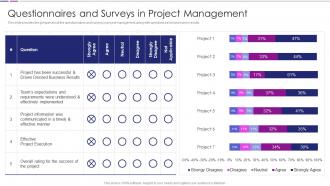
This slide provides the glimpse about the questionnaires and surveys in project management along with questions asked and survey results.
People who downloaded this PowerPoint presentation also viewed the following :
Questionnaires And Surveys In Project Management Quantitative Risk Analysis with all 7 slides:
Use our Questionnaires And Surveys In Project Management Quantitative Risk Analysis to effectively help you save your valuable time. They are readymade to fit into any presentation structure.





FAQs for Questionnaires And Surveys In Project Management
So there's four main pieces to quantitative risk analysis. You start by identifying all the potential threats - just make a big list of everything that could go wrong. Next comes probability assessment, where you assign actual numbers to how likely each risk is. Impact quantification is probably the hardest part because you're trying to put dollar amounts on hypothetical disasters, which honestly feels like educated guessing half the time. Finally there's risk modeling - Monte Carlo simulations and stuff like that to crunch all your data together. I'd focus on nailing down that initial risk inventory first though, since everything else depends on it.
So basically, qualitative uses words like "high" or "low" risk while quantitative gives you actual numbers and percentages. Qualitative's way faster - perfect when you're starting out or your data's sketchy. Takes maybe an afternoon. Quantitative needs good historical data and more time, but you get real figures like "15% chance this costs us $50K." Way easier to sell to your boss. Honestly? I'd go quantitative if you can swing it, especially if you need budget approval. Though qualitative isn't useless - sometimes you just gotta move fast and work with what you've got.
You'll run into three main ones constantly: Monte Carlo simulation, sensitivity analysis, and probability distributions. Monte Carlo's your best friend - runs thousands of scenarios so you see every possible outcome. Pretty clever stuff. Sensitivity analysis shows which variables actually matter (hint: way fewer than you'd expect). For the inputs, you can use different probability distributions - normal, triangular, beta, whatever fits your data. Honestly, just start with Monte Carlo if you're jumping in fresh. Most software already has it and once you run that first model, everything clicks into place.
So scenario analysis is basically stress-testing your models with "what if" situations. Way better than just staring at expected values all day. You can see how your risk profile shifts during market crashes, reg changes, operational disasters - whatever keeps you up at night. Honestly it's my go-to tool because it makes those abstract numbers actually mean something again. You'll catch tail risks that normal distributions totally miss, plus you start seeing how different risk factors connect. Oh and the interconnections thing is huge - didn't realize that until I'd been doing this for like two years. Start with 3-5 realistic but painful scenarios next time.
Okay so Monte Carlo simulation is this really powerful tool for risk analysis. Basically you run thousands of scenarios to see how different variables might play out. You give it probability distributions for your main risk factors, then it crunches all the possible combinations and shows you what could happen. It's like stress-testing your model under every condition imaginable - honestly pretty cool stuff. Works great when you've got multiple uncertainties happening at once, which traditional methods just can't handle well. I'd start with your biggest risks first and build from there.
Honestly, start by listing everything that could screw up your model - market swings, defaults, liquidity issues, operational stuff. Monte Carlo sims are clutch for this btw, they'll run tons of scenarios showing possible outcomes. Assign probability distributions to each risk using historical data or expert opinions. The tricky part? Risks don't happen alone - correlations matter big time. I learned this the hard way once. Stay systematic about tracking everything and update your assumptions when new data drops. Otherwise you're just guessing with fancy math.
Ugh, the worst part is never having enough historical data to actually mean anything. Your records will be incomplete or in totally different formats across systems. Sometimes the data you need just doesn't exist yet - super frustrating. Also, people are terrible at estimating risk (everyone swears their project is "safe" until disaster strikes). Half the time you're working with outdated info anyway. Oh, and different collection conditions mess everything up too. Honestly? Just start collecting data now even if it seems pointless, and double-check everything with multiple people.
Basically, sensitivity analysis shows you which variables actually mess with your risk calculations the most. You'll stop wasting time on stuff that doesn't matter. Like, I've seen projects where material costs were causing 70% of the risk but everyone was obsessing over tiny schedule delays. Makes you feel kinda dumb when you realize it, honestly. But then you can focus your energy on monitoring the things that'll actually screw you over. Just test your top 5-6 risk factors first and see which ones make everything go crazy. Way more efficient than stressing about every little uncertainty.
You'll see quantitative risk analysis everywhere there's serious money on the line - finance, insurance, energy, pharma. Banks need it for credit risk and market swings. Insurance companies? They're basically built on actuarial models. Energy firms use it because, honestly, when an oil rig goes wrong it's catastrophically expensive. Pharma companies rely on it for clinical trial predictions too. What ties them together is having mountains of historical data and facing risks that could sink the whole business. My advice? If you're in any of these fields, get comfortable with statistical modeling ASAP.
Honestly depends what you're working with. @RISK is solid if you're stuck in Excel hell like most of us - super user-friendly for Monte Carlo stuff. Crystal Ball's another good option there. Python's where I'd go though - scipy and numpy handle pretty much any statistical modeling you throw at them, plus it's free. R works too but Python just feels cleaner to me. For bigger enterprise deals there's Palisade DecisionTools Suite and GoldSim. MATLAB's great if you already have it lying around. I'd probably start with @RISK for simplicity, or jump into Python if you don't mind coding.
Look, it really comes down to what's at stake and how good your data is. Million-dollar decision? Yeah, don't just eyeball it - get better numbers and proper models. But honestly, most people way overthink this stuff. Like, you'll see teams running crazy simulations when they just need to know if something's risky or not. Getting the ballpark right beats obsessing over exact numbers for 90% of business calls. My advice? Figure out what level of "maybe" would actually make you choose differently, then work from there. If you just need "safe" vs "sketchy," keep it simple.
Honestly, the worst thing you can do is trust sketchy data - garbage in, garbage out, you know? Real life's way messier than those clean probability charts make it seem. Risks almost never happen alone either, they're usually connected somehow. I've seen people present stuff like "there's exactly a 23.7% chance" when really they're just guessing within a huge range. My advice? Beat up your assumptions first - stress test everything. And always tell people how confident you actually are in the numbers, not just the pretty final result.
Stop talking tech speak and start talking money. Show them what these risks actually do to their budgets and deadlines. Those red/yellow/green dashboards? They're your best friend - nobody has to think about what they mean. Tell stories too, like "if this thing goes sideways, your Q4 numbers are toast." Don't pretend you know exactly what'll happen - give ranges instead. Be honest about what you're guessing at. Oh, and here's the big one: connect every single thing back to what they need to decide right now. Give them actual next steps, not just problems.
Think of risk appetite as your reality check for all those fancy numbers you're crunching. You'll get probability distributions and VaR calculations, but without knowing how much risk your company can actually handle, you're basically flying blind. Honestly, I've seen too many people get lost in the math and forget the bigger picture. Map your results against whatever risk thresholds you've set - that's how you figure out if you need tighter controls or if the current exposure is fine. The quantitative stuff is just data until you put it in context.
Look, quantitative risk analysis actually gives you real numbers instead of those useless "high/medium/low" ratings that don't tell anyone anything. Regulators love seeing actual probability distributions and dollar impacts - makes your compliance reports way more solid. You can set up clear triggers too, like if cyber risk hits $2M expected annual loss, boom, straight to the board. No guesswork. The numbers help you figure out where to actually spend your budget instead of just throwing money at whatever feels scary. Honestly, auditors eat this stuff up because it's defensible, and your executives get real data to make decisions with.
-
The PPT layout is great and it has an effective design that helps in presenting corporate presentations. It's easy to edit and the stunning visuals make it an absolute steal!
-
Keep doing the good work guys. Surpass the needs and expectations always!!