


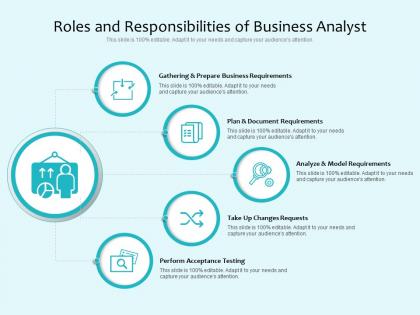
Roles and responsibilities of business analyst




Try Before you Buy Download Free Sample Product
 Impress Your
 Audience
 100%
100% Editable
 Save Hours
 of Time


Grab our creatively-designed Roles And Responsibilities Of Business Analyst and explain why companies should hire business analysts. This company executive responsibilities PPT theme can be utilized by business experts and HR to illustrate the role of a business analyst. With the help of graphical representation, first, define who is a business analyst. In the next step, systematically explain the roles and responsibilities of a system analyst by incorporating our eye-pleasing enterprise analyst duties PowerPoint slide. Describe each role in detail and what impact their decisions could have on business by adopting the business associate duty PPT theme. Emphasize the importance of communication skills as they deal with stakeholders and investors by employing our enterprise analyst duties PPT template. Discuss the significance of analytical skills, leadership skills, technical skills, business process, and planning by using our system analyst role PPT template. Don’t waste another minute and download our business analyst role PPT template to amaze your audience.
People who downloaded this PowerPoint presentation also viewed the following :
Roles and responsibilities of business analyst with all 2 slides:
Use our Roles And Responsibilities Of Business Analyst to effectively help you save your valuable time. They are readymade to fit into any presentation structure.
FAQs for Roles and responsibilities
Honestly, being a good BA is like being a translator between techies and business people - they literally speak different languages. You've gotta nail the analytical stuff obviously, but communication is huge. I'd focus on requirements gathering, process mapping, and data analysis first. Stakeholder management though... oof, some of those meetings get spicy. Pick up SQL or Tableau too, depending on what your company actually uses. Oh, and don't try to learn everything at once - that's overwhelming. Start with maybe one technical skill and work on your people skills simultaneously. Build from there based on whatever industry you're targeting.
So basically, business analysts figure out *what* needs to get built - they're always gathering requirements and translating between the business people and developers. Project managers are more about *when* and *how* things happen. They juggle timelines, budgets, all that coordination stuff. BAs are like detective-translators, honestly. PMs keep the trains running on time. There's overlap though, especially at smaller companies where you'll probably do both anyway. Which one appeals to you more - digging into messy business problems or herding cats (aka managing people and deadlines)?
Oh man, Excel is still king for most BA stuff - you'll live in that thing. SQL is a must for pulling data from databases. Then grab either Tableau or Power BI for making pretty charts (honestly I'm terrible at picking colors but whatever). For mapping out processes, I use Lucidchart mostly, though Visio works too. Jira's good for tracking requirements if your company's into that. Start with Excel and SQL basics first. The visualization tool depends on what your team already uses - no point learning Tableau if they're all Power BI people.
Honestly, the biggest thing is knowing your audience - execs just want the business impact while devs need all the nitty-gritty details. Visuals are your best friend here. Process flows, mockups, whatever works because people get it so much faster than walls of text. I made this mistake early on where I'd assume everyone was on the same page (spoiler: they weren't). Now I always ask people to repeat back what they heard in their own words. Sounds awkward but it catches confusion immediately. Also set up regular check-ins and keep everything documented somewhere everyone can actually find it.
Agile's probably your best starting point - most teams I know are using Scrum these days. Waterfall still pops up for traditional projects, and if you're doing process improvement stuff, Lean Six Sigma is pretty common. BABOK is like the go-to guide for requirements and stakeholder management (kind of dry but useful). Honestly though, most companies just mix and match methodologies now instead of following one religiously. Design Thinking comes up when you're tackling more creative problems. I'd say learn Agile basics first since it's everywhere, then pick up others based on whatever industry you end up in. Oh, and don't stress too much about memorizing frameworks - you'll figure out what works as you go.
Think of business analysts as translators between messy data and actual decisions. They dig into requirements, map out processes, then turn all that chaos into clear recommendations leadership can use. Instead of executives just winging it on gut instinct, BAs give them real numbers and dashboards to work with. They run workshops and present stuff so different teams actually get it - not just data dumps, but the whole story. Honestly, half the meetings I've been in would've been way more productive with a BA there to keep things focused. Worth suggesting next time decisions feel all over the place.
Ugh, scope creep is the worst - people will change their minds constantly once you're halfway done. Plus you're stuck translating between business folks and developers who might as well speak different languages. Getting access to data and the right people? Good luck with that. Oh, and everyone thinks their project is top priority. Document literally everything though, seriously. I learned that the hard way when someone claimed they "never said that" about a major requirement. Set boundaries early or you'll be working weekends forever. Always get stuff in writing before you start building anything!
Honestly, data analysis is like having a cheat sheet for business decisions instead of just winging it. You'll spot stuff that's not obvious - which products suck, where to spend money, future trends. Way better than going off hunches alone. The tricky part though? Don't get lost in all the numbers. I see people do this all the time - they pull every metric possible but have no clue what they're actually looking for. Figure out your main problem first. Then dig into customer behavior and market patterns. It's pretty much the closest thing to a working crystal ball you'll get.
Dude, stakeholder engagement can totally make or break your BA project. You need everyone on board to get solid requirements and realistic feedback - otherwise your solutions just sit there gathering dust. I've watched projects crash and burn because people skipped this step (not pretty). Build those relationships from day one. Map out who matters and figure out how each group likes to communicate. Some people want emails, others prefer quick calls or even Slack messages. Keep talking to them regularly throughout the whole process, not just at the beginning. Trust me, that ongoing communication saves you so much headache later.
Dude, requirements gathering is where most projects crash and burn if you skip it. Think of it like this - you wouldn't build a house without blueprints, right? Same logic applies here. Map out your stakeholders first, then really dig into what's bugging them. Don't just take their first answer though - people are terrible at explaining what they actually need versus what they think they want. Ask better questions upfront and document everything properly. Trust me, it'll save you from those nightmare scope changes later when someone suddenly remembers a "critical" feature they forgot to mention.
Honestly, proper business analysis can boost your project success by like 20-30%. Sounds boring but hear me out - when you analyze requirements upfront, you actually catch scope creep before it kills your timeline. Plus you spot stakeholder drama early instead of having everything blow up mid-project. I've watched so many teams skip this step and just dive into coding, then wonder why everything's a mess. Projects with dedicated BA folks consistently hit deadlines better and don't go over budget as much. Skip it and you're basically rolling dice on whether things work out.
Ditch the spreadsheets - seriously, your audience will thank you. Charts and graphs tell the story way better than endless rows of numbers. People spot trends instantly with visuals instead of getting lost in data. Bar charts work great for comparisons, line graphs for tracking changes over time. I honestly think heat maps are underrated for showing correlations. Excel's fine to start with, though Tableau's prettier if you want to get fancy. Here's the trick: lead with your main point first, then show the visuals that back it up. Makes everything click faster.
Data analytics is huge now - you can't avoid Tableau, Power BI, and SQL anymore. Agile's taken over everything, so those giant requirement docs are dead. AI and ML stuff is creeping in too, which is kinda cool but also makes me wonder if we're automating ourselves out of jobs lol. Remote work totally changed how we do requirements gathering. Honestly, the biggest game-changer has been how central data visualization became. Pick that up first if you're behind on skills. Also workshops are weird now - half the people are on Zoom boxes while others are in person.
Dude, you've gotta get good with data stuff - that's where everything's going. SQL is huge, plus Tableau or Power BI for making charts that don't suck. Basic data analysis too. I swear, so many BAs I work with are totally behind on this and panicking about it. Pick a specific area though - like healthcare or fintech or whatever you're into. Being a generalist BA isn't really cutting it anymore. The money's in being that bridge person who gets both the business side and tech side, but can also actually dig into the numbers. Just start with one new tool this month. Don't try to learn everything at once or you'll burn out.
Look, data privacy is huge - don't ever share sensitive stuff outside your stakeholder circle. Be upfront about what you don't know instead of acting like you've got all the answers. I've watched way too many analysts crash and burn because they promised certainty when they should've been talking about risks. Check your own biases too - they creep in more than you think. Consider how your solutions affect different users fairly, and honestly? Document everything. Your reasoning, your ethical calls, all of it. You'll thank yourself later when someone questions your decisions.
No Reviews