

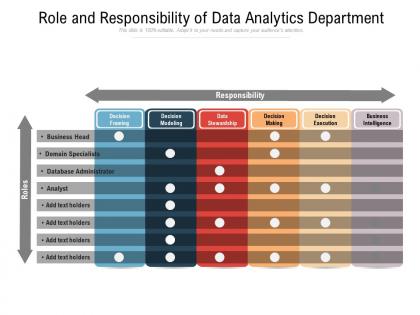
Role and responsibility of data analytics department




Try Before you Buy Download Free Sample Product
 Impress Your
 Audience
 100%
100% Editable
 Save Hours
 of Time


Data analysts use data to assist their firms in making better business decisions. Data analysts use skills from a variety of disciplines, such as computer programming, mathematics, and statistics, to derive inferences from data in order to characterise, forecast, and improve company performance. They are the foundation of any analytics team and are often generalists who are well-versed in mathematical and statistical analytical methodologies. The data analytics PowerPoint templates from SlideTeam provide in-depth information about the role and responsibility of the data analytics department. These templates can be used to create an informative and visually appealing presentation that will help you get your point across effectively. Download our templates today to get started.
People who downloaded this PowerPoint presentation also viewed the following :
Role and responsibility of data analytics department with all 2 slides:
Use our Role And Responsibility Of Data Analytics Department to effectively help you save your valuable time. They are readymade to fit into any presentation structure.
FAQs for Role and responsibility of
Data analysts collect, process, and interpret complex datasets to identify trends, patterns, and actionable insights that drive strategic business decisions. They create comprehensive reports, develop predictive models, and collaborate with cross-functional teams to translate data findings into operational improvements, ultimately enabling organizations to optimize performance, reduce costs, and enhance competitive positioning.
Data scientists focus on extracting insights, building predictive models, and interpreting complex datasets to drive strategic decision-making, while data engineers design, build, and maintain the infrastructure and pipelines that collect, store, and process data. In organizations like banks or retail companies, engineers create the systems that capture transaction data, while scientists analyze these patterns to predict customer behavior, optimize operations, and ultimately deliver competitive advantages through data-driven insights.
Python and R dominate data analytics for their extensive libraries, statistical capabilities, and machine learning frameworks, while SQL remains crucial for database management and data extraction. These languages enable data professionals to streamline complex analyses, automate reporting processes, and build predictive models, with many organizations finding that proficiency in these tools delivers faster insights and competitive advantages.
Machine learning techniques integrate into data analytics through automated pattern recognition, predictive modeling, anomaly detection, clustering algorithms, and real-time data processing capabilities. These technologies streamline analytics workflows by reducing manual analysis time, enhancing prediction accuracy, and enabling scalable insights across massive datasets, with organizations in healthcare, finance, and retail finding significantly improved decision-making speed and operational efficiency.
A data visualization expert should possess technical skills in tools like Tableau, Power BI, and D3.js, combined with design principles, statistical knowledge, and strong storytelling abilities. These professionals enhance decision-making by transforming complex datasets into intuitive dashboards and interactive charts, with many organizations finding that effective visualization specialists bridge the gap between technical analysis and executive understanding, ultimately delivering faster insights and improved strategic outcomes.
Data governance establishes the framework for data quality, security, compliance, and accessibility across analytics operations, ensuring consistent standards, policies, and procedures for data management. It enables analytics teams to work with trusted, reliable datasets while maintaining regulatory compliance and minimizing risks, ultimately delivering more accurate insights and strategic decision-making capabilities for organizational growth.
Business intelligence analysts support strategic decision-making by transforming raw data into actionable insights, creating comprehensive reports, and identifying market trends that guide executive choices. Through advanced analytics tools, they enable organizations to optimize resource allocation, predict customer behavior, and assess competitive positioning, with many companies finding that data-driven strategies significantly enhance operational efficiency and long-term growth.
Common data cleaning and preprocessing tools include Python libraries like Pandas and NumPy, R with dplyr, OpenRefine, Trifacta, and Tableau Prep. These platforms streamline data transformation by automating duplicate removal, handling missing values, and standardizing formats, with many organizations finding that proper preprocessing reduces analysis time by up to 60% while significantly improving data quality and decision-making accuracy.
Advanced analytics leverages machine learning, predictive modeling, and AI algorithms to forecast future trends and prescribe actions, while traditional analytics primarily examines historical data through descriptive reporting and basic statistical analysis. These sophisticated approaches enable organizations across healthcare, finance, and retail to anticipate customer behavior, optimize operations proactively, and gain competitive advantages through predictive insights rather than reactive responses.
Data professionals should prioritize privacy protection, consent verification, bias mitigation, transparency in methodologies, and responsible data usage throughout their analytical processes. These ethical frameworks enable organizations to build customer trust, ensure regulatory compliance, and maintain competitive advantage, with many financial services and healthcare institutions finding that robust ethical practices ultimately deliver stronger stakeholder relationships and sustainable business outcomes.
Cross-functional collaboration enhances data analytics effectiveness by providing diverse domain expertise, ensuring data relevance to business objectives, and accelerating insight implementation across departments. Through strategic partnerships with marketing, finance, and operations teams, analytics departments deliver more targeted solutions, reduce project timelines, and ultimately transform data insights into measurable business outcomes and competitive advantage.
Emerging trends in data analytics include automated machine learning, real-time analytics, augmented analytics, edge computing, and ethical AI frameworks. These technologies streamline decision-making by reducing manual processes, enhancing predictive capabilities, and enabling faster insights, with many organizations finding that early adoption delivers significant competitive advantages and operational efficiency gains.
Big data significantly expands data analytics roles by requiring specialized skills in data engineering, machine learning, and cloud architecture, while traditional analysts increasingly focus on strategic interpretation and business insights. Teams now include data scientists, engineers, and visualization specialists who manage massive datasets from IoT sensors, social media, and customer transactions, ultimately delivering faster decision-making and competitive advantage.
Key metrics include ROI on analytics investments, data accuracy rates, time-to-insight delivery, user adoption of analytics tools, and business impact measurements like revenue growth or cost reduction. These metrics enable organizations to demonstrate value by tracking operational efficiency improvements, decision-making speed enhancements, and competitive advantages gained, with many companies finding that comprehensive measurement frameworks ultimately drive greater stakeholder buy-in and strategic alignment.
Cloud computing transforms data storage and processing for analytics teams by eliminating infrastructure limitations, enabling scalable computing resources, and providing real-time collaboration capabilities. Through cloud platforms, teams can process massive datasets faster, reduce storage costs significantly, and access advanced analytics tools seamlessly, while enabling remote collaboration and ultimately delivering accelerated insights that enhance competitive advantage in increasingly data-driven business environments.
-
Content of slide is easy to understand and edit.