


Safety Routine Inspection Checklist For Hospitals




Try Before you Buy Download Free Sample Product
 Impress Your
 Audience
 100%
100% Editable
 Save Hours
 of Time


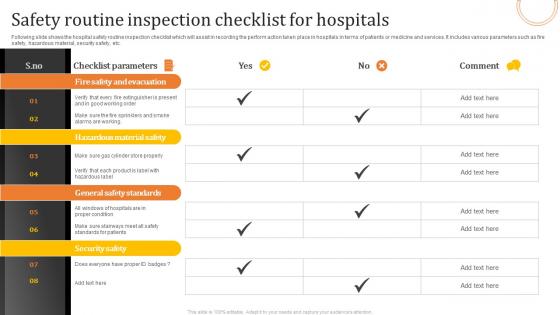
Following slide shows the hospital safety routine inspection checklist which will assist in recording the perform action taken place in hospitals in terms of patients or medicine and services. It includes various parameters such as fire safety, hazardous material, security safety, etc.
People who downloaded this PowerPoint presentation also viewed the following :
Safety Routine Inspection Checklist For Hospitals with all 6 slides:
Use our Safety Routine Inspection Checklist For Hospitals to effectively help you save your valuable time. They are readymade to fit into any presentation structure.






FAQs for Safety Routine Inspection
A comprehensive safety inspection checklist should include emergency equipment verification, hazard identification protocols, personal protective equipment compliance, workplace ergonomics assessment, and incident reporting procedures. These elements work together by systematically evaluating risk factors, ensuring regulatory compliance, and maintaining operational safety standards, with many organizations finding that structured checklists reduce workplace incidents while enhancing overall safety culture.
Safety inspection frequency depends on workplace hazards, regulatory requirements, and industry standards, with high-risk environments like manufacturing requiring monthly inspections while offices typically need quarterly assessments. Many organizations find that combining scheduled comprehensive inspections with weekly spot checks enables early hazard identification, regulatory compliance, and enhanced employee safety, ultimately reducing workplace incidents and insurance costs.
Technology enhances safety inspection efficiency by automating data collection, enabling real-time reporting, and providing predictive analytics capabilities. Through mobile applications, IoT sensors, and digital documentation systems, organizations streamline compliance processes, reduce inspection time, and minimize human error, with many manufacturing facilities and construction companies finding significantly faster audit cycles and improved safety outcomes.
Common pitfalls include creating overly generic checklists, failing to customize for specific workplace hazards, neglecting regular updates, and making items too vague or complex. These oversights streamline inspection accuracy by ensuring site-specific relevance, incorporating regulatory changes, and enabling clear compliance verification, with many organizations finding that tailored, regularly updated checklists ultimately deliver more thorough safety assessments and regulatory compliance.
Organizations ensure employee buy-in for safety inspections by involving workers in checklist development, providing comprehensive training on inspection procedures, and communicating the direct benefits to workplace safety and job security. Through transparent communication and recognition programs, companies like manufacturing facilities and construction firms find that employees become active safety advocates, ultimately reducing incidents while enhancing operational efficiency and regulatory compliance.
Employee training plays a critical role in safety inspection effectiveness by ensuring inspectors can identify hazards accurately, use proper inspection techniques, understand regulatory requirements, and document findings comprehensively. Well-trained employees across manufacturing, construction, and healthcare facilities consistently deliver more thorough inspections, reduce workplace incidents significantly, and maintain compliance standards, ultimately enhancing organizational safety performance and minimizing liability risks.
Safety inspection checklists can be tailored by incorporating industry-specific hazards, regulatory requirements, equipment types, and operational environments unique to each sector. Manufacturing facilities focus on machinery safety and chemical handling, while healthcare settings emphasize infection control and patient safety protocols, ultimately ensuring compliance and reducing workplace incidents across diverse operational contexts.
Failing to perform safety inspections can result in regulatory fines, legal liability for workplace injuries, workers' compensation claims, and potential criminal charges in severe cases. These consequences significantly impact operational costs and reputation, with many organizations finding that comprehensive inspection programs ultimately deliver legal protection, reduced insurance premiums, and competitive advantages through enhanced safety culture.
Safety inspection data can be effectively documented through digital checklists, real-time mobile reporting, photographic evidence capture, standardized compliance templates, and automated data integration systems. These approaches streamline documentation by enabling instant uploads, consistent formatting, and centralized dashboards, with many organizations finding that digital systems reduce reporting time while enhancing regulatory compliance and safety transparency.
Key metrics include inspection completion rates, identified hazard frequencies, corrective action closure times, incident reduction percentages, and regulatory compliance scores. These measurements enable organizations to streamline safety protocols, enhance workplace protection, and minimize operational risks, with many manufacturing facilities and construction companies finding that consistent tracking ultimately delivers improved employee safety and reduced liability costs.
A safety inspection checklist helps in risk assessment by systematically identifying potential hazards, evaluating their severity and likelihood, and documenting compliance gaps across workplace environments. Through structured evaluation processes, organizations can prioritize high-risk areas, allocate resources more effectively, and implement targeted safety measures, ultimately reducing incidents and ensuring regulatory compliance while enhancing overall workplace safety.
Safety checklists become more user-friendly through clear, simple language, logical sequencing, visual elements like icons and color coding, and mobile-friendly digital formats. Organizations across manufacturing, healthcare, and construction find that incorporating photographs, step-by-step illustrations, and intuitive navigation significantly enhances compliance rates, ultimately delivering improved safety outcomes and streamlined inspection processes.
Employee feedback can be incorporated through regular safety surveys, suggestion boxes, post-incident reviews, safety committee participation, and digital reporting platforms that encourage anonymous input. Many manufacturing and construction companies find that involving frontline workers in developing inspection criteria and conducting peer safety audits ultimately delivers more comprehensive hazard identification and stronger safety compliance across operations.
**INPUT**: What resources are recommended for developing comprehensive safety inspection checklists? **OUTPUT**: Recommended resources include OSHA guidelines, industry-specific safety standards, regulatory compliance databases, professional safety organizations, and established audit frameworks from similar facilities. These resources enable organizations to streamline comprehensive coverage by incorporating legal requirements, best practices, and sector-specific protocols, with many manufacturing and healthcare facilities finding that combining multiple authoritative sources ultimately delivers enhanced workplace safety and regulatory compliance. [Word count: 60 words]
Regular inspections contribute to workplace safety culture by demonstrating management commitment, engaging employees in hazard identification, creating accountability through consistent protocols, and fostering proactive risk awareness. Through systematic inspection processes, organizations enhance communication about safety priorities, empower workers to report concerns, and build collective responsibility for maintaining safe conditions, ultimately delivering reduced incidents and stronger safety mindsets across teams.
-
I faced no difficulty while searching for the slide I wanted. Honestly, the website’s interface is easy to use and can be navigated easily!
-
“Excellent information with easy access.”