


Sales Team Skills Assessment Matrix PDCA Stages For Improving Sales




Try Before you Buy Download Free Sample Product
 Impress Your
 Audience
 100%
100% Editable
 Save Hours
 of Time


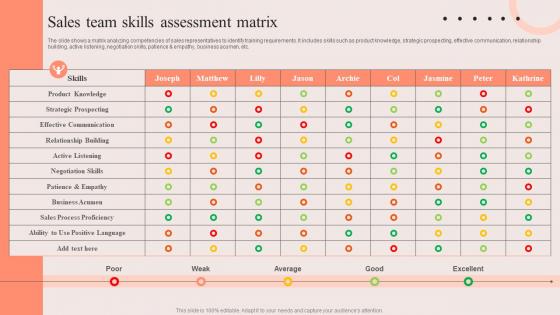
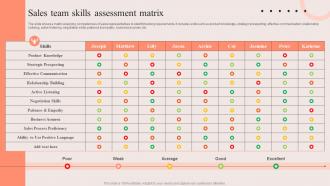
The slide shows a matrix analyzing competencies of sales representatives to identify training requirements. It includes skills such as product knowledge, strategic prospecting, effective communication, relationship building, active listening, negotiation skills, patience and empathy, business acumen, etc.
People who downloaded this PowerPoint presentation also viewed the following :
Sales Team Skills Assessment Matrix PDCA Stages For Improving Sales with all 6 slides:
Use our Sales Team Skills Assessment Matrix PDCA Stages For Improving Sales to effectively help you save your valuable time. They are readymade to fit into any presentation structure.





FAQs for Sales Team Skills Assessment Matrix PDCA Stages
Focus on the basics first - product knowledge, communication, and how they handle objections. Role-plays work way better than just asking theoretical questions, trust me on that one. Most reps completely bomb when it comes to building rapport and actually listening to what customers need. Test their closing skills obviously, but also check if they can use your CRM properly since that stuff matters more than people think. Oh, and create scenarios based on your real situations instead of generic examples. You'll get a much better read on whether they can actually do the job or just talk a good game.
Honestly, just throw them into realistic scenarios that match what your team deals with daily. Have someone play an angry customer or whatever objections come up most. Watch how they handle it in real time - way better than asking "tell me about a time when..." Trust me, you'll spot who can actually think fast vs who just interviews well. Score them on building rapport, solving problems, stuff like that. Oh and make the scenarios super specific to your industry, not some generic sales thing. Short bursts work better than long drawn-out role plays too.
Focus on three things: completion rates, score reliability, and predictive validity. Nobody's gonna finish a boring 2-hour assessment, so track if your team actually completes it. Score reliability means consistent results when retaken. The big one though? Predictive validity - do the scores actually predict real performance 6-12 months out? I'd match assessment results against quota attainment and deal closure rates. Also revenue generated, obviously. Honestly, most companies skip this step and wonder why their hiring's still hit-or-miss. Start collecting baseline data now so you'll have something to compare against later.
Dude, this is huge - what kills it in New York might totally flop in Japan. That aggressive, close-fast style? Comes off super rude where relationship-building matters more. You can't use the same playbook everywhere. Germans love consultative selling while Americans want quick decisions. Communication styles are different too. Honestly, I learned this the hard way when I first started managing international teams. Don't compare your Tokyo rep to your Dallas standards - that's unfair to everyone. Find local top performers and see what they're doing instead.
Get back to them within a day or two while everything's still fresh in your mind. Pick like 2-3 main things to focus on - I swear, nothing's worse than getting hit with a laundry list of critiques all at once. Mix some positives with areas they can work on, but be specific about what you actually saw them do (or not do). Skip the personality stuff and stick to behaviors. Oh, and don't just leave them hanging - give them actual next steps. Maybe it's more practice, training, or pairing them up with someone who's good at this stuff. They need to walk away knowing what to do differently, not just what went wrong.
Dude, you've gotta check out AI role-playing platforms - they simulate actual customer conversations and it's kinda wild how realistic they get. Video analysis tools are clutch too, breaking down your body language during mock calls. The video feedback honestly changed everything for me... people finally get to see what they look like to prospects (usually not pretty lol). CRMs can track your real performance next to assessment scores. Plus automated scoring saves tons of time and spits out personalized development plans instantly. Don't go crazy though - start with just one tool, maybe try the role-play simulator first.
EQ matters so much in sales - probably more than people realize. Role-playing scenarios work best for testing it during interviews. You want candidates who can read the room and bounce back from rejection without getting weird about it. I've watched smart salespeople crash because they just couldn't vibe with customers, you know? Look for empathy and self-control under pressure. Those situational judgment questions reveal a lot too. Can they adapt their style mid-conversation? Do they stay cool when things go sideways? That's what separates decent reps from the ones who actually close deals.
Quarterly is the sweet spot for sales assessments, then do a big annual review. Monthly will just piss everyone off - I've watched teams get completely burned out from that. But if you go longer than quarterly, you're basically flying blind on performance changes. Those quarterly check-ins catch problems before they get worse, plus you can tweak training as you go. The yearly deep dive? That's for promotions, pay decisions, and figuring out who needs serious help. Oh, and start with your worst performers first. They actually want the feedback more than you'd think.
Don't make it too generic or just test product knowledge - focus on actual selling skills. Skip those weird role-play scenarios that have nothing to do with your real environment (seriously, I've seen some crazy ones). Test the stuff that matters: objection handling, discovery questions, closing techniques your team actually uses. Situational judgment beats theoretical knowledge every time. The biggest mistake? Making it so complex it takes forever to complete. Nobody wants that. Keep it realistic and tied to behaviors that actually drive results in your specific context.
Honestly, peer feedback is gold because your coworkers see the real you during those awkward client calls and team meetings. They notice if you're actually helpful when someone's struggling or if you get weird when handling pushback - stuff your manager totally misses. Your colleagues won't sugarcoat things either, especially about how you communicate. Way more honest than what they'd tell your boss. Oh, and don't overwhelm yourself - just pick 2-3 people you trust and ask about one specific thing. You'll get way better insights that way.
Honestly, it really depends on what industry you're dealing with. B2B tech? You need people who can handle consultative selling and technical demos - plus they better know how to handle objections. Retail's totally different though. That's all about building relationships and upselling without being pushy about price. Healthcare is weird because it's less about traditional sales tactics and more about trust and compliance stuff. Financial services people need to be good at needs analysis and understanding regulations. Real estate's obviously heavy on negotiation and market knowledge. My advice? Figure out your typical sales cycle first, then build assessments around those specific scenarios your team actually faces.
Look, you've gotta connect your assessment to what actually makes you money. Customer retention matters most? Then test relationship skills, not just how fast someone can close. Take your top 3 business goals and reverse-engineer which sales skills support them. Honestly, most companies waste time testing generic "salesperson" stuff instead of behaviors that actually matter for their specific situation. Like if you're pushing into new markets, you better be testing how adaptable reps are and whether they really know the product across different customer types. Makes way more sense than cookie-cutter assessments.
Quarterly check-ins work best - use that same scoring system from your first assessment. I'd track conversion rates, deal size, and how long your sales cycles are taking since those numbers actually show if you're improving. Keep a simple log of what new stuff you're trying too. Trust me, you'll totally forget what you were even focusing on otherwise! Set up a basic spreadsheet to compare your scores each quarter. Actually, doesn't matter if it's fancy - just needs to be consistent so you can tell if you're genuinely getting better or just spinning your wheels.
Be upfront about why you're doing assessments - like, tell them from the start if it's for coaching or figuring out training needs. People get paranoid they're being evaluated for cuts or something worse. Let your team help pick the tools if you can. Share the overall results back with everyone so they see the full picture, not just their piece. Here's the thing though - you absolutely have to follow through. If you promised development, actually do it. Don't just disappear after collecting data. Give them a timeline too, so they know when they'll see changes happen.
Skip the one-size-fits-all training approach - it's such a money pit. Target each person's actual weak spots from the assessment instead. Someone bombed objection handling but crushes prospecting? Focus on objections, obviously. I've watched managers dump everyone into identical programs way too many times. Role-playing works great for some skills, shadowing your best reps helps others. Start with their biggest gap since that's gonna move the needle fastest. Honestly, you'd be surprised how much faster people improve when the training actually matches what they suck at.
-
I am really satisfied with their XYZ products. Used their slides for my business presentations and now I am taking their help for my son's high-school assignments. Super satisfied!!
-
Professionally designed slides with color coordinated themes and icons. Perfect for enhancing the style of the presentations.