

Shipping Delivery KPIs Analysis Dashboard





Try Before you Buy Download Free Sample Product
 Impress Your
Audience
 100%
Editable
 Save Hours
of Time


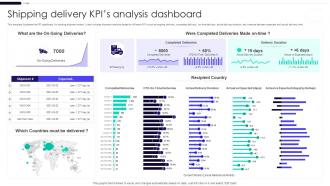
This template illustrates the KPI dashboard for tracking shipment orders. It also includes shipment analysis based on different KPIs such as ongoing delivery, completed delivery, on time delivery, actual delivery duration, and variance between expected and actual delivery time.
People who downloaded this PowerPoint presentation also viewed the following :
Shipping Delivery KPIs Analysis Dashboard with all 7 slides:
Use our Shipping Delivery KPIs Analysis Dashboard to effectively help you save your valuable time. They are readymade to fit into any presentation structure.






FAQs for Shipping Delivery
Honestly, just focus on the big three first - on-time delivery, cost per shipment, and customer satisfaction. Those will tell you if things are actually working or falling apart. Transit time variance is huge too because people get weird about deliveries being unpredictable, even when they arrive early. Damage rates matter obviously - replacing stuff eats your profits alive. Oh, and track fuel costs plus how much of your capacity you're using. I mean, you could get fancy with tons of other metrics later, but start here. Get a solid dashboard going with these basics before you go crazy with data.
Honestly, start by tracking where you're actually losing time - might not be what you think. Real-time route planning makes a huge difference, and keeping your fleet maintained prevents those random breakdowns that kill your schedule. Loading docks are probably your biggest enemy though. Those delays stack up ridiculously fast. Maybe partner with local carriers for the final stretch instead of handling everything yourself? Use data to spot problems before they hit you. Don't overpromise delivery times either - customers appreciate honesty over missed deadlines. Predictive stuff helps but honestly, just knowing your weak spots is half the battle.
Look, tech is gonna save your sanity here. Route optimization cuts delivery times, analytics help you catch trends, and inventory systems prevent those annoying stockouts. Real-time tracking means no more "where's my package?" panic calls. Manual tracking is dead - like seriously dead. Pick tools that play nice with what you already have though, because juggling five different dashboards is worse than the original problem. Oh, and don't try to fix everything at once. Just tackle whatever's driving you crazy right now and build from there.
So basically you wanna track how much fuel you're burning per nautical mile or per ton of cargo. Most shipping companies measure it as gallons per mile or liters per TEU - that's the twenty-foot container thing. Weather data makes it way more accurate if you can swing it, though honestly some companies are lazy about that part. Start collecting fuel and distance data from your vessels consistently, then run monthly averages to see patterns. Compare against your old numbers and what everyone else in the industry is doing. Once you've got that down, you can actually start optimizing routes and saving money.
Look at your recent customer complaints - that's literally your roadmap for which shipping KPIs to focus on. Late deliveries pissing people off? Time to get stricter with your on-time targets. Getting roasted for damaged packages? Track those damage rates like your life depends on it. Honestly, customer feedback is way better than staring at random metrics that look pretty but don't mean much. The stuff that keeps customers happy - consistent delivery times, accurate tracking, minimal damage - that's what you should obsess over. I learned this the hard way at my last job. Start with whatever's making customers complain most, then work backwards to fix those specific metrics first.
Yeah, so domestic vs international shipping KPIs are like comparing apples to oranges honestly. For domestic stuff, you're obsessing over speed - 1-3 day delivery, same-day processing, all that. But international? We're talking weeks, not days, plus you've got customs headaches and duty calculations. Cost tracking gets messy too. Domestic is pretty straightforward while international has currency swings that'll screw with your budget. Oh, and separate dashboards are a must - comparing a 2-day domestic shipment to something that takes 10 days internationally is basically useless. Trust me on that one.
Dude, inventory accuracy is huge for shipping because bad data screws everything up. You'll promise stuff you don't have or think you're sold out when you're not. Honestly, nothing kills customer trust faster than sending wrong items or constant delays. Regular cycle counts help catch problems early - I learned that the hard way at my last job. Shoot for 95% accuracy minimum. Otherwise you're just guessing at what you can actually ship, and customers will bail for competitors who have their act together.
Set up dashboards that track your vessel performance, fuel consumption, and port turnaround times in real time. This stuff catches bottlenecks before they cost you serious money. Monitor KPIs like delivery rates, cargo damage, and fleet utilization - the visual dashboards honestly make spotting trends so much easier than staring at spreadsheets. Predictive analytics will help anticipate weather delays and port congestion too. First step though? Get all your existing systems talking to each other so you're working with clean data in one central platform. Otherwise you'll just be chasing your tail with incomplete info.
Start with carrier diversification and zone skipping - that's where you'll see the biggest savings. But here's the thing: track your cost per shipment AND delivery performance like crazy. I made the mistake once of going with the cheapest option and it absolutely tanked our customer satisfaction. Negotiate volume discounts using your actual shipping data, consolidate shipments when you can wait on delivery, and seriously audit your packaging. Those oversized boxes will destroy you on dimensional weight costs. Focus on your top shipping lanes first, figure out what KPIs actually matter for each route, then optimize from there.
So for shipping sustainability, start tracking your carbon footprint per package and how much eco-friendly packaging you're actually using. Rail and sea freight are way better than air when you can swing it - though yeah, sometimes customers just want their stuff yesterday. Monitor fuel efficiency too, plus waste and recycling at your warehouses. Honestly, the trick is putting these green metrics right next to your cost and speed numbers so people actually pay attention to them. Don't try to track everything at once though. Pick like two that make sense for your business first.
Honestly, tailor your metrics to whoever you're talking to - execs want cost per shipment and delivery rates, ops teams need the nitty-gritty carrier stuff by route. Dashboards beat spreadsheets every single time (learned this the hard way). Weekly reports for day-to-day operations, monthly for the bigger strategic picture. Compare your numbers against both last year's performance and what everyone else in the industry is doing. Oh, and don't just dump raw data on people - write a quick explanation when something looks weird or off-trend.
Yeah so basically when your lead times are all over the place, it screws up everything else. Your on-time delivery rates go to hell, customers get annoyed, and you're stuck paying extra for rush shipping or keeping way too much inventory around. Forecasting becomes impossible too - how can you plan when nothing's predictable? I swear the variance is almost worse than just having consistently long lead times. Short bursts of efficiency followed by delays just mess with people's expectations. Track that variance religiously and figure out what's causing it. Once you nail down the root causes, you can actually start fixing your delivery windows.
Honestly, the biggest headache is that every department cares about totally different things that clash with each other. Operations wants speed, finance obsesses over cost per shipment, and customer service tracks satisfaction scores. Everyone's basically playing their own game with the same numbers. Things get messy when these goals work against each other - like when you push for faster delivery but it kills your profit margins. What actually works is picking a few shared metrics everyone can focus on together, maybe customer lifetime value or overall delivery performance. That way teams aren't accidentally sabotaging each other's work.
Honestly? Check the big stuff daily if you're shipping tons of orders - delays snowball crazy fast. Weekly works fine for smaller ops though. Don't overthink it like some teams I know who obsess over every tiny metric (total waste of time). Delivery times, costs, and damage rates - that's what actually matters. Set up dashboards so you're not pulling reports manually every damn time. Oh, and do a monthly deep dive to spot trends you might miss day-to-day. Keep it simple.
So for shipping KPIs, Oracle Transportation Management and Manhattan Associates are solid but expensive as hell. ShipStation's great for smaller ops - way more budget-friendly and still tracks delivery times, costs, all that stuff. Honestly? Start with Excel if you're just figuring things out. Whatever you pick though, make sure it connects to your carriers' APIs automatically. Trust me, manual data entry will make you want to quit. Oh, and definitely trial 2-3 options first since every company's workflow is different.
-
Easily Understandable slides.
-
Love the template collection they have! I have prepared for my meetings much faster without worrying about designing a whole presentation from scratch.